Pace Per Lap Calculator
Calculate target lap splits from venue length, lap count, target time, rest allowance, turn cost, strategy, drift, and sport context for track, pool, cycling, walking, and rowing sessions.
📌Lap Session Presets
Use presets as starting points, then adjust lap length to match the actual track lane, pool course, loop, machine split, or event setup.
⚙Lap Pace Inputs
Lap pace snapshot
Enter lap length, lap count, target time, rest, and strategy to calculate target lap splits.
📊Lap Metrics Grid
📑Lap Planning Tables
| Lap | Target Split | Allowed Range | Cumulative Clock |
|---|---|---|---|
| --- | --- | --- | --- |
| Setting | Common Lap | Best Use | Watch Cue |
|---|---|---|---|
| Outdoor track | 400 m | Intervals and racing | Every lap |
| Reference | Calculated Pace | Useful For | Notes |
|---|---|---|---|
| Per lap | --- | Split calls | Average |
| Signal | Meaning | Next Lap | Risk |
|---|---|---|---|
| Green | Inside band | Hold rhythm | Low |
💡Lap Pace Tips
With nearly all structured session, Pace per lap work forms the core. This applies whether you’re swimming a long set, going out for a brisk 5K run, or taking a leisurely fitness walk. Why? Because when you know your pace for the lap, there’s no more guesswork; it allows you to make conscious decisions regarding rest vs. Effort. It helps you determine exactly how far off course you can stray before workout comes apart at the seams.
Those are the inputs in the calculator above: In real life, the numbers aren’t clean; they don’t line up. Machine settings or venue changes change the lap length. The number of laps may include a partial final circuit. And target time typically spans entire clock, meaning you have to take out rest and turn costs to reveal what the actual moving pace should be. People speed up or slow down, there’s strategy, there is drift.
Why Pace Per Lap Matters for Your Workout
The tool takes all that apart to show you the split you saw on your watch was the one you actually planned for. Most athletes assume the rest allowance and turn cost aren’t important. But a short-course pool is different than a long-course pool, it adds walls and push-offs that the long-course one doesn’t. An outdoor oval has less bend time per lap than an indoor track, these tiny differences compound over dozens of laps.
And when you think about each lap as only moving time, your splits appear quicker on paper then they do in practice. You end up chasing unrealistic numbers, which makes them hard to catch. The same goes for fatigue drift. Three percent slower for several laps sounds like nothing in print, yet it can transform an even pace workout into a noticeable positive split as the last few laps hit.
With the calculator you can dial up what that might do and determine if you want to back off or adjust your plan. Alternatively, you can acknowledge the drift and focus on your main goal. Also, having the warning band that includes each split provides more realistic range rather than one hard line, which means less overcorrecting when you have a slower lap.
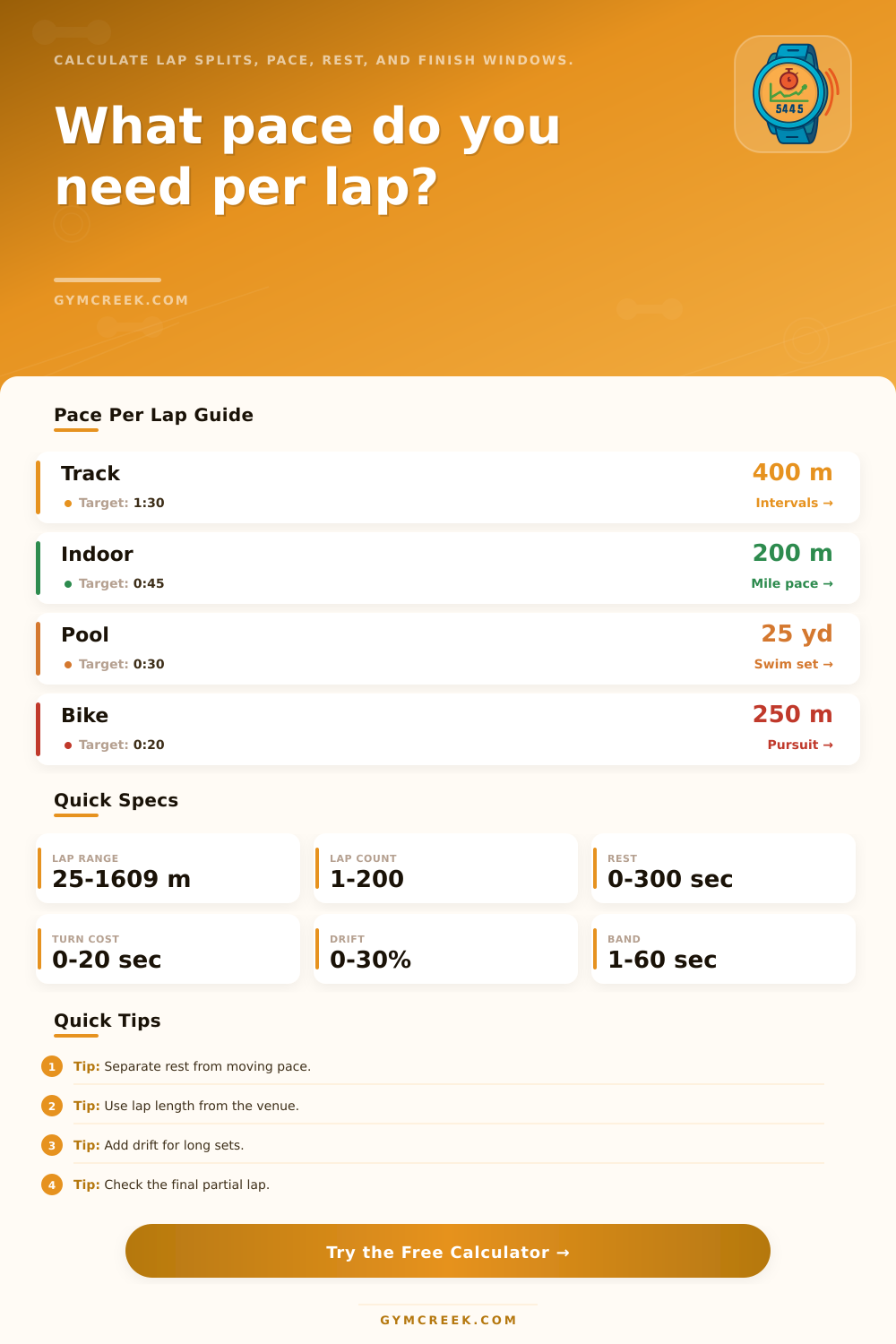
Because athletes hop from place to place, common laps is included in the table of reference. For example, the same total time will generate different split times on an outdoor 400-meter track, an indoor 200-meter oval, a 25-yard swimming pool or a 250-meter velodrome. Match up the calculator result with what’s under your feet by comparing the usual distance and cue shown in table.
But it’s that result applied in real-time during the workout which makes this cool. Is your rhythm good? If you’re seeing a green split, then yes. A green split tells you the rhythm are working.
Is there a slow split within the band? If so, it’s time to hold effort rather than chase time. If so, it’s time to work harder rather than just spending more time. Is the split outside of the band? It’s time for a little adjustment on the next lap or maybe it’s time to change the plan altogether. That’s what makes it useful, taking raw pace math and turning it into training decision.
After you enter the limitations that will truly influence your performance, the calculator does the math. The rest is judgment: How much leeway do I want on the initial lap? How much drift should of I anticipate? Does my warning band allow me to stay within the margins without making me anxious? That’s where real pacing expertise lives.