Overhead Squat Load Calculator
Estimate overhead squat capacity, target bar load, bodyweight ratio, and session volume from your squat strength, snatch strength, skill, mobility, and set plan.
📌Presets
Each preset fills a complete overhead squat scenario, including unit labels, lift history, technical modifiers, and set structure.
⚙Calculator
Overhead squat load snapshot
Enter your squat, snatch, and technical details to estimate a working load.
📊Fitness Metrics Comparison
📑Reference Tables
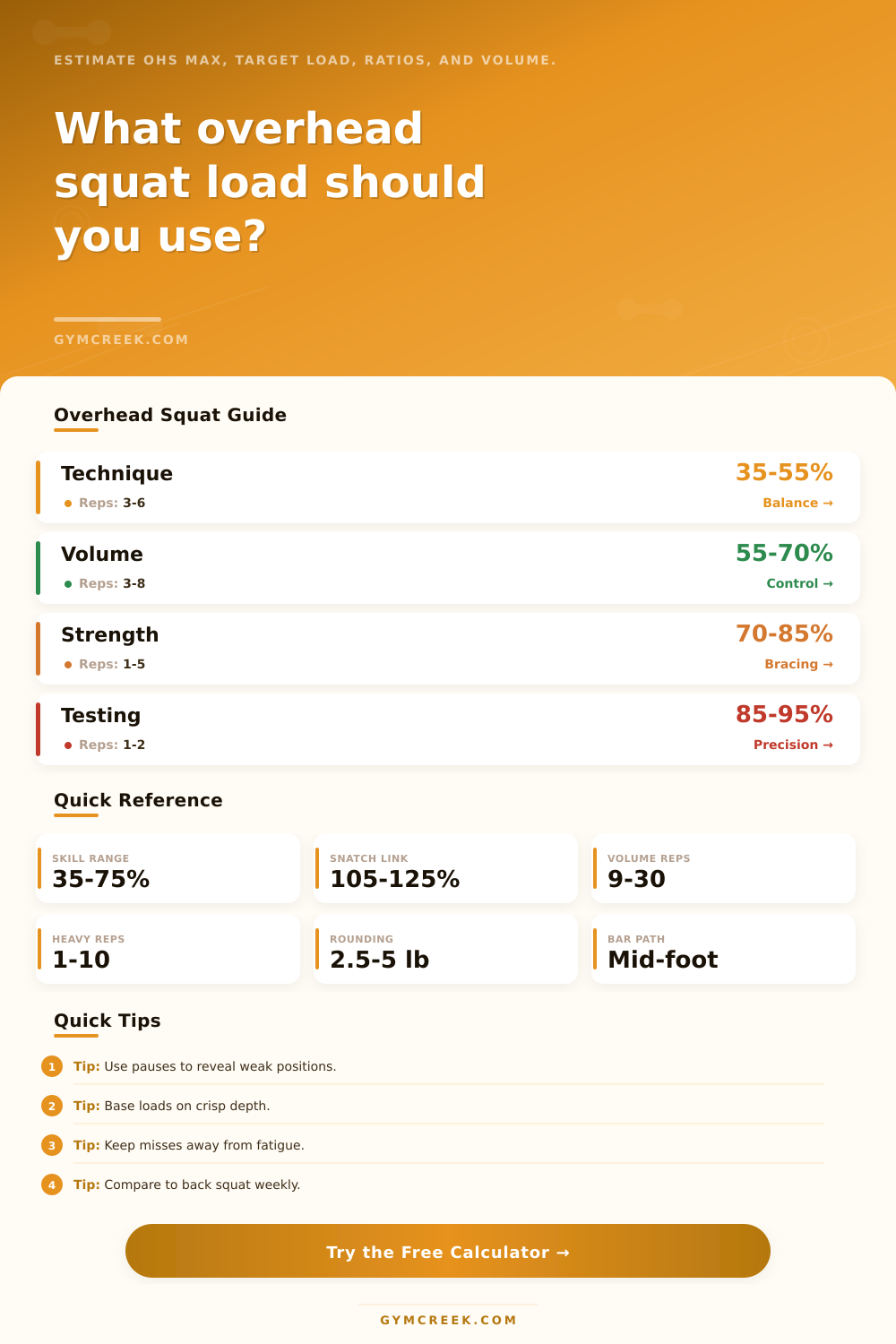
| Training Purpose | Useful Intensity | Common Reps | Primary Constraint |
|---|---|---|---|
| Technique practice | 35-55% estimated OHS max | 3-6 | Balance, depth, and locked elbows |
| Snatch warm-up | 40-60% estimated OHS max | 2-5 | Speed under the bar and foot pressure |
| Volume strength | 55-70% estimated OHS max | 3-8 | Repeatable torso angle and breathing |
| Strength work | 70-85% estimated OHS max | 1-5 | Bracing, depth, and stable bar path |
| Testing singles | 85-95% estimated OHS max | 1-2 | Precision and low fatigue |
| Skill Level | Back Squat Transfer | Snatch Multiplier | Interpretation |
|---|---|---|---|
| New or inconsistent | About 35% of back squat | About 1.05 x snatch | Position limits load more than leg strength |
| Developing | About 46% of back squat | About 1.10 x snatch | Stable enough for controlled triples |
| Solid intermediate | About 56% of back squat | About 1.16 x snatch | Strength and technical limits are closer |
| Advanced | About 64% of back squat | About 1.22 x snatch | Good transfer from squat strength |
| Weightlifter | About 72% of back squat | About 1.28 x snatch | Receiving position is highly trained |
| Bodyweight Ratio | Male Standard | Female Standard | Training Meaning |
|---|---|---|---|
| Beginner | 0.25-0.45 x bodyweight | 0.20-0.35 x bodyweight | Focus on depth, balance, and mobility |
| Intermediate | 0.45-0.75 x bodyweight | 0.35-0.60 x bodyweight | Use planned progressions and crisp reps |
| Advanced | 0.75-1.05 x bodyweight | 0.60-0.85 x bodyweight | Manage fatigue before heavy overhead days |
| Weightlifting level | 1.05 x bodyweight or more | 0.85 x bodyweight or more | Technique and confidence support high loads |
| Formula Step | Calculator Formula | Output | How to Use |
|---|---|---|---|
| Squat limit | Back squat 1RM x skill transfer | Leg-strength ceiling | Shows how much squat strength may carry over |
| Snatch limit | Snatch 1RM x skill multiplier | Overhead receiving ceiling | Links load to your trained catch position |
| Technical max | Lower limit x modifiers | Estimated OHS max | Accounts for mobility, age, and rep style |
| Work load | OHS max x intensity | Rounded bar load | Turns capacity into a practical set weight |
💡Tips
At first glance, the overhead squat appear easy. But then you add weight, and all of the sudden it’s not so simple. What was a comfortable lift off of the rack turns into a wild monster as soon as it clears your shoulders.
Whether you’ll get a clean rep or find yourself scrambling for balance typically depends on your ability to control the amount of weight based off available stability, not necessarily leg strength. Athletes tend to grossly overestimate the joint’s ability to withstand the loaded position with legs locked out. They vastly underestimate the need for balance to maintain torso rigidity.
Why Technique Matters More Than Strength
Back squat numbers tell only half the story. They demonstrate that you’ve got strong legs, sure, but they don’t indicate if your ankles/hips/thoracic spine/etc. Is capable of holding that vertical posture while under load. That’s where this tool comes in.
Rather than using your back squat as a starting point, it treats leg strength as a limit. It determines the maximum potential output of your quads and makes reasonable deductions to reflect your age, mobility limitations, and technical proficiency. This means you won’t be pulling a number out of nowhere. And it means you won’t mindlessy copy another lifter who has better shoulder flexibility than you do.
Finally, plugging in your snatch maximum includes an important contextual variable. Because the bottom of your snatch and the overhead squat are the same receiving position, your ability to be comfortable there is going to have a direct effect on the amount of weight you can handle. If you find it difficult to catch snatches with excessive forward lean, odds are your overhead squat won’t match its pure strength ratio equivalent. To address this connection, the calculator uses both your squat max and your snatch performance. This provides a more realistic representation of your technical limit.
You know that position frequently trumps muscle, right? It forces you to face that fact here. However, entering your training purpose might be more practical. If you’re doing a technique workout and lifting 50% of your max, it’s going to require a different approach compared to when you’re using an 85% lift for strength development. The former needs high-volume exposure to establish motor pattern repetition without accumulating fatigue. The latter requires heavy load to reveal flaws in balance and brace. Choose the right category to match the right intensity. This prevents you from trying to master form with weights that force bad movements, or attempting maximal strength lifts with endurance-based rep schemes.
The page also has reference tables with good benchmarks for measuring how your lifts compare with others. Where do you fall in terms of bodyweight ratios? Are you an advanced, intermediate, or beginner level lifter? The standards aren’t meant to be targets but guidelines. For example, maybe you have a high back squat but a modest overhead squat. That could mean ankle mobility is limiting your depth. In this case, you’d be better off targeting mobility work to improve your position instead of chasing numbers. Adding weight too soon will likely do more harm then good.
Variations in tempo and pause length can play a huge role as well. By removing the bounce on the rep’s bottom half, you eliminate any help from the elastic energy and reveal the raw stability deficit. For example, you are able to get through your normal working sets without issue but you find yourself folding over during a paused variation. That’s not because weight is weak, it’s an admission that overhead control trumps mass. Don’t be afraid to lighten up in situations like this.
There are some small details regarding age and height too. Longer lever arms (taller) makes things more unstable, so a bit of caution can be added to the estimate based on how joints hold up. Similarly, older folks might need to add a bit of caution to the estimate, which would of then help them get a weight they know will work. These modifiers keep suggested weight relative to what your body is capable of doing.
It will spit out a rounded number that corresponds to how many plates you have available and takes the guesswork out of programming. The overhead squat is all about precision and patience more than raw power. It forces you to think before you act. It teaches you to train smart with an educated guess rather than mindlessly fumbling around in the dark.
You learn to respect how technique, mobility, and strength works together. This creates a solid base from which you can safely increase weight over time. Your bar won’t fall out because you forced it to stay up; it will remain upright because you’ve set yourself up for success.