Ounces to Grams Food Calculator
Convert food ounces into raw grams, edible grams, cooked-weight equivalents, serving targets, calories, macros, and daily target context for meal prep or nutrition tracking.
◎Food Presets
Presets load realistic food ounces, portion counts, yield, cooked-weight change, nutrition per 100 grams, and body-context settings. Edit any field after loading.
⚙Calculator Inputs
Food gram conversion snapshot
Enter a food weight in ounces to convert it into grams and nutrition totals.
▦Food Metrics Grid
▣Reference Tables
| Ounces | Grams | Common food use | Scale note |
|---|---|---|---|
| 0.5 oz | 14.2 g | Small garnish or nut add-on | Round to 14 g or 15 g |
| 1 oz | 28.3 g | Cheese, nuts, jerky, dry snack | Often logged as 28 g |
| 3 oz | 85.0 g | Small cooked protein serving | Useful restaurant estimate |
| 4 oz | 113.4 g | Standard meat or fish portion | Round to 113 g |
| 6 oz | 170.1 g | Larger lean protein portion | Round to 170 g |
| 8 oz | 226.8 g | One half pound of food | Round to 227 g |
| Food type | Typical change | Why it happens | Tracking cue |
|---|---|---|---|
| Lean meat | -20% to -30% | Water and fat loss during cooking | Track raw or cooked consistently |
| Fatty fish | -10% to -25% | Water and rendered fat loss | Recipe method changes the number |
| Dry grains | +150% to +250% | Water absorption | Do not mix dry and cooked entries |
| Vegetables | -10% to -40% | Water loss and trimming | Yield matters for peels and stems |
| Nuts and seeds | 0% to -5% | Very low water change | Weigh directly for best accuracy |
| Input | Calories | Density signal | Practical note |
|---|---|---|---|
| Protein | 4 kcal/g | Lean foods vary by water | Protein-heavy foods can still differ |
| Carbohydrate | 4 kcal/g | Dry grains are dense | Cooked water weight lowers density |
| Fat | 9 kcal/g | Most calorie dense macro | Small ounce changes matter |
| Fiber | Shown separately | Usually inside carbs | Use label rules from your tracker |
| Output | Formula | Inputs used | Purpose |
|---|---|---|---|
| Raw grams | ounces × 28.3495 | Food ounces | Base food weight conversion |
| Edible grams | raw grams × yield | Yield percent | Adjust for non-edible trim |
| Cooked grams | edible grams × cook factor | Cooked change percent | Estimate final cooked weight |
| Calories | grams × kcal per 100 g | Macros or label kcal | Nutrition estimate from weight |
| TDEE | Mifflin-St Jeor × activity | Body stats | Daily calorie context |
◇Tips
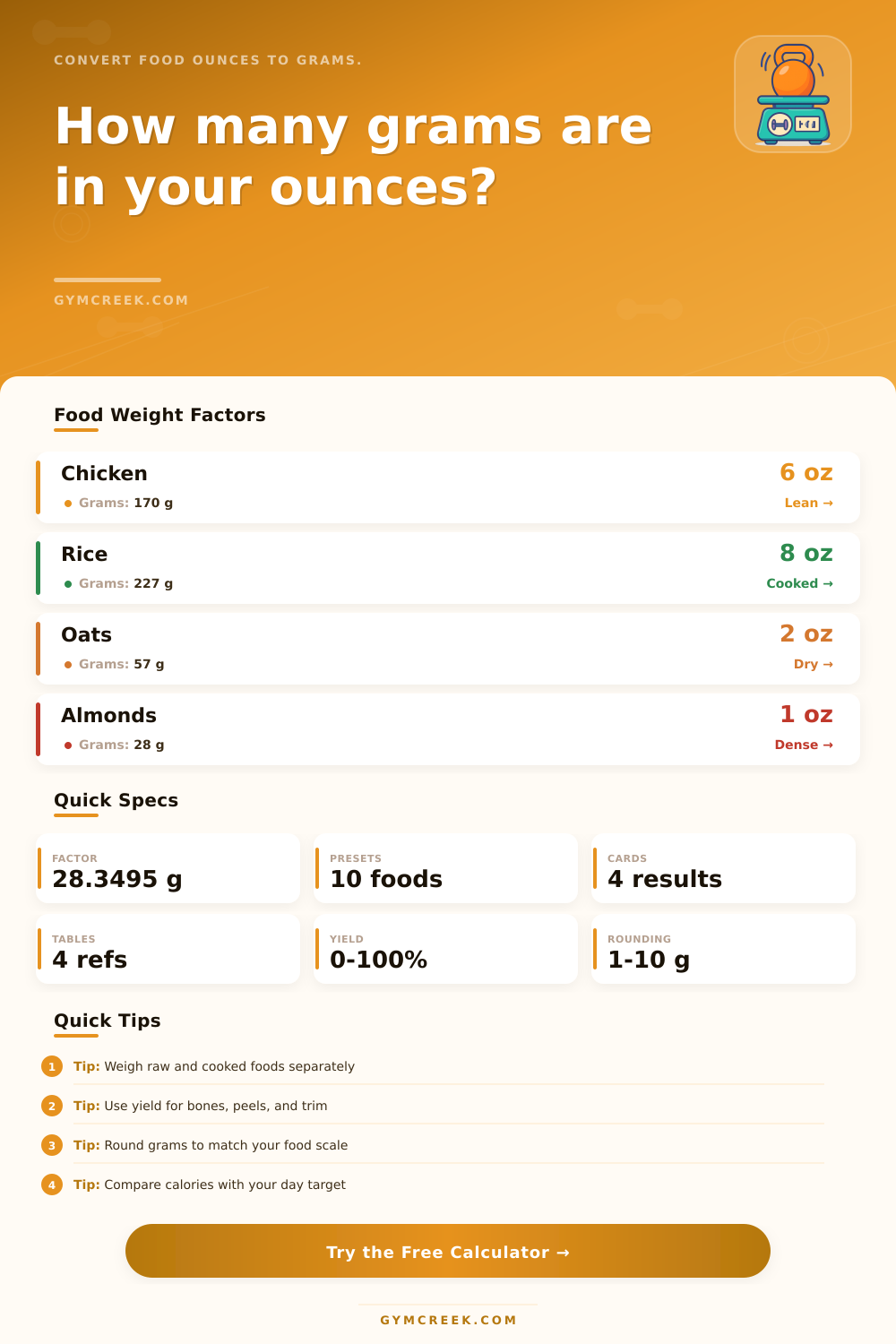
There’s a raw chicken breast on the counter, and there you are in your kitchen. The recipe say six ounces, and your scale says one hundred seventy grams. How do metric nutrition label weights differs from imperial weights? Many people gets lost in tracking how much they eat, and that’s why we’ve created this calculator. It does the math for you! Enter in your raw ounces, and the tool handles the math so you don’t have to guess whether a shrinkage factor apply to that type of rice or meat.
It’s simple: one ounce is approximately 28.3 grams. But cooking introduces variables that can breaks that relationship. When you add milk and cook the oatmeal, the oatmeal absorbs some of that milk, causing it to weigh more on the plate than it did in bag. That same thing happen with water when you sear a steak; some of the water boils away.
Why Your Food Weight Changes When You Cook
You’ll end up eating fewer calories if you measure your food by its dry weight and then consume it in cooked form. A lot of folks imagine the weight on their plate to be the same weight as what was listed on package. The truth is they often leave out the loss due to trimmings, peels or bones. This waste can be corrected by setting a percentage yield on edibles. When you enter a lower number, the gram count will reflects what you’re eating (i.e., potato skin = mass you don’t consume). Otherwise you log calories that go into compost bin rather than your stomach.
Since cooking changes the density of food, it’s also important to adjust for cooked weight change. Most lean meats will loses 20-30% of their raw mass due to rendering out water and fat. Conversely, grains will absorbs liquid and become heavier. If you mix these states, you’ll get inconsistent tracking unless you adjusts for them.
With these grams, the tool then puts them in context with what your body require each day. By entering some general information about yourself (body stats, level of physical activity), you can determine how that portion contribute to your nutritional budget. A single 150 calories may not sound like much by itself. But if it’s a low calorie day and you’re aiming for a deficit, it’ll be a meaningful portion of your intake. That shift in perspective move away from blind conversions and toward carefully planning meals.
Instead of thinking about food only as something that changes your weight, think of it as fuel, functional fuel. The number of calories per gram vary across macronutrients: fat has nine; carbs and protein have four. If you have a small error in your food weighing (for example, adding 100 grams of nuts), this will result in a bigger difference in calories different than if you had 100 grams of lean chicken. Why? Because fat packs nine calories per gram while protein and carbs only offer four. Because the former is higher-fat and the latter is lower.
When you input label information into the calculator, it factor in these differences using macros. That means that the resulting overall sum are an accurate picture of caloric content, not merely mass. It’s a small point, but it matters when trying to be accuratly.
The biggest issue I see in many cooks heads is that they don’t know what their reference point is. Are you weighing ingredients when raw? Or are you weighing them after cooking? There’s no right or wrong answer here, provided you stick to whatever convention makes sense. If you switch between the two then you’re introducing noise into your data which obscures any trends you may observe.
The tool includes some handy reference tables that provides at-a-glance benchmarks for typical ingredient conversions. That way you can use your own inputs and let the tool spit out numbers, using the tables as quick benchmarks so you don’t have to perform mental arithmetic each time you prepare a meal.
Precision doesn’t mean measuring each bite like you’re in a lab. Precision means reducing your margin of error so you can use that data to make good decisions for your body. You should of practiced more. Once you learn how macro density, cooking methods, and yield affect your weight, the grams on your scale no longer feel random. They feel like useful information related to your own needs.
You don’t need to be perfect all the time; you just have to measure consistently. And once it’s clear what you should weigh, it becomes doable, turning a complex kitchen chore into a manageable habit.