Open Powerlifting Calculator
Compare a meet total across federation style, testing status, equipment, age class, bodyweight class, DOTS-style scoring, and ranking context.
📌Presets
Each preset loads a complete lifter profile and recalculates class, adjusted score, and ranking context.
⚙Calculator
Open powerlifting snapshot
Enter bodyweight, total, division, and federation context to estimate ranking bands.
📊Comparison Metrics
📑Reference Tables
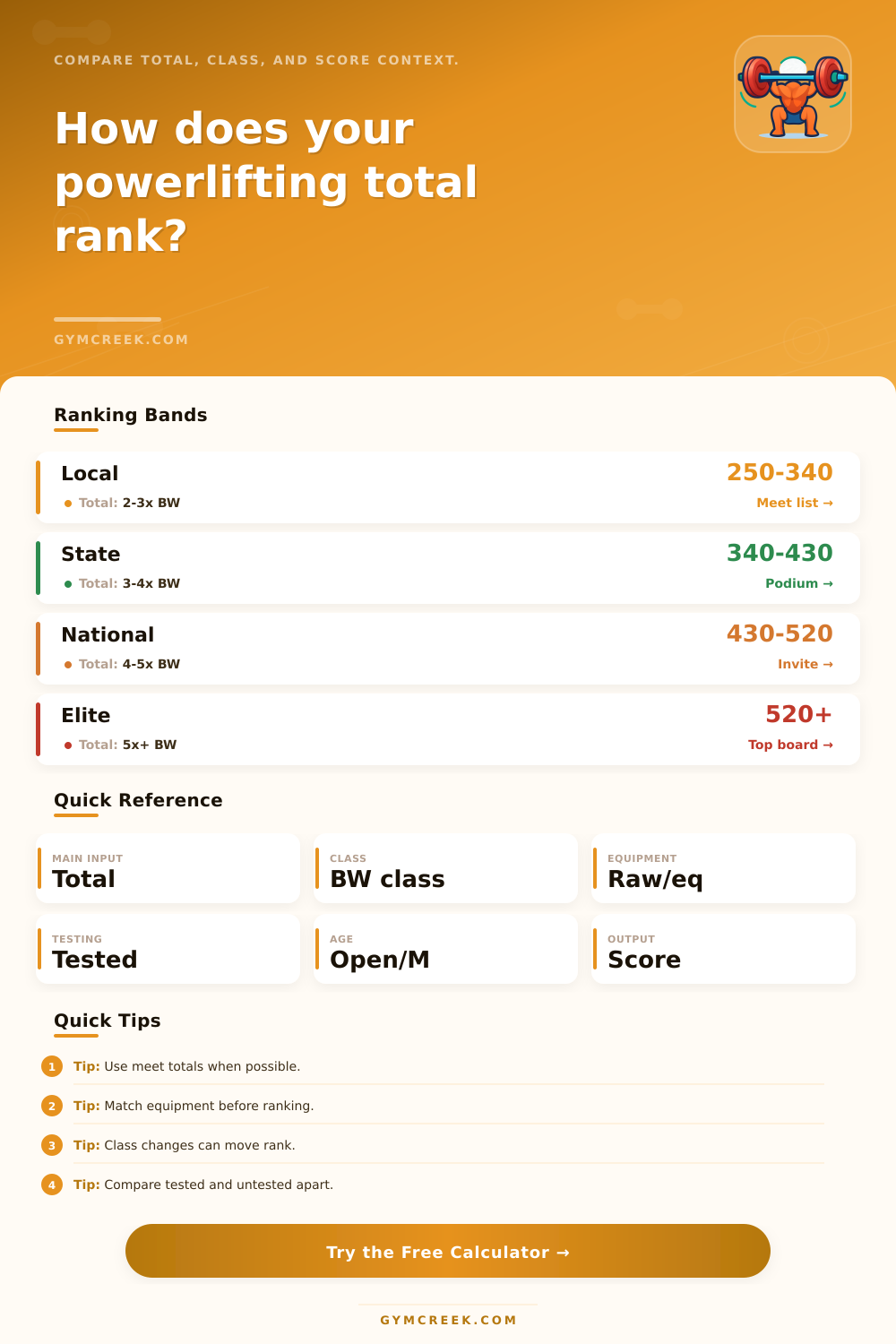
| Band | Score | Typical context | Ranking note |
|---|---|---|---|
| Local board | 250-339 | Meet-ready total | Often competitive locally |
| State list | 340-429 | Strong division total | Can place in deeper meets |
| National list | 430-519 | High-end class total | Invite or podium context |
| Elite shortlist | 520+ | Top-board total | Compare with strict filters |
| Equipment | Index factor | Why it matters | Compare against |
|---|---|---|---|
| Raw / sleeves | 1.00 | Baseline modern division | Raw lifters |
| Raw with wraps | 0.96 | Wraps can add squat load | Wraps rankings |
| Single-ply | 0.88 | Support gear changes totals | Single-ply lists |
| Multi-ply | 0.76 | Highest equipment carryover | Multi-ply lists |
| Division | Lower middle | Upper middle | Heavy |
|---|---|---|---|
| Men kg | 66 / 74 | 83 / 93 | 105 / 120+ |
| Women kg | 52 / 57 | 63 / 69 / 76 | 84 / 84+ |
| Men lb approx | 145 / 163 | 183 / 205 | 231 / 264+ |
| Women lb approx | 114 / 125 | 139 / 152 / 167 | 185 / 185+ |
| Output | Formula idea | Inputs | Use |
|---|---|---|---|
| Open Index | Total / BW curve | Total, BW, division | Primary comparison |
| DOTS-style | DOTS body curve | Total kg, BW kg, sex | Modern points context |
| Gloss-style | Legacy body curve | Total kg, BW kg, sex | Second comparison lens |
| Percentile | Band thresholds | Score, equipment, scope | Ranking estimate |
💡Tips
Powerlifting totals is numbers that show the sum of a powerlifters best lift. However, the total is only useful when compared to other powerlifting totals. A powerlifting total of 1500 pounds from an 181-pound lifter who competes in raw division is not comparable to a 1500-pound total from a 275-pound powerlifter in a multi-ply, untested division.
These totals are different due to the equipment used to lift weight, the age of the powerlifter, the rules established by the powerlifting federation, and the drug test status of the lifter. Knowing these differentiating factors allow an individual to understand if a powerlifting total is representing an elite strength level or simply one that is local within the powerlifters area. A powerlifting calculator allow for the comparison of powerlifting totals by considering several factor of the powerlifter.
How to Compare Powerlifting Totals
These factors include the raw powerlifting total, the bodyweight of the powerlifter, the equipment to lift the weights, and the age of the powerlifter. By normalizing these factors, a powerlifting calculator allows an individual to compare their powerlifting total to others in the powerlifting community. Without the use of a powerlifting calculator, individuals may argue about the strength of powerlifters due to the inability of powerlifting totals to be compared direct with one another.
Bodyweight is one of the primary factor that a powerlifting calculator uses to categorize the strength of powerlifters. By entering the bodyweight of the powerlifter, the powerlifting calculator will display information regarding how close the powerlifter is to the cutoff for their weight class. Because powerlifters may experience a loss of strength if they are five pound over the weight class limit yet have strength advantages if they are five pounds under the limit, the powerlifter must decide whether to remove water to reach the weight class limit or to accept the strength within a heavier weight class.
The powerlifting calculator will eliminate the guesswork of where the weight class limit is for the powerlifter. The equipment that the powerlifter use to lift weights is another of the factors that can be programmed into the calculator. Raw powerlifting performances using only sleeves is one of the standard starting point for powerlifting raw totals.
However, the use of knee wraps will increase the squat total of a powerlifter, as will the use of single- or multi-ply lifting gear. Each of these variables has an index factor that is applied to the powerlifting total that allows the wraps total or raw total to not be directly comparable to one another. The index factor recognize that a powerlifter will have different totals with different types of lifting equipment.
Another of the categories in the powerlifting calculator is the testing status of the powerlifter. A powerlifter who has taken drugs and submitted to drug tests will have a different powerlifting total than one who has not submitted to drug tests. The powerlifting calculator will also account for an unknown testing status to ensure that raw powerlifting totals are not compared direct to tested powerlifting totals.
This testing status allows powerlifters who have submitted to drug tests to not feel discouraged by the high totals of untested powerlifters and ensures the accuracy of the discussion of powerlifting totals. The age of a powerlifter is another factor in the powerlifting calculator. A powerlifter who is 22 years of age may have the same total as a 48-year-old powerlifter, but the strength of that total may not be comparable due to the differences in strength recovery between younger and older ages.
The age adjustment will create a normalization factor for powerlifting totals within different age groups so that comparisons are even between age groups. While the actual weight lifted is the same, the age-context adjustment will allow for an honest comparison within the proper age group for powerlifting. The powerlifting calculator will produce several different output after the powerlifter enters their data.
The Open Index will calculate the strength of the powerlifter after adjusting their total for bodyweight and age. A DOTS-style score will calculate the powerlifting total of the lifter within the context of bodyweight. The Gloss-style number will provide another value for the powerlifters total by using an older strength curve.
While none of these calculators will replace the database of the powerlifting federation, these calculators will allow the powerlifter to understand their total within their division. The reference tables included within the powerlifting calculator will provide information that can help the powerlifter understand their total. These tables will provide information on the weight bands that represent local, state, or national powerlifting strength.
The reference tables will also display cues for the type of equipment used to lift the weights to provide an understanding of how that may impact the total. These reference tables will not replace the judgment of an individual powerlifter, but they will allow for two individuals to have an agreement as to the meaning of their powerlifting totals. Some of the common mistakes in powerlifting use a failure to use these different categories to compare powerlifting totals.
For instance, an individual might attempt to directly compare a powerlifting total based on the use of multi-plies with a raw powerlifting total. Another mistake is to ignore the body weight class limit of the powerlifter; this will lead to potentially incorrect ranking in powerlifting competitions. By using the powerlifting calculator, these different categories will be accounted for and the powerlifter will not make these mistake.
The real meets for powerlifting include several factor that cannot be programmed into the calculator. For example, some powerlifting federations require a depth for squats that others do not. Some lift competitions require a pause after a lift that others do not.
Additionally, the weigh-ins for powerlifting competitions can vary from gym to gym. Finally, the strength measured at a gym may not be the same as that measured by a platform judge who observe powerlifting competitions live. For these reasons, the powerlifting calculator is not a tool that will present the true total for powerlifting competitions.
However, it can be used to set the training plan for the powerlifter so that the powerlifter can present a true total for competitions on the powerlifting platform. While there is no “magic” number for powerlifting strength, the goal in establishing a powerlifting total is to understand what each number represent. By understanding the total, the weight class, the equipment used, and the testing status for powerlifting, the powerlifter can understand their strength and their goals in the program.
By understanding the strength that they possess, the powerlifter can better understand their strength to determine a training plan that will ensure that the efforts that they put into powerlifting are reflected in their powerlifting numbers.