Estimated 1RM From Reps Calculator
Blend multiple rep-max formulas, compare formula spread, adjust for reps in reserve and set quality, then set a practical training max.
📌Rep Max Presets
Each preset loads a different blend choice, rep range, lift context, rounding rule, and confidence profile.
⚙Calculator Inputs
1RM estimate snapshot
Enter a rep max, reps, RIR, blend, and rounding rule to estimate your one-rep max.
📊Formula Metrics
📑Reference Tables
| Formula | Equation | Usual range | Blend role |
|---|---|---|---|
| Epley | Weight × (1 + reps / 30) | 1 to 10 reps | Reliable general anchor |
| Brzycki | Weight × 36 / (37 - reps) | 1 to 10 reps | Often more conservative |
| Lander | 100 × weight / (101.3 - 2.67123 × reps) | 1 to 10 reps | Percent-style comparison |
| Lombardi | Weight × reps ^ 0.10 | 3 to 12 reps | Smooth high-rep curve |
| Mayhew | 100 × weight / (52.2 + 41.9 × e^(-0.055 × reps)) | 3 to 15 reps | High-rep smoothing |
| O'Conner | Weight × (1 + 0.025 × reps) | 1 to 10 reps | Milder rep gain |
| Wathan | 100 × weight / (48.8 + 53.8 × e^(-0.075 × reps)) | 3 to 15 reps | Spread comparison |
| Blend | Weights emphasis | Best use | Watch for |
|---|---|---|---|
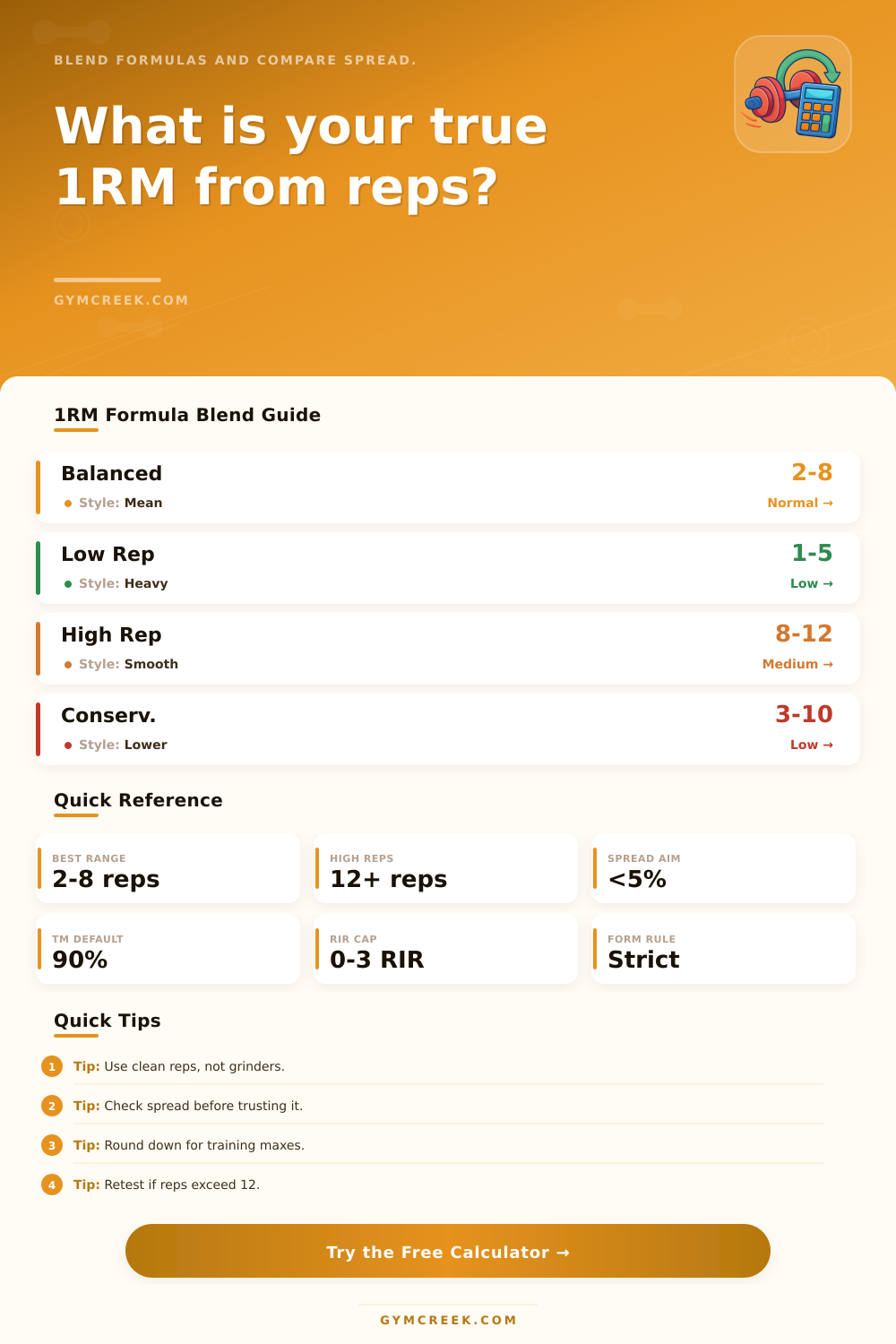
| Balanced | All seven formulas | Normal gym estimates from 2 to 8 reps | Moderate spread if reps are high |
| Low-rep strength | Epley, Brzycki, Lander, O'Conner | Heavy doubles, triples, and fives | Less useful past 10 reps |
| Conservative lower | Brzycki, Lander, O'Conner | Training max setup and comeback blocks | May understate a true peak |
| High-rep smoothing | Mayhew, Wathan, Lombardi | Sets of 8 to 12 with clean pace | Confidence drops past 12 reps |
| Powerlifting meet | Epley, Brzycki, Wathan | Opener checks and peak-week singles | Needs strict comp-style reps |
| Trimmed coach average | Drops highest and lowest | Noisy sets or mixed formula output | Still needs honest RIR |
| Completed reps | Confidence | Best blend | Training use |
|---|---|---|---|
| 1 | Direct but demanding | Low-rep strength | Use only if recovery is good |
| 2 to 5 | High | Balanced or low-rep | Best range for strength planning |
| 6 to 8 | Good | Balanced | Useful for training maxes |
| 9 to 12 | Moderate | High-rep smoothing | Round down and watch spread |
| 13 to 20 | Low | Trimmed coach average | Retest heavier when possible |
| Lift | Ratio cue | Estimate note | Rounding habit |
|---|---|---|---|
| Squat | 1.0 to 1.6x bodyweight | Depth and brace consistency matter | Round down if depth changes |
| Bench press | 0.7 to 1.2x bodyweight | Pause style changes the result | Use small jumps for TM |
| Deadlift | 1.2 to 2.0x bodyweight | Hitching makes estimates noisy | Conservative if straps differ |
| Strict press | 0.4 to 0.8x bodyweight | Lean-back reps inflate estimates | Microload when possible |
| Pull-up | Total load matters | Add bodyweight plus external load | Use exact added weight |
💡Tips
Knowing a true one-rep max for a given exercise is important for those who lifts weights. However, few individual will actualy test their true one-rep max due to the taxing nature of the test of strength for one repetition, as well as the risk of injury that can result from performing such a test. Instead, an individual can estimate the strength of an individual for one repetition through the use of a certain number of repetitions of that exercise.
Using these estimation methods, an individual can gather data about their strength, and use that data to create a training program around they’re estimated one-rep max strength. There are several formula for estimating an individual’s one-rep max strength. Each of these formulas utilize different mathematics to arrive at the estimate of an individual’s one-rep max strength, and each of these formulas was created for different categories of individuals.
How to Estimate Your One-Rep Max and Choose a Safe Training Weight
For example, some formulas will estimate an individual’s one-rep max strength as a conservative number, while other formulas will calculate the one-rep max for that individual to be a higher number. In creating a training program for an individual, it is helpful to utilize each of these different formulas to determine how far apart each estimate for the individual’s one-rep max strength is from each other. If the estimates are very far apart from each other, the individual can rely on little of the estimates for that individual’s one-rep max strength.
An individual’s quality during the sets of repetitions can impact the accuracy of the estimate of their one-rep max strength. If an individual can perform their sets with good form, and if they have additional repetitions that they can perform beyond those included in the estimation of their one-rep max, then the estimate will be more accurately. However, if the individual performs the sets with poor form or if the repetitions are performed at a high level of difficulty, the one-rep max estimate will be less accurate.
Accordingly, because an individual gathers less accurate data during sets of poor form, an individual should of be more cautious in the use of one-rep max estimations gained during sets with poor form. Additionally, the weight of the individual’s body impact their one-rep max strength and can therefore change the context of the individual’s strength. One of the most common mistake of individuals who wish to estimate their one-rep max strength is to use that estimated one-rep max strength for training.
An individual’s training maximum strength is not the same as their estimated one-rep max strength. If an individual trains with their estimated one-rep max strength, they may find that their strength stalls or their technique break down during training. Instead, an individual’s training maximum should be the floor for their training effort; it is the weight that an individual can lift as many repetitions as possible with good speed.
An individual’s training maximum should be between 85 and 92 percent of their estimated one-rep max strength. An individual should also avoid the use of formulas that estimate the one-rep max strength for repetitions beyond twelve repetitions. For repetitions beyond twelve, the individual’s strength for that number of repetitions become less defined, and the one-rep max estimations for that individual will not be as accurate as other estimations.
If the estimations from each of the different formulas are very far from one another, the individual’s data is noisy. In these instances, it is better to perform a set of repetitions with a heavier weight than the weight used for the one-rep max estimations. The goal of estimating one-rep max strength for various exercises is not to find the perfect number for those estimations, but rather to find the training weight that an individual can lift with good speed and good technique.
If an individual finds a one-rep max estimation to be accurate and their sets to be of high quality and accuracy, they can use this number within their training program. However, if an individual finds that their estimations are not as consistently as they would like, their one-rep max should be rounded down. Rounding an individual’s one-rep max down ensures that their training and the progress of their training remain steady and consistent.