Omega 3 Dosage Calculator
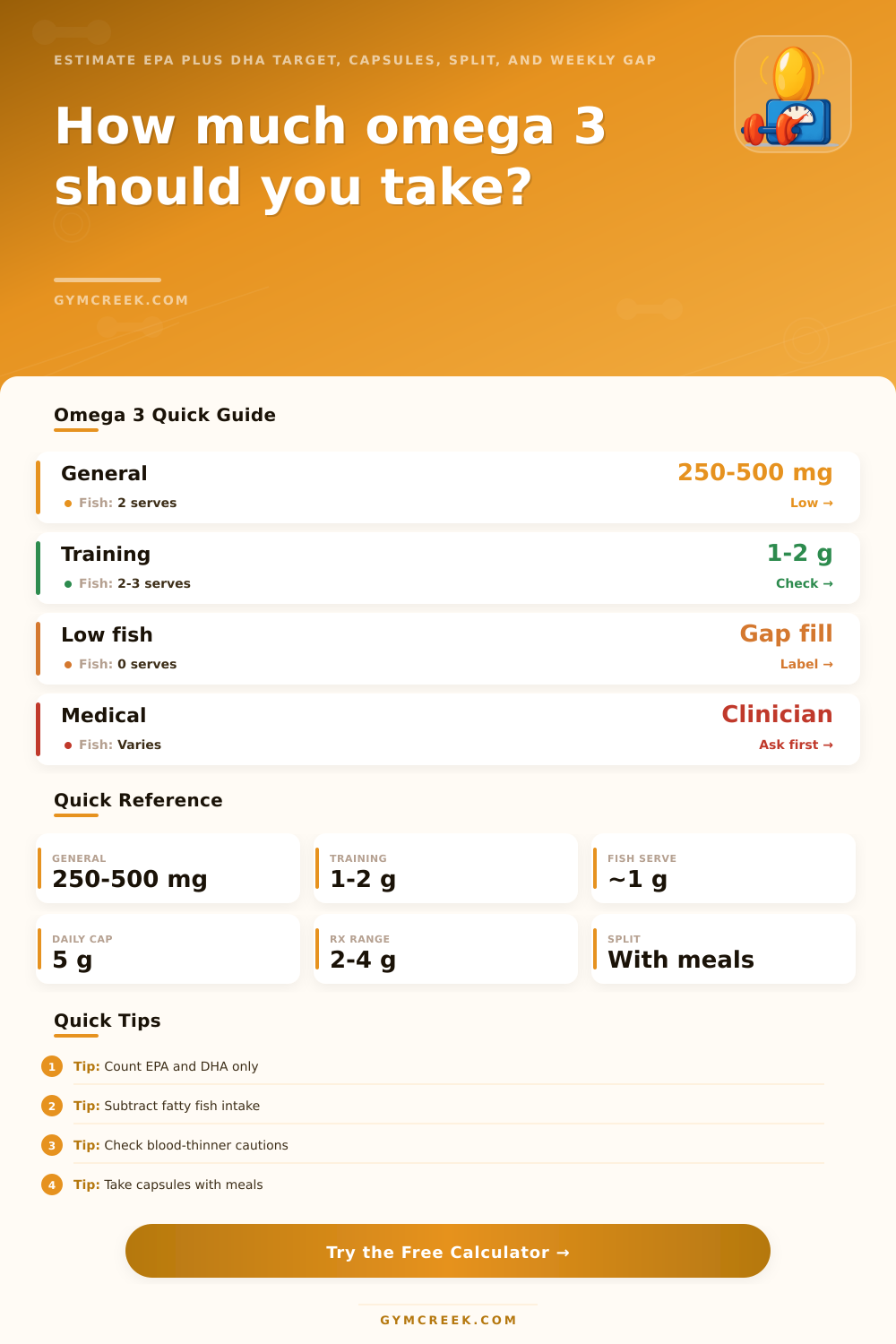
Estimate EPA plus DHA target, capsules per day, EPA:DHA split, fish-intake gap, weekly intake gap, and upper-limit caution from your training and nutrition context.
📌Omega-3 Presets
Presets load common fitness and diet scenarios. Edit the goal, body weight, fish servings, capsule label, training load, diet type, and medical caution fields before using the result.
⚙Calculator Inputs
Omega-3 intake snapshot
Your EPA plus DHA target, capsule math, weekly gap, and upper caution update as inputs change.
📊Metrics Grid
📘Calculation Rules
📑Omega-3 Reference Tables
| Goal | Baseline range | Calculator target | Planning note |
|---|---|---|---|
| General wellness maintenance | 250 to 500 mg/day | 500 mg/day before modifiers | Often covered by about two fatty-fish servings weekly. |
| Training recovery support | 1000 to 1500 mg/day | 1200 mg/day before modifiers | Common athlete planning range when fish intake is low. |
| Endurance-heavy training block | 1200 to 2000 mg/day | 1600 mg/day before modifiers | Used for demanding weekly training loads. |
| Low fish intake gap fill | 700 to 1200 mg/day | 1000 mg/day before modifiers | Designed to replace missed food omega-3 contribution. |
| Joint comfort planning | 1500 to 2500 mg/day | 2000 mg/day before modifiers | Higher planning range that should still be screened for cautions. |
| Clinician-guided high dose | 2000 to 4000 mg/day | 3000 mg/day before modifiers | Use only when supervised by a qualified clinician. |
| Fish intake | Estimated weekly EPA plus DHA | Daily average | Calculator meaning |
|---|---|---|---|
| 0 servings/week | 0 mg/week | 0 mg/day | Capsules must cover the full selected target. |
| 1 serving/week | 1000 mg/week | About 143 mg/day | Small contribution, usually still leaves a gap. |
| 2 servings/week | 2000 mg/week | About 286 mg/day | Can cover much of a general wellness target. |
| 3 servings/week | 3000 mg/week | About 429 mg/day | May reduce or remove capsule need for low targets. |
| 5 servings/week | 5000 mg/week | About 714 mg/day | Often enough for general intake without capsules. |
| Label example | EPA | DHA | EPA plus DHA per capsule |
|---|---|---|---|
| Standard fish oil capsule | 180 mg | 120 mg | 300 mg EPA plus DHA |
| Concentrated fish oil | 360 mg | 240 mg | 600 mg EPA plus DHA |
| High EPA product | 650 mg | 250 mg | 900 mg EPA plus DHA |
| High DHA product | 250 mg | 500 mg | 750 mg EPA plus DHA |
| Algae oil capsule | 0 to 150 mg | 250 to 600 mg | Check the exact label lines. |
| Band | Total EPA plus DHA | Medical context | Action |
|---|---|---|---|
| Food-first | Under 500 mg/day | No known caution | Review fish intake and label strength. |
| Standard | 500 to 2000 mg/day | No known caution | Usually a moderate planning range for adults. |
| Elevated | 2000 to 3000 mg/day | No known caution | Check stacked supplements and clinician advice. |
| High caution | 3000 to 5000 mg/day | Any caution or high dose | Use professional guidance before continuing. |
| Do not self-dose | Over 5000 mg/day | Any context | Do not use without medical supervision. |
💡Omega-3 Tips
Getting your omega-3 intake right is important, and getting your omega-3 intake right is important because the molecule that provide benefits to the body are EPA and DHA. EPA and DHA help with heart rhythm, joint comfort, and recovery from training. Many peoples find the information on supplement labels to be somewhat confusingly.
For instance, supplement labels will often list the total weight of the fish oil supplement instead of the amount of EPA and DHA that the supplement contains. Consequently, people may believe that they is consuming more EPA and DHA from their supplement than they are actualy consuming from those labels. This is one of the reasons that confusion exists regarding EPA and DHA intake from supplements.
How to figure out your EPA and DHA needs
The calculator is one way that people can more or less manage the confusion regarding EPA and DHA. The calculator require that the user enter several different pieces of information. For example, the user must enter their goal, their body weight, the amount of fatty fish that they eat, and the amount of EPA and DHA that are contained in their supplement capsules.
Each of these factors can alter the total amount of EPA and DHA that the individual need to consume daily. For instance, an individual who incorporates more training into there schedule may need more EPA and DHA than an inactive individual. Additionally, an individual’s diet may contain EPA and DHA, or it may not contain any EPA and DHA at all.
Body weight is one of the factors to consider because the ranges of EPA and DHA that is suggested for different goals may be scaled according to body weight. Even if the scaling factor according to body weight is small, it is still one of the factors that should of been considered in the calculation. Additionally, the number of servings of fatty fish that the individual eat each week will also impact the amount of EPA and DHA that the individual consumes by the body.
For instance, an individual who eats fish twice per week will consume some of the EPA and DHA that their body require each week, but an individual who eats no fatty fish will require more EPA and DHA from their supplement capsule. Consequently, the calculator will subtract the amount of EPA and DHA that is consumed from fatty fish from the total amount required each week to determine the number of EPA and DHA supplement capsule that the individual should take each day. The ratio of EPA to DHA in the supplement capsules is another factor that the calculator is consider.
Some individuals may require more EPA from their supplement capsules than others due to their training needs, others may require more DHA for different reasons. Consequently, the calculator will display the ratio of EPA to DHA so that the individual can review whether the ratio of EPA to DHA from their supplement matches there goals for EPA and DHA in there body. Additionally, the calculator will display the gap that the individual will create each week in relation to their EPA and DHA goals.
Displaying this gap is one of the ways that the calculator help the individual to understand the amount of EPA and DHA that they are still missing each week. One of the most common mistake that people make with EPA and DHA supplements is to consider the total amount of fish oil that is contained in the supplement rather than the amount of EPA and DHA. For instance, a supplement that contains 1000 mg of fish oil may contain only 300 mg of EPA and DHA, meaning that the other 700 mg is merely carrier oil.
Additionally, another common mistake is to round up the number of capsules that is required of an individual. Rounding up the number of capsules may cause the individual to consume too much EPA and DHA. Therefore, the surplus of EPA and DHA that is shown on the calculator allow an individual to decide if they will take the rounded amount of capsules or if they will alter the type of supplement capsule that they take.
Finally, another consideration for the calculator is for individuals to be made aware of their medical condition. Certain upper limits for EPA and DHA are shown on the calculator as caution bands. These limits are not rules that the individual should be followed, but they are reminders of the condition under which certain total amounts of EPA and DHA may require the individual to speak with a physician.
For instance, individuals who take blood thinner or those who is pregnant may have specific limits to their EPA and DHA intake that require them to speak to a medical professional regarding their intake of EPA and DHA supplements. Finally, the reference table on this calculator website contain information regarding where the ranges of EPA and DHA that is suggested for various goals come from. These tables contain information regarding how many serving of fatty fish contain EPA and DHA, and the amount of EPA and DHA that is contained in different supplement.
These tables are not a replacement for the individual’s own judgment, but they do provide information regarding the data behind EPA and DHA supplement needs for various reasons. Ultimately, the decision of how much EPA and DHA to take is a personal decision. An individual is aware of their training load, meal, and potential medical considerations.
The calculator can provide a clear picture of the EPA and DHA needs of the individual based off these factor. Therefore, once they understand their goal, their fish and supplement calculation, and their medical considerations (if any), an individual can create a plan for EPA and DHA supplement intake that match the needs of there body.