Olympic Triathlon Calculator
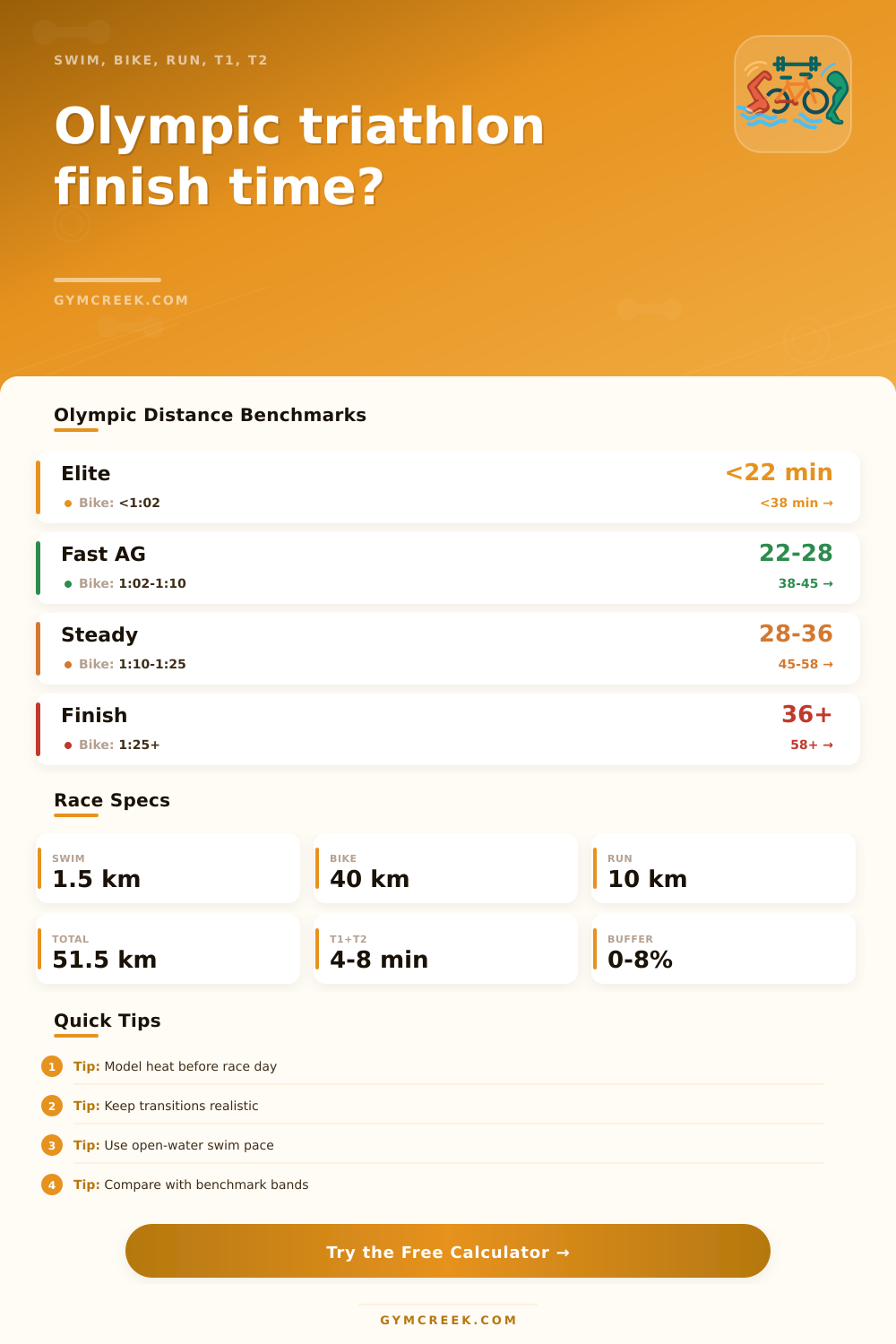
Project a 1.5 km swim, 40 km bike, 10 km run, transitions, course drag, and finish benchmark band.
Projected race result
| Benchmark band | Typical finish | Swim split | Bike split | Run split |
|---|---|---|---|---|
| Elite / podium range | Under 2:00 | Under 22:00 | Under 1:02 | Under 38:00 |
| Front pack amateur | 2:00 to 2:15 | 22:00 to 26:00 | 1:02 to 1:08 | 38:00 to 43:00 |
| Competitive age group | 2:15 to 2:30 | 26:00 to 30:00 | 1:08 to 1:16 | 43:00 to 50:00 |
| Steady age group | 2:30 to 3:00 | 30:00 to 38:00 | 1:16 to 1:30 | 50:00 to 1:05 |
| Completion focus | Over 3:00 | Over 38:00 | Over 1:30 | Over 1:05 |
| Leg | Condition | Multiplier | What it represents |
|---|---|---|---|
| Swim | Light chop / minor crowding | 1.03 | About 3% slower from sighting, drafting breaks, or traffic. |
| Bike | Rolling course | 1.03 | Small climbs, turns, and speed changes across 40 km. |
| Run | Warm weather | 1.03 | Moderate heat or pacing restraint after the bike leg. |
| Projection | Finish buffer | 0% to 15% | Optional margin for aid stations, course length, and execution drift. |
| Preset | Swim pace | Bike speed | Run pace | Best use |
|---|---|---|---|---|
| First Olympic Finish | 2:35 / 100 m | 25.5 km/h | 6:25 / km | Completion-focused race plan with conservative transitions. |
| Steady Age Grouper | 2:05 / 100 m | 31.0 km/h | 5:15 / km | Balanced training day estimate for many experienced amateurs. |
| Sub-2:30 Target | 1:48 / 100 m | 34.5 km/h | 4:45 / km | Checks how close each segment is to a 2:30 finish. |
| Front Pack Amateur | 1:28 / 100 m | 39.0 km/h | 3:58 / km | Fast amateur projection with tight transitions. |
| Formula | Distance used | Calculation | Output |
|---|---|---|---|
| Swim split | 1,500 m | Pace per 100 m multiplied by 15, then condition multiplier. | Condition-adjusted swim time. |
| Bike split | 40 km | Distance divided by speed, converted to minutes, then multiplier. | Condition-adjusted bike time. |
| Run split | 10 km | Pace per km multiplied by 10, then condition multiplier. | Condition-adjusted run time. |
| Finish projection | 51.5 km plus T1/T2 | All adjusted splits plus transitions plus selected buffer. | Total projected race finish. |
An Olympic-distance triathlon consist of three different sports. For an Olympic-distance triathlon, you have to swim, bike, and run in that order. Planning for an Olympic-distance triathlon can be difficult because the swimming portion of the event take place in open water.
Additionally, there are rules regarding the terrain for the cycling portion of the race and for the running portion of the race that follow the biking split. Many athletes attempt to use there training numbers to calculate the split at which they will complete the Olympic-distance triathlon. However, training numbers for Olympic-distance triathlons is often inaccurate because they fail to account for the fatigue that athletes will experience during the race.
Plan Your Olympic Triathlon with a Calculator
However, triathlon calculators allow athletes to calculate their split based on their expected paces for each portion of the race. Additionally, triathlon calculators account for the time that athletes may take during the transitions between each portion of the race and account for the condition of the athletes during the different portions of the race to provide an athlete with a more accurat prediction of their split for the Olympic-distance triathlon. To understand the race split that an athlete will achieve during an Olympic-distance triathlon, the athlete must provide accurate data to the triathlon calculator.
Often, athletes provide data that is based off their optimistic split for each portion of the race. For instance, they may provide their fastest time for swimming in a pool and biking without others on the road beside them. To provide an even more accurate split for the athlete, the triathlon calculator will be more accurate if the athlete enters their pace for an open water swim.
Additionally, the calculator will be more accurate if the athlete enters their cycling speed for a one-hour ride into the calculator. Finally, the calculator will account for leg fatigue if the athlete enters their running pace into the calculator. These splits can have an impact on the total time that the athlete may require to complete the race.
For instance, if the athlete alters their splits by only a few minutes, their total time can increase by ten to fifteen minute. In addition to accounting for the physical portions of the race, triathlon calculators also account for the time that athletes take during the transitions between each portion of the race. These splits for the transitions are referred to as T1 and T2. The time for these transitions is not often thought of as critical for athletes prior to enter the race.
However, the time for T1 and T2 may impact the number of split benchmark that an athlete can reach during the Olympics-distance triathlon. Triathlon calculators permit athletes to model the time for these two transitions to ensure that the split that the calculator provides to the athlete is accurate. Finally, other conditions during the race may alter the total time that an athlete split during an Olympic-distance triathlon.
Weather and the course for each portion of the race may impact the total time for athletes to complete each split. Race day conditions, such as a rolling bike course or warm environment, can increase an athlete’s total time. The triathlon calculator includes field multipliers for different conditions.
These condition multipliers make it possible to compare, for instance, a calm day with a hot day. Thus, the triathlon calculator allow an athlete to plan for different scenarios. Another helpful tool within the triathlon calculator is the benchmark tables.
These tables compare an athlete’s projected time with the times of other athletes. The tables display whether an athlete’s time will fall into the front-pack amateur range or the steady age-group band. With these figures presented, an athlete can determine if there projected time is realistic.
If the athlete decides that the projected time is not realistic, the athlete can adjust their training programs. The triathlon calculator is most effective when employed in several different scenarios. For instance, an athlete can use the calculator to change the percentage of the buffer in the triathlon, to change to more aggressive split for the bike portion, or to model the effect of heavy legs in the run on the total race time.
By testing several scenarios in the triathlon calculator, an athlete can determine which variable have the greatest impact on their total time. An Olympic-distance triathlon requires an even effort in the swim, bike, and run portions of the race. An even effort throughout all three portions will result in a faster time then an inconsistent effort.
Using the triathlon calculator, an athlete can determine the difference between even pacing throughout the race and an aggressive split between the various portions of the race. The calculator help to illustrate that even pacing allows the athlete to better recover for the running portion of the race. Finally, through using the triathlon calculator, an athlete can compare their hopes for the race with what their training will actualy deliver.
Seeing the difference between these two figure allows the athlete to establish a realistic target for their upcoming race.