O'Conner 1RM Calculator
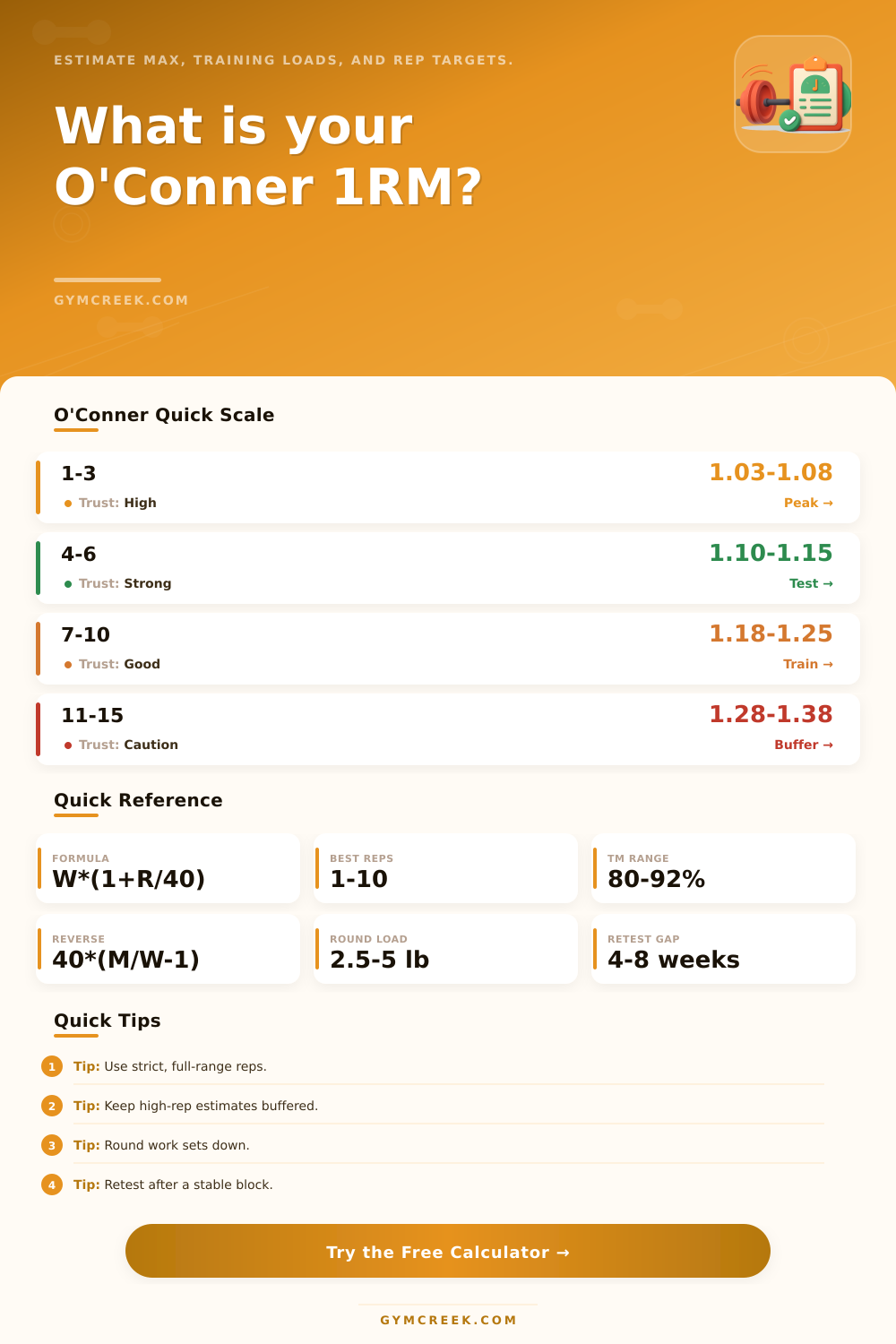
Estimate a one-rep max with O'Conner-only math: tested weight multiplied by one plus reps divided by forty.
📌O'Conner Test Presets
Each preset fills a different strength-testing scenario while keeping every result tied to the same O'Conner formula.
⚙Calculator Inputs
O'Conner strength snapshot
Enter a tested set to estimate max strength, work-set reps, and training loads.
📊O'Conner Metrics
📑Reference Tables
| Clean reps | Formula factor | Load share | Reliability note |
|---|---|---|---|
| 1 | 1.025 | 97.6% | Near-max single with a small formula lift |
| 3 | 1.075 | 93.0% | Strong low-rep estimate |
| 5 | 1.125 | 88.9% | Common anchor for strength planning |
| 8 | 1.200 | 83.3% | Useful when technique stays even |
| 10 | 1.250 | 80.0% | Upper edge of the preferred zone |
| 15 | 1.375 | 72.7% | Needs a larger training buffer |
| Load as % of 1RM | Estimated reps | Best use | Planning cue |
|---|---|---|---|
| 95% | About 2 reps | Heavy exposure | Use only with crisp setup |
| 90% | About 4 reps | Top-set practice | Good for heavy triples to fours |
| 85% | About 7 reps | Strength volume | Stop before technique breaks |
| 80% | About 10 reps | Back-off sets | Useful submax benchmark |
| 75% | About 13 reps | Capacity check | Endurance affects the estimate |
| Posture | Typical range | Best fit | Adjustment cue |
|---|---|---|---|
| Return buffer | 72-82% | Layoffs or uncertain form | Keep several reps in reserve |
| Conservative | 78-86% | Longer accumulation blocks | Round down most work sets |
| Balanced | 84-90% | Normal strength blocks | Use after a clean 3-8 rep test |
| Assertive | 88-94% | Short peak blocks | Needs recent heavy practice |
| Scenario | Rep style | Primary output | Why it matters |
|---|---|---|---|
| Heavy triple | Low reps | Top-set target | Small fatigue error |
| Five-rep audit | Moderate reps | Training max | Balanced between skill and fatigue |
| Eight-rep volume | Higher reps | Back-off range | Useful but more conditioning-driven |
| Return block | Submax reps | Buffered max | Readiness should shape loading |
💡O'Conner Notes
The O’Conner 1RM estimate allow an individual to estimate there one-repetition maximum by lifting a weight and performing a specific number of repetitions. To calculate the one-repetition maximum, an individual simply has to multiply the weight lifted by a specific mathematical factor that relates to the number of repetitions performed. Because the mathematical factor assigned to a set of repetitions decreases as that number of repetitions increases, it is possible to use the O’Conner 1RM equation to calculate the one-repetition maximum for any given number of repetitions performed (such as five repetitions or eight repetitions).
The accuracy of this calculator are dependent upon the quality of the set performed by the individual. Sets performed with a full range of motion and at a fast tempo will result in the most accurateley calculation of 1RM by the O’Conner 1RM calculator. Sets performed with limited range of motion or at a slower tempo will result in less accurate calculation.
How to Use the O’Conner 1RM Calculator
Thus, individual should remember that the accuracy of the O’Conner 1RM calculator is only as accurate as the set performed to calculate that individual’s 1RM. Many individuals can use the O’Conner 1RM estimate to determine their training max. The weight that they will lift during their training session. The training max is typically less than the calculated 1RM value for the lifter; allowing for the lifter to gradually increase the weights lifted over time instead of attempting to fail every time they lift a weight in their training sessions.
The calculator allows an individual to choose different postures for there training lifts. For example, an individual returning to lifting after taking a break may choose a “cautious” posture; while an individual that lift heavy weights regularly may opt for the “assertive” posture. Body weight is also a factor in the O’Conner 1RM calculation.
An individual that lifts a weight that is one and a half times their body weight is more differently strong than an individual that is able to lift a weight equal to their body weight. Thus, you can enter body weight into the calculator; however, it is an optional field. If an individual does enter their body weight, the calculator will provide an ratio of the 1RM estimate to their body weight.
The O’Conner formula can also be used in reverse. A reverse calculation of the O’Conner 1RM calculation allow an individual that intends to lift some specific weight to calculate how many repetitions they should perform. This reverse calculation can be especially useful within a strength block to determine if an individual’s lifts will remain within the repetition range that they intend to lift.
Thus, the O’Conner 1RM calculation and estimate is just as applicable to calculating the number of repetitions that an individual should lift as it is to calculating the weight that they should lift. The readiness that an individual is in during the set will impact the strength value of their 1RM estimate. An individual that is rested and feeling good with their physical strength will have a higher 1RM estimate than an individual that is tired or otherwise not physically ready to perform sets of lift.
Thus, the readiness scale is provided for the individual to adjust their training max according to their physical readiness. The readiness scale should be used to ensure that the calculations are based upon the individual’s current physical condition; otherwise, they may be unable to follow through with their calculated strength estimates in the following few week. The reference table on the page allow an individual to understand how the multipliers relate to the number of repetitions performed in a set.
Additionally, the tables help to explain the loading ranges created by each posture selection for an individual’s training lifts. Sets that consist of a low number of repetitions will more closely map to an individual’s true 1RM; whereas sets that consist of high repetitions require more caution with the strength calculations. An individual should avoid some mistake when using the O’Conner 1RM estimate.
One mistake is to believe the calculated 1RM estimate the weight that they will lift in their training sessions. Another mistake is to perform sets with a high number of repetitions without including an extra buffer in relation to the calculated 1RM estimate. Both of these mistakes are made due to the fact that the 1RM estimate is, as the name implies, only an estimate of one’s strength.
Thus, rounding the calculated weights to the nearest plate size and leaving some repetitions in reserve can ensure that the 1RM estimate remains a helpful calculation for training. An individual should periodically retest their 1RM using the O’Conner 1RM calculation. By performing the test at the same time under similar conditions, an individual can more accurately compare their current 1RM calculations to their former calculations.
Thus, by performing this test every four to eight weeks, an individual can more effectively monitor their development of strength. The method used by O’Conner is effective due to the simplicity of the calculations and the need for only one set of repetitions to create the training tool for strength training.