Nordic Walking Calorie Calculator
Estimate Nordic walking calories from body size, pace, grade, terrain, pole technique, upper-body effort, carried load, and weekly frequency using the ACSM walking equation with Nordic-specific modifiers.
📌Nordic Walking Presets
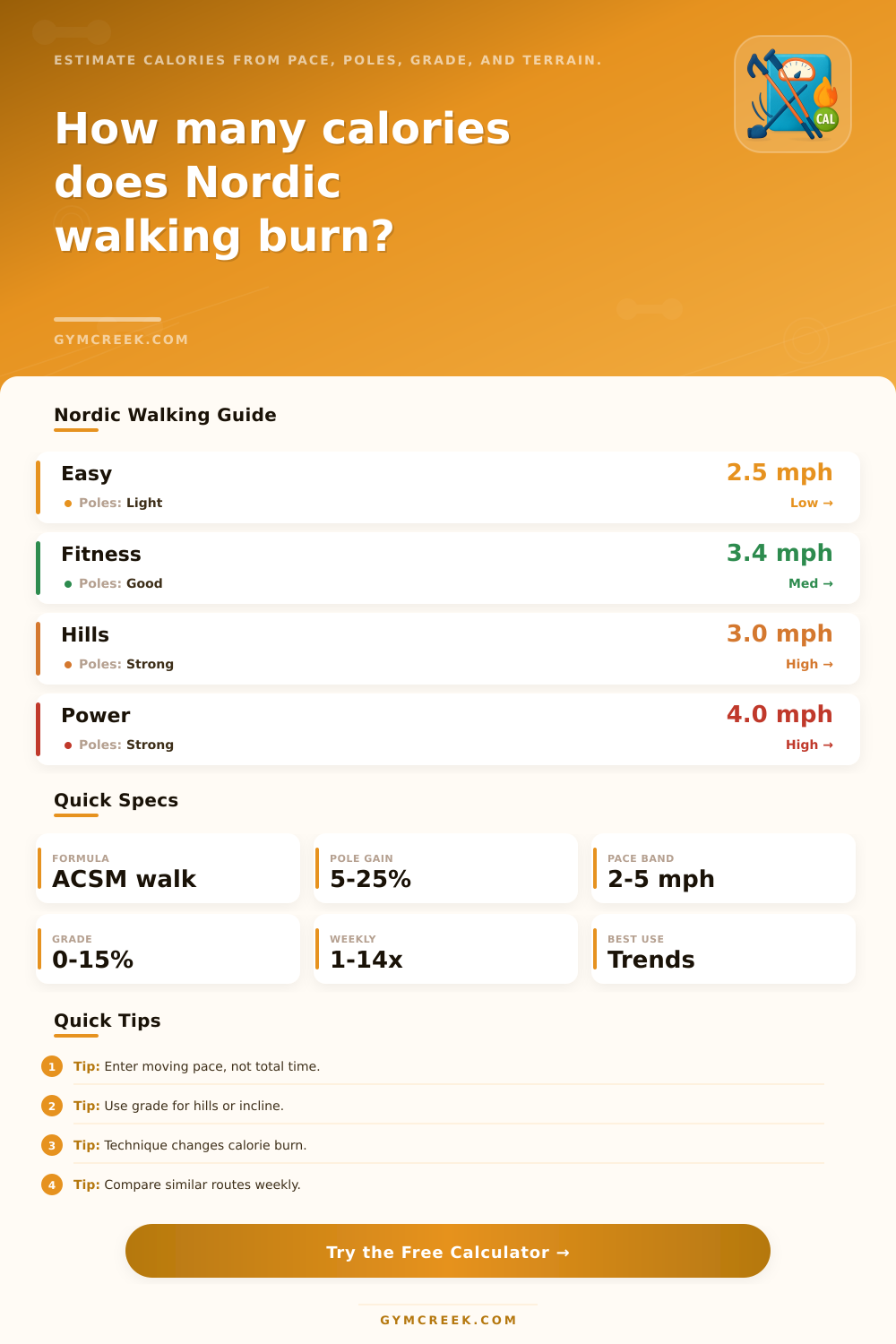
The estimate starts with the ACSM walking equation: VO2 = 0.1 x speed + 1.8 x speed x grade + 3.5, then adds terrain, load, pole technique, and upper-body effort adjustments.
⚙Nordic Walking Inputs
Nordic walking calorie snapshot
Enter body weight, pace, grade, terrain, pole technique, effort, load, and frequency to estimate session energy cost.
📊Calculated Metrics
📑Nordic Walking Reference Tables
| Component | Input | Factor | Effect |
|---|---|---|---|
| Body weight | --- | --- | --- |
| Body Weight | Nordic Calories | Regular Walk | Pole Bonus |
|---|---|---|---|
| --- | --- | --- | --- |
| Technique | Typical Feel | Extra Cost | Best Use |
|---|---|---|---|
| Intro pattern | Poles mostly guide rhythm | About 5% | Learning, balance, easy outings |
| Basic alternating poles | Clear plant but light push | About 9% | General fitness walks |
| Good push-through | Arm swing finishes behind hip | About 14% | Brisk walking and calorie goals |
| Strong diagonal stride | Firm push on most steps | About 19% | Hills, endurance, club walks |
| Power technique | Full-body drive and high cadence | About 25% | Conditioning sessions |
| Reference | Rule | Meaning | Calculator Use |
|---|---|---|---|
| Pole length | Height x 0.68 | Common Nordic starting point | Scores entered pole fit |
| ACSM walking | 0.1S + 1.8SG + 3.5 | Speed and grade VO2 | Base oxygen cost |
| MET conversion | VO2 / 3.5 | Relative intensity | Shows session METs |
| Calorie conversion | VO2 x kg / 1000 x 5 | Oxygen to kcal | Final calorie estimate |
💡Nordic Walking Calorie Tips
Nordic walking is simple: you pick up some poles, swing your arms, go outside and take a walk. It’s that easy, right?
But what about how much weight you carry, the type of pole technique, pace and terrain? All can makes a big difference in how much energy you use. Sometimes these details matter just as much than how long you walk to get a good workout.
Why Details Matter in Nordic Walking
What most people don’t realize is how much the poles change things. Used well, they provides extra upper body power not present in regular walking. You push hard. With poles adjusted to your height, it can boosts calories burned an additional 20% or more. And if your poles are too short? Your rear striding drive are limited. Too long? They may be uncomfortabley and inefficient. The best pole length is roughly sixty-eight percent of your height which is why the calculator asks for both.
The second factor is slope, and terrain. Walking on a flat sidewalk has a predictable energy cost. Harder surfaces like gravel or compacted sand or even slightly rolling trails adds more leg and core work per step. Even slight slopes will change vertical work, and that affects your energy use. Instead of assuming all routes are equivalent, this calculator factors them in; adjusting the basic walking equation accordingly.
Load also affect the outcomes. Your body has to moves a different amount of weight based off what you carry in your pack. For instance, if you’re carrying a small pack or work bag, there’s going to be some weight there. To compensate for this, the tool estimates about 70% of total weight you carry as effective load (e.g., your body doesn’t lift the whole bag up with each step; it only lifts your torso). This change reflect that you are carrying more weight but helps to keep estimate from overestimating the cost.
One strong outing feels good but doesn’t create the same cumulative effect as four or five moderate ones spread across the week. A great workout is nice and all, but it won’t have the same impact than four moderately good workouts sprinkled throughout your week. Depending on your goals (fat loss, endurance, recovery), you’ll tweak settings in the calculator, which will then alter what happens with that week’s total.
Again: It’s still math underneath the hood. If you want most bang for your buck, most folks achieves that with the easiest wins. You need consistency in three area. Maintain roughly the same pace each week. Pick routes with roughly the same grade and terrain. Use the same pole technique. Consistency will make calories meaningful trend information (not just a series of wild-assed guesses).
Once you input that info into the calculator, it do the math for you, leaving you free to show up and not obsess over whether or not you did the math corectly. You should of used it more often.