Non-Exercise Activity Thermogenesis Calculator
Estimate daily NEAT calories from ordinary movement: steps, standing, chores, stairs, commuting, desk breaks, and fidgeting, while keeping planned exercise separate.
📌NEAT Presets
Presets load realistic daily movement profiles. Adjust any input to match a normal day, then compare your NEAT estimate with your calorie target.
⚙Calculator Inputs
Daily NEAT snapshot
Enter movement details to estimate non-exercise activity thermogenesis.
📊Fitness Metrics Grid
📑Reference Tables
| Metric | Low day | Typical day | High day |
|---|---|---|---|
| Daily steps | Under 4,000 | 6,000 to 9,000 | 12,000 plus |
| Standing time | Under 1 hour | 2 to 4 hours | 6 hours plus |
| Chores and errands | Under 15 min | 25 to 50 min | 70 min plus |
| Stair flights | 0 to 3 | 5 to 15 | 25 plus |
| Formula | Inputs | Output | Use |
|---|---|---|---|
| Mifflin-St Jeor | Sex, age, height, weight | BMR | Resting baseline |
| MET calorie equation | MET, kg, minutes | Gross kcal | Movement energy |
| Net activity subtraction | Gross minus rest | Net kcal | NEAT estimate |
| Step distance estimate | Height, sex, steps | Miles or km | Step cross-check |
| Target comparison | NEAT and target | Gap | Planning cue |
| Scenario | Movement pattern | Expected NEAT | What changes it |
|---|---|---|---|
| Remote desk day | Low steps, little standing | Low | Breaks and errands |
| Office commute | Moderate steps and breaks | Moderate | Parking and stairs |
| On-feet job | Long standing and walking | High | Shift length |
| Manual workday | Steps, carrying, stairs | Very high | Load and pace |
| Diet phase | NEAT may drift down | Variable | Fatigue and routine |
| Component | Approx MET | Rest removed? | Notes |
|---|---|---|---|
| Standing | 1.5 | Yes | Small hourly effect |
| Easy steps | 2.5 to 3.2 | Yes | Depends on pace |
| Chores | 2.8 to 3.8 | Yes | Task intensity varies |
| Stairs | 8.0 | Yes | Short but intense |
| Movement breaks | 2.2 | Yes | Estimated 3 min each |
💡Tips
We all believe that we burn calories only while sweating at the gym. You’re tracking every squat and run with exact precision, yet you frequently neglect everything else throughout the rest of the day. That’s where mistake lies. Because guess what? You have about twenty-two hours per day in which you aren’t exercising. Whether your body composition shift or remains the same depends entirely on how you move during these hours.
Next is non-exercise activity thermogenesis (NEAT). Simply put, it’s the energy you expend performing any action other than formal exercise, eating or sleeping. There are a million little things that goes into NEAT and that’s why NEAT sounds vague. If you chop some wood, it gets added to the count. So does fidgeting while you’re in your chair. And walking over to the printer when you could of emailed the file over, that all adds up.
Why Moving During the Day Matters More Than You Think
Once you know what your personal habits of movement are, you can just plug them into the calculator and let it do the math. You don’t need to guess about coefficients. But if you want to understand why these inputs matter, you’ll need to look beyond numbers.
For most people, they under-estimate how many more calories they burn by getting up and standing as opposed to sitting. A few dozen extra calorie an hour isn’t a lot, per minute. But if you think about how long you sit for (eight hours a day), then you’ll see how quickly the gap will add up.
How many flights of stairs are there? How many hours did you spend standing? How much fidgeting is there? How many chores is there? How many steps? The tool divides this up into these categories. There is also research on how tapping your foot and all those little unconscious movements burns hundreds of calories during the course of a week. You lose free energy by being really still. A simple multiplier adjust for this in the calculator. Small thing, but it matters when you’re aiming at a specific surplus/deficit of calories.
NEAT is tricky because it’s often confused with actual exercise. For example, if you go for a five-mile run after work, that’s not NEAT. That’s planned activity. The calculator separate the two, so you can see your total. If you combine them, you’ll overestimate your daily-life burn and assume you’ve burned more then you really have. Then you’ll eat more. Because you feel like you’ve burned off enough.
Average your step count over seven days. Why? Because day-to-day fluctuations is large: One day you may reach ten thousand steps, another you’re stuck at four thousand or less. An average levels out the noise and provides a more realistic baseline.
Because NEAT is a survival mechanism, it drops when you diet. If you dramatically reduce calorie intake, your body will conserve energy by having you move around less. You’ll subconsciously skip the stairs and use the elevator. You’ll take longer breaks at work while sitting more. This is known as metabolic adaptation. It isn’t evil… It’s efficient! But it sabotages your weight-loss goals. To help you avoid this, the calculator allow you to input a desired NEAT level. By comparing your guess to your target, you can see whether you’re falling into the low-movement trap.
These numbers will depend on your job environment: An office worker typing emails will burn less energy (just from labor) than a warehouse worker. Context matter. This is why the tool have preset profiles for this situation and others. Working remotely? Your NEAT may decline without you knowing. Now it’s up to you to walk when you take phone calls, stand when you cook, to create movement. These aren’t workouts. They’re lifestyle tweaks that accumulate across a week.
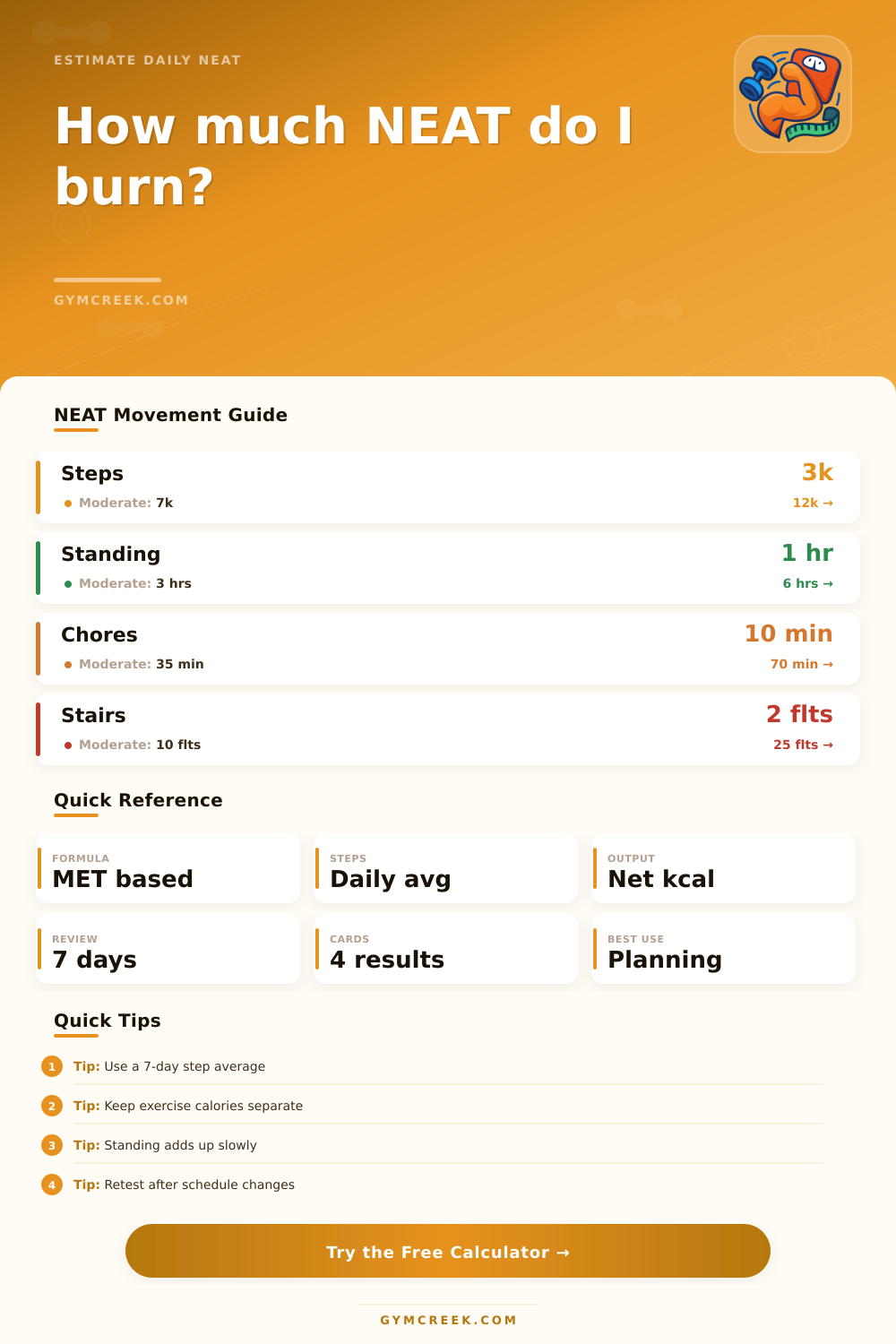
It shows it with a reference table on the page, which breaks things into high, moderate and low bands, depending on the activity. You can figure out where you fit, then pick one thing to move up. You don’t have to change everything about your life. Add in another flight of stairs or stand for twenty more minutes. It’s easy enough math that you can see effect of small changes over time.
NEAT gets ignored by most…until they hit a stall. Then it’s tougher to correct. Pay attention to those quiet hours right now and start tracking them. That’s where the burn realy comes in. This isn’t about hitting the gym; this is what you do when nobody’s looking. Do more throughout the ordinary parts of your day. Twenty-two hours are yours for the taking.