Negative Split Calculator
Build a race plan where the second half is faster than the first by setting distance, target time, split size, negative split percentage, terrain, aid delays, and final push timing.
📌Negative Split Presets
Presets fill realistic racing scenarios. Adjust the target time, split size, negative split strength, terrain, and final push settings to match your course.
⚙Race Inputs
Race pacing snapshot
Enter race details to calculate first-half control, second-half pace, final push pace, and split windows.
📊Calculated Metrics
📑Negative Split Tables
| Split | Target | Window | Cumulative |
|---|---|---|---|
| --- | --- | --- | --- |
| Model | Second-half gain | Best fit | Watch cue |
|---|---|---|---|
| --- | --- | --- | --- |
| Profile | Confidence | Recommended gap | Planning note |
|---|---|---|---|
| --- | --- | --- | --- |
| Step | Formula | Variables | Purpose |
|---|---|---|---|
| Moving time | Finish time - aid time | Target, stops | Separates running pace from stop time |
| Half paces | Average pace split by gain | Distance, target, percent | Creates a faster second half |
| First split | Base split + opening buffer | Split time, seconds | Controls early traffic and adrenaline |
| Final push | Second-half pace x gain | Push percent, gain | Plans the late acceleration |
💡Negative Split Tips
A negative split sounds easy, but it’s hard to pull off on race day. It’s simply a matter of running the second half of your event faster then the first.
Here’s where things get tricky: You have to hold yourself in check early enough that the surge feels controlled. I’m convinced most runners who fall short haven’t done anything wrong in terms of fitness. They simply started out too fast and burned through their energy cushion early, now they’re just trying to hold on for dear life.
How to Run Your Second Half Faster
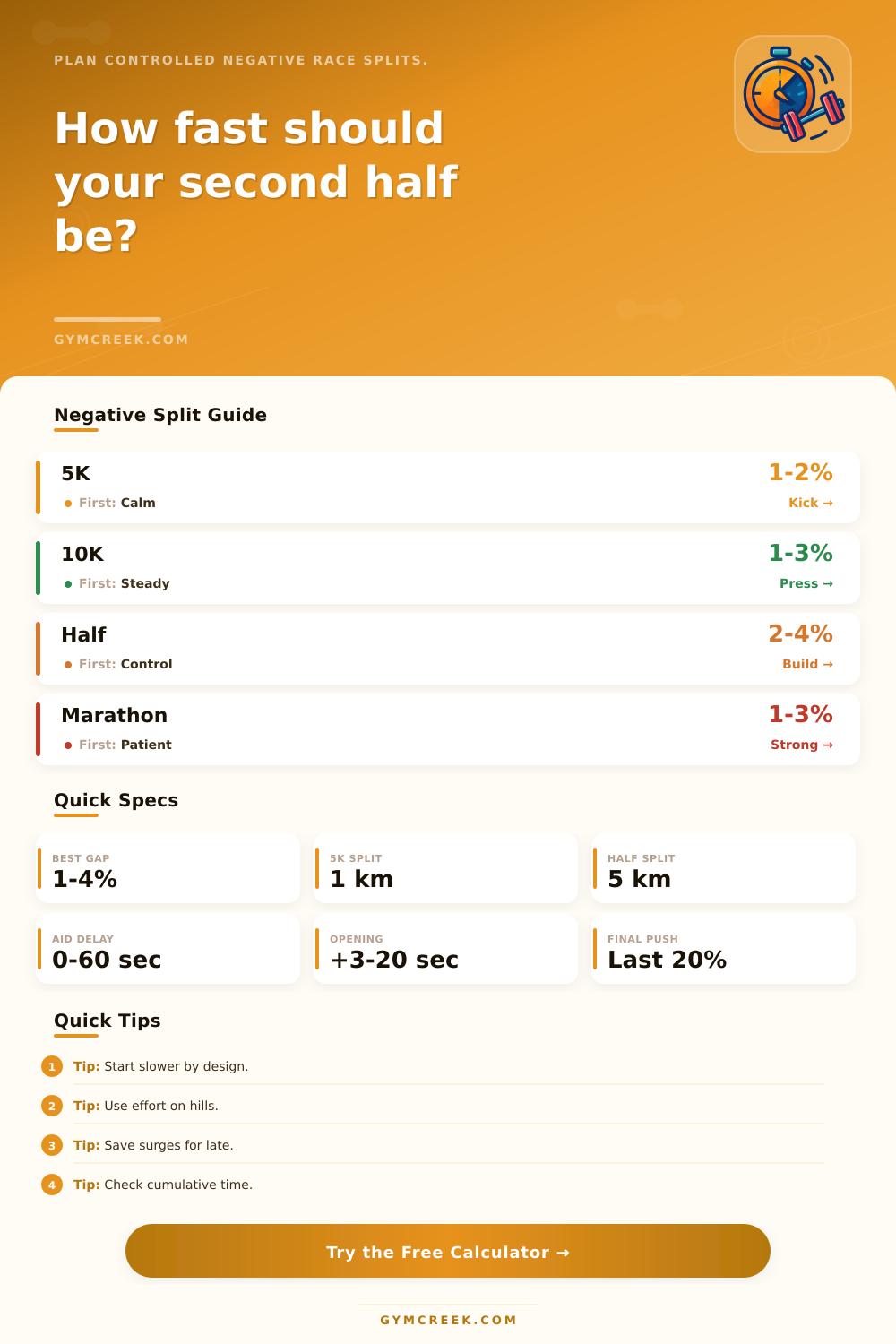
Input your distance, goal finish time, and how aggressive you want your split to be. The calculator do all the work for you. It even takes into account things like a final push section, aid stops, and terrain. Those variables adjust what the second-half pace feel like in course. You aren’t going to run a negative split off a hilly marathon with four aid stations the same way you would based off a flat 10K with zero.
The tool tells you that, so you know if your plan’s realistic or not, before lining up. But it’s the first half that really counts. And no, it’s not about feeling fast, it’s about feeling restrained. That restraint show in your decision to stay calm despite the surge of pack all around you. It also shows in your fatigue reserve percentage and your opening split buffer.
Do this well, and you’ll find second half isn’t a recovery mission at all but a true build. The calculator shows this clearly by dividing total time into moving time and showing the pace needed for each half.
Run the first half as if it were warm-up rather than part of the race and the second half turn into a recovery mission. The terrain eats up your time, as do aid delays. Every second spent adding a little more on at every station add up. A technical section on the trail can transform an expected negative split into more like even.
The reality of all that means that you don’t get surprised when the numbers change; the calculator help you model that out. It also enables you to try out a final push that starts well after you’d think, typically around the last 20 percent of the race. That’s when you really start going negative with your split. Everything prior to that is simply setup.
Runners often overthink exact percentage. You’ll see it on your watch when you have a 2 percent negative split at a marathon. At a shorter race, a 4 or 5 percent split can feel huge. It will vary based off what terrain/pace you think you’ll hit earlier in the run and how much fatigue or change of pace you anticipate later. The calculator allow you to see the trade off between having a ballsy goal but leaving yourself some wiggle room if the race turns out to be a tough go.
And then there’s what happens on paper: you look at your cumulative time at half. It is the true test. Are you ahead of your target for the first half? Or do you find yourself already lagging, meaning that simply breaking even require a pace faster than expected for the latter half. This is where the plan either succeeds or fails.
A positive split doesn’t require any heroic last-mile effort. Instead, it relies on the subtle choices made during the first half which make remaining half plausible and you should of known that.