Neck Training Load Calculator
Estimate effective neck resistance, session load, weekly volume, and a conservative next-step range for flexion, extension, lateral, rotation, and isometric work.
📌Presets
Presets load realistic neck-training sessions and calculate immediately. Keep any neck loading smooth, slow, and pain-free.
⚙Calculator
Neck load snapshot
Enter the exercise details to estimate load and weekly caution.
📊Fitness Metrics Grid
📑Reference Tables
| Neck Action | Load Multiplier | Why It Changes | Use Note |
|---|---|---|---|
| Flexion | 1.00 | Baseline front-neck work | Use slow control |
| Extension | 1.15 | Often tolerates higher force but raises leverage | Avoid snapping reps |
| Lateral flexion | 1.05 | One side carries most of the task | Match both sides |
| Rotation | 0.85 | Usually trained lighter through small ranges | Do not force end range |
| Isometric | 0.75 | No moving lever, but time matters | Breathe normally |
| Experience | Single-Load Cap | Typical RPE | Progression |
|---|---|---|---|
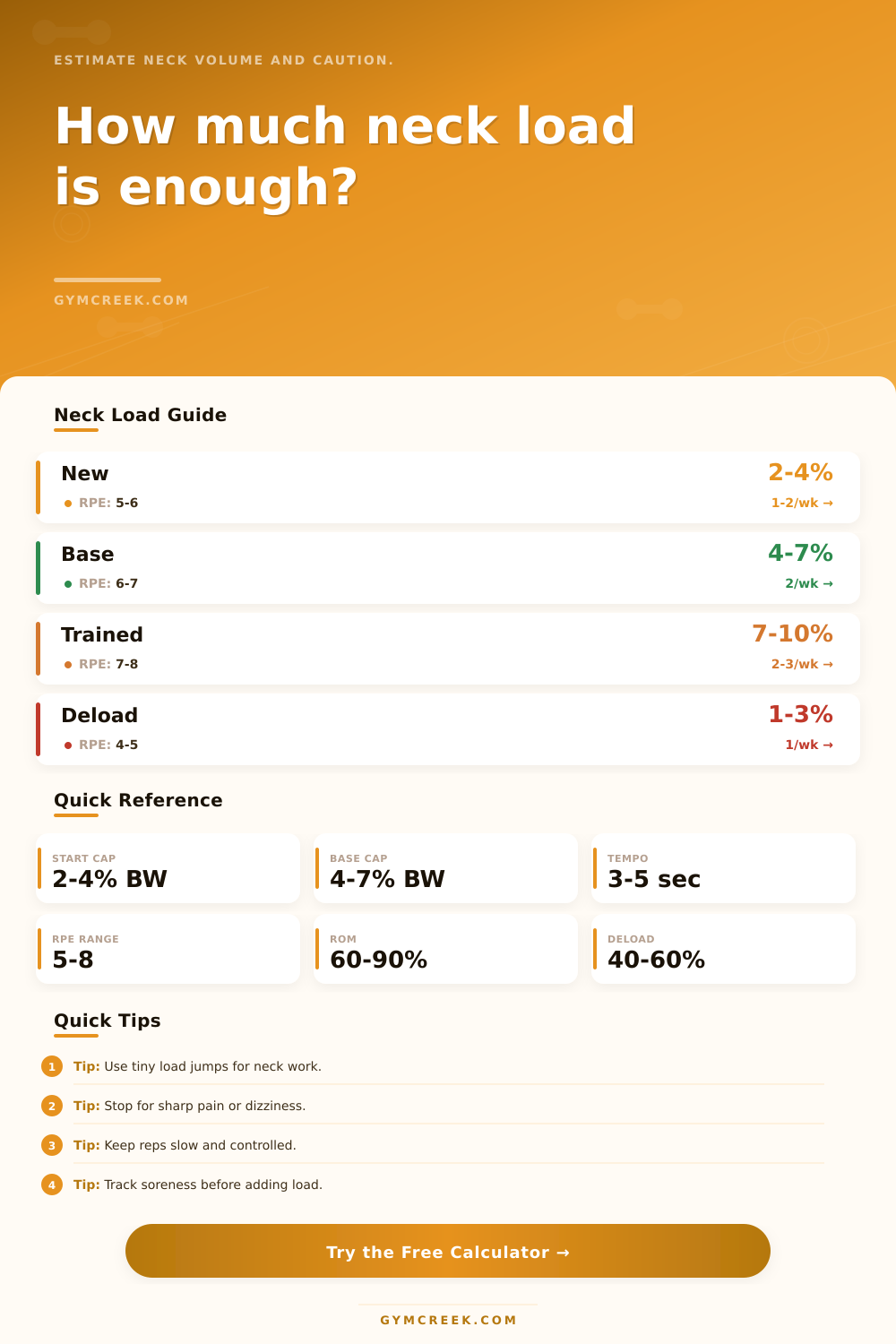
| New or restarting | About 4% body weight | 5-6 | Hold steady first |
| Consistent base | About 7% body weight | 6-7 | Small weekly jumps |
| Trained 6+ months | About 10% body weight | 7-8 | Use volume waves |
| Advanced monitored | About 13% body weight | 7-8 | Track symptoms closely |
| Caution Band | Risk Index | Training Meaning | Next Choice |
|---|---|---|---|
| Low | Under 45 | Comfortable margin | Add slowly if pain-free |
| Moderate | 45-69 | Useful work, watch symptoms | Repeat or add tiny load |
| High | 70-89 | Volume or effort is elevated | Reduce one variable |
| Stop and review | 90+ | Too aggressive for most sessions | Deload and reassess |
| Formula | Variables | Output | Purpose |
|---|---|---|---|
| Effective load | Load, action, ROM, RPE, leverage | Adjusted resistance | Compare exercises |
| Session score | Effective load, sets, reps, seconds | Load points | Estimate today |
| Weekly score | Session score, sessions per week | Planned volume | Manage exposure |
| Risk index | Cap use, weekly load, soreness, age | 0-100+ score | Set caution band |
💡Tips
The neck is easily forgotten until it’s too late and something goes wrong or it starts to get stiff with regular use. But the neck is vulnerable, and strengthening it different than other muscle groups means you can’t just go out and lift heavy weights. It takes time and patience. It’s all about incremental change; that’s why it’s important to pay attention to what you’re doing instead of simply how much.
After plugging in your metrics, the calculator above does all math and saves you from guessing as to whether or not you’re putting too much work on delicate joint. Using your neck size alongside your height and body weight creates a safe starting point. A taller, slimmer individual experiences more mechanical stress compared to a shorter, stockier individual. So those metrics adjusts accordingly and allow you to fairly compare results.
Why Neck Training Is Special
Training experience is another factor, one that determines your recovery requirement and load cap. Since a new lifter’s connective tissue isn’t acclimated to tension, they can gets away with less volume to achieve gains. The other thing folks don’t understand: manual resistance typically feels easier then a loaded harness or band… Yet they both apply roughly equivalent “effective” stress when the tempo is dialed in correctly. That’s why the calculator adjusts for that.
For example, it accounts for flexion, extension, and rotation, as the last two involves smaller ranges of motion that are easier to manage safely. Extension work allow for higher forces because muscle mass has built up over time, but quick movements increase lever arms and the risk of injury. Use flexion as benchmark for strength tests. Rotate and laterally flex with lower loads. Make reps slow and controlled rather than just counting them. Allow the device to clock time under tension instead, meaning a four second rep is safer then a bouncing one.
So beyond session intensity, weekly volume matters too, and the calculator estimates your overall week’s load from your intended sessions, allowing you to visualize accumulated stress before it shows up as pain. When the output indicates you’re within the high caution band, it’s telling you that the volume you intend to hit over the week is more than can be safely recovered from given your age and existing soreness. Pushing yourself right up into the red doesn’t mean you are making progress; in fact, long term, better results may come from operating mostly in the low and moderate caution bands. So deloading, instead of failing, is a necessary part of the process. More is not always better: consistency trumps intensity here. Load caps moves with experience levels, which is why the page also has reference tables to show that.
You should of not force anything if you experience sharp pain, numbness, dizziness, or any other hard stop; these are indications to take a break. Avoiding those hard stops: Weighting up too fast or simply missing cues of irritation (soreness) are common mistakes. Pain ≠ soreness. The calculator will adjust its recommendations downward based off how sore you say you feel, so don’t go by feeling sore; go by feeling good enough to increase load, or at least reduce either load or frequency if you’re getting very sore. Otherwise, you’ll just get stuck in the hurt, rest, repeat cycle that derails progress. Go by what you can do, don’t try to go by what you think you need to do. Think of this planned next step as more like a ceiling, not a floor.
You want to make baby steps with resistance increases over time, even over weeks or months. Use the calculation as a guide to go slightly beyond, but never force yourself past it. Better to be shy of your potential than go out and hurt yourself trying to reach it. The key to neck training is to be precise and patient, you’re dealing with structure protecting your spinal cord and brain. Don’t underestimate that biology; use the tool to take guesswork out of your programming, but also listen to your body for feedback even more. Make all moves smooth and breathe as normal. Focus on control and let strength follow durability once you stop chasing heavy numbers and start managing your tissue stress. When you care for the weak link it dissapears, and this is how you build a neck to last, not just look big for a week.