Neck Harness Load Calculator
Estimate a conservative neck harness working load from your current reps, target movement, range quality, soreness status, and smallest available plate jump.
📌Presets
Each preset loads a realistic neck training setup and recalculates with conservative safety caps.
⚙Calculator
Neck harness load snapshot
Enter a current clean load and calculate a conservative working target.
📊Fitness Metrics
📑Reference Tables
| Experience | Start Cap | Progress Jump | Session Target |
|---|---|---|---|
| Return or cautious | 3-4% body weight | 0-1 lb | Easy control |
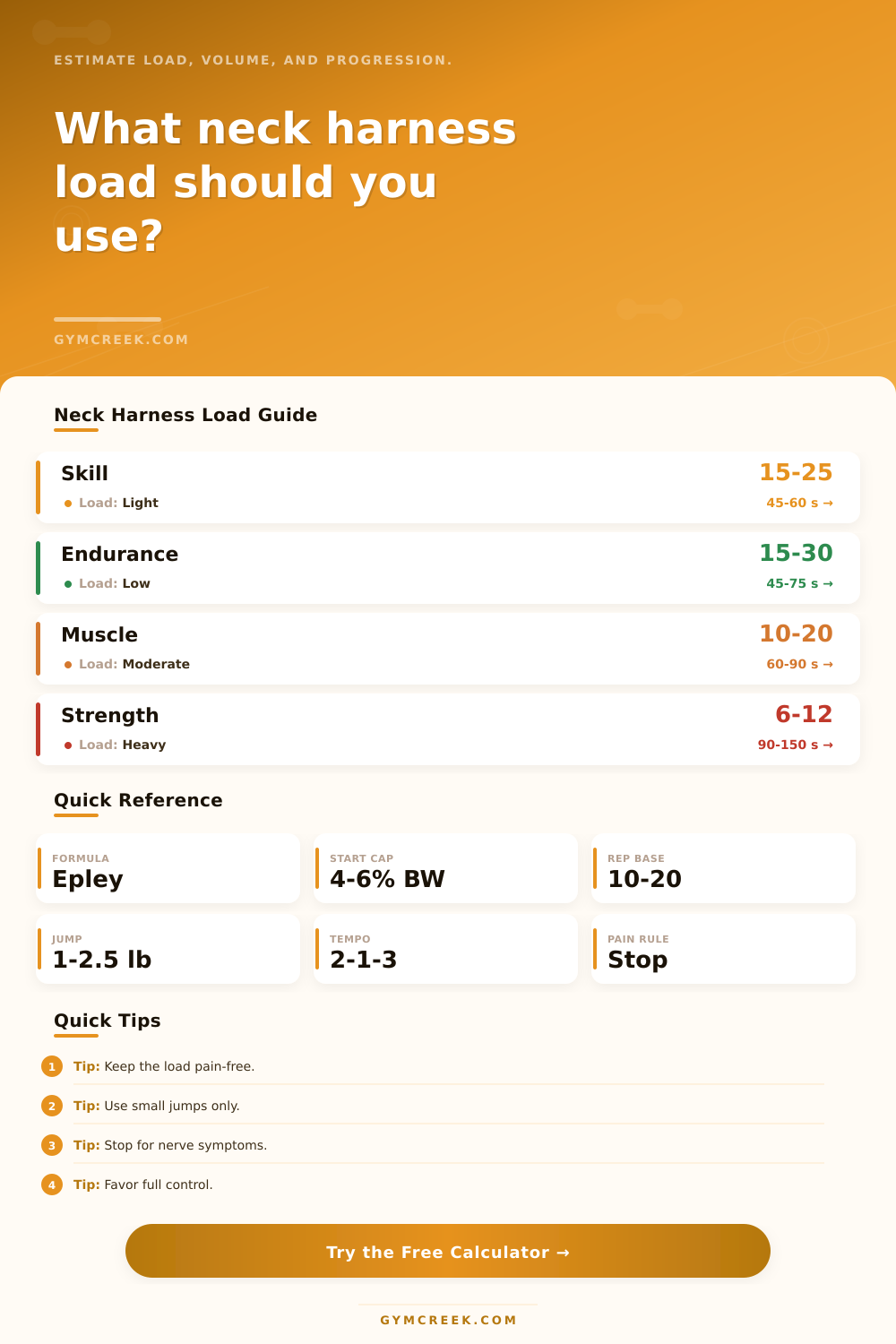
| New to harness | 4-6% body weight | 1 lb | Skill reps |
| Beginner base | 6-8% body weight | 1-2.5 lb | Clean volume |
| Intermediate | 8-12% body weight | 2.5 lb | Planned blocks |
| Advanced only | 12-16% body weight | 2.5-5 lb | Low symptom risk |
| Movement | Load Tolerance | Best Reps | Safety Note |
|---|---|---|---|
| Extension harness | Highest | 10-25 | Smooth arc |
| Supported flexion | Moderate | 12-25 | No jaw strain |
| Lateral flexion | Lower | 12-30 | Even sides |
| Rotation pattern | Very low | 15-30 | No twisting load |
| Isometric hold | Low-moderate | 10-30 sec | Neutral spine |
| Goal | Rep Zone | Intensity | Rest |
|---|---|---|---|
| Skill tolerance | 15-25 | Very light | 45-60 sec |
| Endurance | 15-30 | Light | 45-75 sec |
| Muscle control | 10-20 | Moderate | 60-90 sec |
| Strength focus | 6-12 | Heavy for neck | 90-150 sec |
| Deload | 12-20 | Reduced | 60-90 sec |
| Formula | Variables | Output | When Used |
|---|---|---|---|
| Epley estimate | Load, reps | Estimated max | Clean reps |
| Rep intensity | Target reps | Base load | Work sets |
| Safety cap | Body weight | Max allowed | All outputs |
| Volume | Load x reps x sets | Session work | Weekly planning |
| Progression | Load + jump | Next load | Pain-free sets |
💡Tips
In the gym, just look around, folks will lift heavy during squat workouts while treating their necks as fragile. Why? Because unlike shoulder or hip muscles, the cervical spine have fewer protective muscle tissue. If your neck give out while wearing a heavy harness, there is no spotter to save you, you’re on your own.
Thankfully, you don’t need to guess at conversions and coefficients (the math’s been done for you). Simply input your body weight and clean reps into the calculator above.
Why You Should Use the Neck Training Calculator
Unlike bench pressing, neck training are low on tissue tolerance (you don’t want to grind through neck pain) and high on immediate feedback (stop when it pinches). No glory in that. You enter your current load and number of reps you can perform with perfect form. This is important, since neck strength is very specific to the tempo/range of motion.
The neck respond better to consistent volume than to sudden spikes in intensity. But a slow, controlled rep build more usable tissue than a fast, jerky rep. That’s what the calculator base its estimated safe working load on. And it takes into account experience level.
Starters aren’t going to get loaded like the experienced athlete who’s trained for years. Their start caps will be much lower. See table on the page for that.
This is also why the calculator recommend very gradual increases (often only a couple pounds at a time). Your neck will respond better if you increase weight slowly over time, rather than adding weight to rapidly by going from nothing to 10 pounds in one session. This causes cumulative micro-trauma which show up as chronic stiffness. So don’t get hung up on trying to hit the “max”, the output provides an estimate, but use it more like a theoretical number, not something to work towards. The point isn’t to set a personal record on the harness; the point is to build structural integrity.
Another important number is how much load you use compared to your body weight. This determines if you’re loading your harness with a percentage of your body weight that’s unsafe. It’s recommended for most individuals to stay under six percent of their body weight until muscles adjust and the vertebrae are protected.
You can monitor how much work you’re doing in a session. This keeps it from getting out of control. We don’t want to train too hard or too often, because the connective tissue doesn’t recover as well than neck muscles. So inflammation occurs, putting you at risk for a setback for months.
Extension normaly handles more weight than rotation and lateral flexion. This is taken into account by the calculator, which means that when it recommends a lighter load it’s accounting for the fact that you’re working laterally, and those small muscles on the side of your neck need protection. The smallest amount of load can be tolerated during rotation as the cervical spine is not built to handle large twisting loads. When someone gets injured, they was likely ignoring this difference because applying the same load to rotation as they do to other movements breaks the system over time.
The other key input is soreness status, meaning it will suggest rest or a deload when you are still sore or stiff. This isn’t “soft,” but smart. The neck is the bridge between your brain and everything else below, and you don’t want to mess with it.
The tips section remind you to stop instantly if experiencing any dizziness/tingling, those are nerve signals, not muscle fatigue. Knowing this difference is what makes the smart trainee separate from the one who finds himself/herself with a chronic neck condition.
So at its core, neck training is a marathon, not a sprint. And the calculator give you a framework to make gradual improvements while ensuring you don’t put yourself at risk. It eliminates the ego from this process, replacing it with data. Enter the numbers, hit submit and it will spit out a gameplan that you stick to. You’ll end up with a stronger, more resilient neck capable of surviving the demands of sport and livig.
People get this one wrong because they confuse strength with being able to move the most amount of weight. In fact, strength is about moving the right weight consistently over time without getting injured. That’s what the calculator does, it helps you discover that sweet spot between consistent improvement and cost-free growth. It also makes a vague goal become a concrete plan. Build a foundation that will last you because your neck isn’t something you fix later, it should of been something you protect from the beginning.