Muscle Symmetry Calculator
Compare left and right muscle circumference plus unilateral strength to find your biggest side-to-side imbalance.
📌Presets
Presets load realistic paired measurements and unilateral strength numbers, then calculate the symmetry profile.
⚙Calculator
Muscle symmetry snapshot
Enter paired measurements to compare side balance.
📊Symmetry Grid
🎯Side Balance Targets
📑Reference Tables
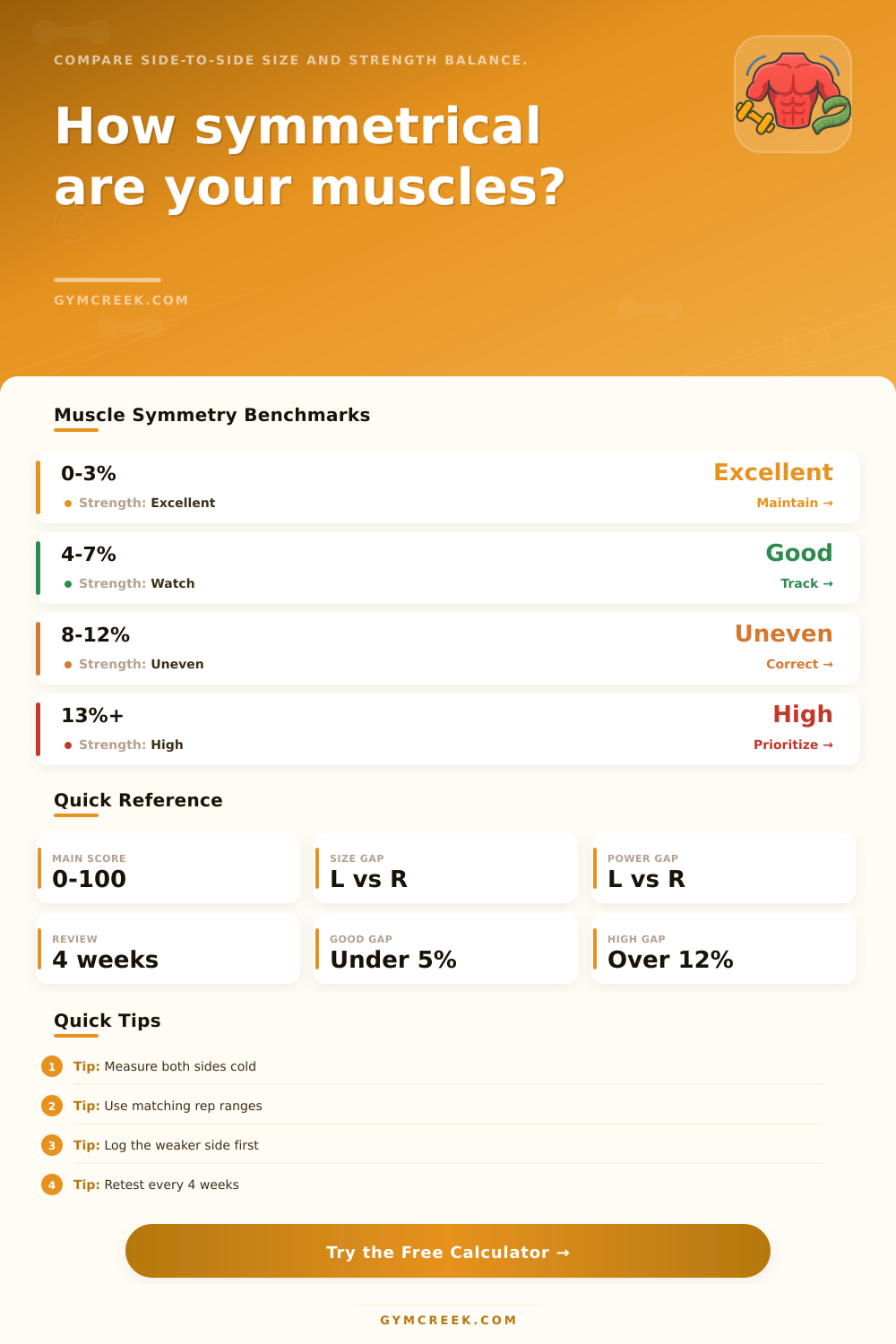
| Gap range | Size meaning | Strength meaning | Action |
|---|---|---|---|
| 0-3% | Excellent symmetry | Excellent match | Maintain normal work |
| 4-7% | Small difference | Watch technique | Track weekly loads |
| 8-12% | Clear imbalance | Performance gap | Start weaker side |
| 13%+ | High imbalance | High imbalance | Prioritize correction |
| Measurement | Formula | Best practice | Common error |
|---|---|---|---|
| Upper arm | Difference / larger | Same flex state | One side pumped |
| Forearm | Difference / larger | Widest point | Tilted tape |
| Thigh | Difference / larger | Same landmark | Different height |
| Calf | Difference / larger | Stand evenly | Toe pressure |
| Strength test | Compare | Rep rule | Use |
|---|---|---|---|
| Dumbbell press | Left vs right | Same reps | Press balance |
| One-arm row | Left vs right | Same tempo | Pull balance |
| Split squat | Left vs right | Same depth | Leg balance |
| Suitcase carry | Left vs right | Same distance | Trunk balance |
| Focus | Score weight | Priority cue | Review |
|---|---|---|---|
| General | 50/50 split | Largest gap | 4 weeks |
| Hypertrophy | Size weighted | Circumference | 4 weeks |
| Sport balance | Power weighted | Strength gap | 3 weeks |
| Return training | Conservative | Both gaps | 2 weeks |
💡Tips
When it comes to looking good in the mirror, we tend to pay attention to muscles that contribute most to our image… Our shoulders. We’ll do countless curls and benches in search of some look, yet there’s more to it then appearances: symmetry is also a matter of mechanics. To get an idea of whether having slightly larger arms is normal variability or something worth pursuing, simply input your measurements into muscle symmetry calculator above; it does all the math for you.
That’s fine. Except then you think your body is symmetrical. And it isn’t. You sleep on a certain side, you’re probably right handed and one of your legs probably carries more weight as you walk. All these little imbalances accumulate over time. Day to day in training and regular life, one side takes most of the workload, while the other play a supporting role in a passive way.
How to Check Your Muscle Balance
That’s what the calculator measures. It’s not about measuring total mass. It doesn’t remove focus from strength, but rather compares strength and circumference on both sides of body. That’s where people go wrong. They measure their big bicep and think everything’s cool because it’s so big. But if one arm are bigger than another, then you’ve got an imbalance that can lead to pain.
Incorrect measuring is why most data sets fail. Be consistent about how you measure. If you measure immediately after working out, it’s going to mess up your numbers (tissue pressure rises during exercise due to increased blood flow). Take your measurements at rest. That gives you a more accurat starting point. The same goes for testing strength. It doesn’t help if you compare a sloppy rep on one side versus a heavy row on the other. Match range of motion, depth and speed exactly. And don’t use momentum on one side and not the other. The difference in the number you see is false. Precise input lead to precise output.
To clarify that in ranges, go look at the reference table on the page. The best symmetry is between zero and three percent. This means most people who are well-trained athletes. They just keep it that way. Watch what you are doing when you reach four to seven percent. This is where compensatory patterns frequenty begin. The stronger side begins to dominate the complex moves and the weaker one lag behind. Eight to twelve percent would be more obvious imbalances. Now you need to work towards fixing the weakness rather than increasing size. So instead of working to build up both sides equally, now you are focused on the weak link. Thirteen plus percent? That’s the red zone. Time to get right on correcting because if you don’t your form will break down under load.
These variables adjust to your goal of what you’re training. Do you want to grow muscles? Then size is all that matter. Strength won’t affect this as much. Circumference changes will be flagged more by the algorithm. Are you a sport athlete or a powerlifter? Then the strength symmetry score is more important; after all, force production is key. One arm looking weaker doesn’t just make you look like a freak, it also prevents you from lifting maximum safe loads. With an unstable limb, your nervous system might stall.
Closing these holes takes time and involves no ego lifting. You’ll find yourself taking weight off your dominant side until it’s even with your weak side. It may seem as if you’re slowing down, which isn’t true. What you’re really doing is strengthening the structure. How do I know? Because that’s what I was measuring. You don’t want them to be totally identical in every way; rather, they needs to support an equal amount of the load, or else one arm will bear too much weight.
Take a measurement every four weeks so that you can see if anything has changed. Neural pathways are slow to re-balance, whereas muscles is quick to adapt. Note what happens and tweak your sets/volume based off the results. Don’t worry about being perfect, since trying too hard to be perfect will get you injured. Worry about balance. Balance keeps your body able to lift as you get older. It lets you train harder, recover faster, and train for decades. Make sure the gaps aren’t huge. Let your ego go and make your movements honest. Let the data tell you how much you can do with next set rather than letting your ego decide.