Muscle Recovery Time Calculator
Estimate how many hours a muscle group may need before hard training again using workout type, body size, soreness, sleep, stress, protein, hydration, age, activity, and recent training frequency.
📌Recovery Presets
Presets load complete recovery scenarios. Edit any field to match the trained muscle group, athlete profile, and next-session plan.
⚙Calculator Inputs
Muscle recovery snapshot
Enter training stress and recovery markers to estimate the next useful hard-training window.
📊Recovery Metrics Grid
📑Reference Tables
| Workout Type | Low Stress | Moderate Stress | High Stress |
|---|---|---|---|
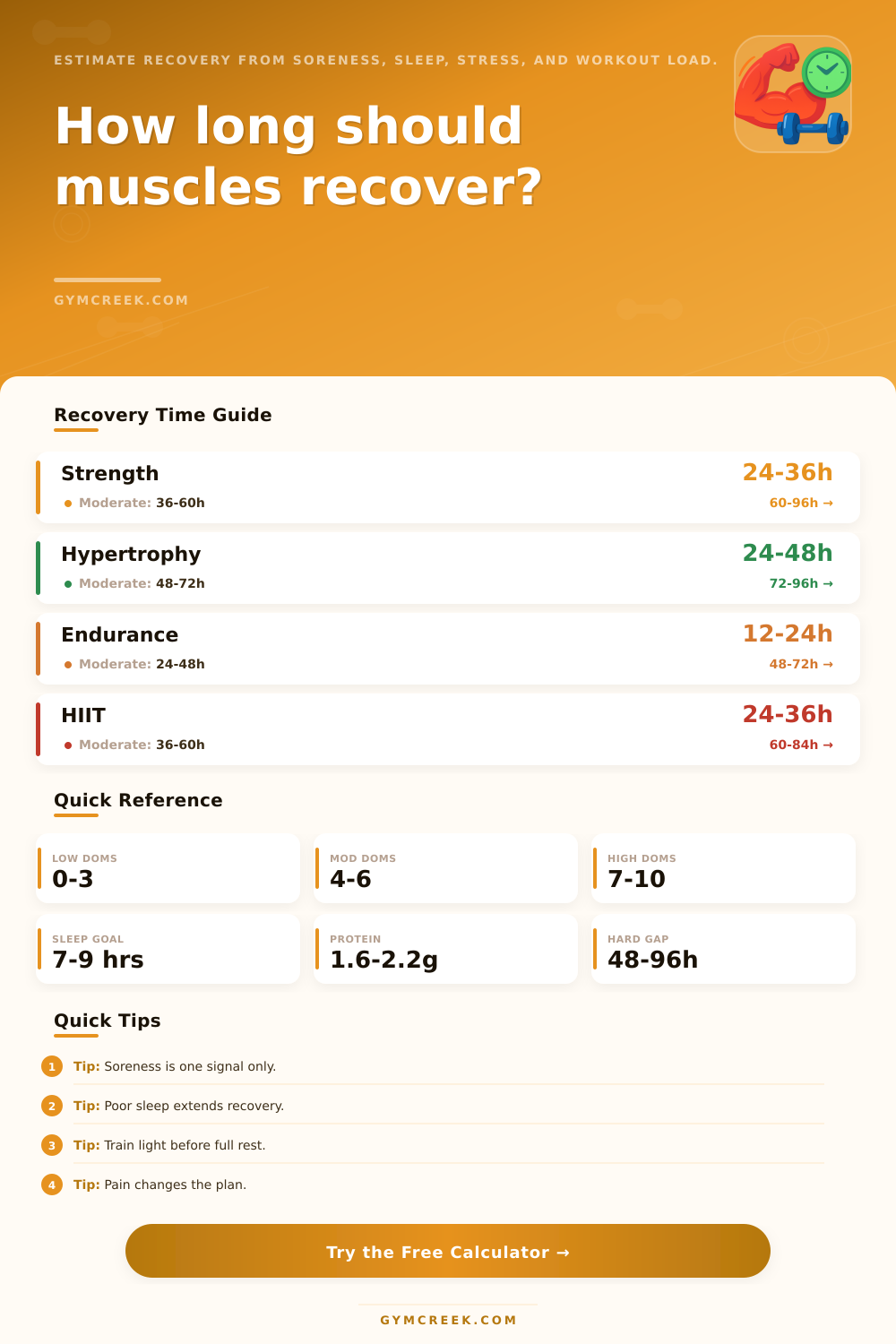
| Heavy strength | 24-36 hours | 36-60 hours | 60-96 hours |
| Hypertrophy volume | 24-48 hours | 48-72 hours | 72-96 hours |
| Endurance cardio | 12-24 hours | 24-48 hours | 48-72 hours |
| HIIT or metcon | 24-36 hours | 36-60 hours | 60-84 hours |
| Readiness Signal | Green | Caution | Hold Back |
|---|---|---|---|
| Soreness | 0-3 out of 10 | 4-6 out of 10 | 7+ out of 10 |
| Sleep | 7-9 hours | 6-7 hours | Under 6 hours |
| Stress | 0-3 out of 10 | 4-6 out of 10 | 7+ out of 10 |
| Protein | 1.6-2.2 g/kg | 1.2-1.5 g/kg | Under 1.2 g/kg |
| Muscle Group | Examples | Recovery Bias | Watch Point |
|---|---|---|---|
| Small | Arms, calves | Shorter window | Local tendon irritation |
| Medium | Chest, back focus | Average window | Joint soreness |
| Large | Quads, glutes | Longer window | High DOMS and stiffness |
| Full body | Metcon, total lift | Longest window | Systemic fatigue |
| Formula Piece | Variable | Role | Use |
|---|---|---|---|
| Mifflin-St Jeor | BMR | Baseline energy | Body-size context |
| Training stress | RPE x minutes | Workout load | Raises base hours |
| Recovery quality | Sleep, fuel, stress | Modifier | Adjusts readiness |
| Goal threshold | Next session | Intensity cap | Sets safe wait time |
💡Recovery Tips
You’re not realy sore until the day after a tough workout when you wake up feeling like your legs weighs 100 lbs. The question then isn’t “Are my muscles sore?” but rather “Has the tissue I wanted to work on recovered enough to bear an additional realistic load? The gap between being sore and having rebuilt tissue are recovery time. And recovery time depends on far more than just your workout. Both your recovery condition and the stress you placed on yourself is described by inputs that make sense.
The first is workout type, which establish a baseline: an easy endurance run doesn’t tax the body as hard as a heavy strength day. Next up is muscle group size; bigger muscles (like those in your glutes or quads) typically requires more time to settle than smaller ones (such as in your calves). Finally, how hard did you worked? How long were you out there for? The Training Stress Number is the intensity plus the duration. That’s the starting point, and recovery markers then adjusts it.
How to Know When You Are Ready to Train Again
The clever marker is sleep: With less than seven hours, there are simply fewer resources left over for repair and the clock gets stretched. Another signal is soreness, but again, just one of many. If soreness is high, it can hides true readiness, or lingering inflammation that flares up under load. Life outside the gym adds another layer, too: Elevated cortisol slows down the exact same processes that rebuild muscle. In contrast, hydration status and protein intake work in the other direction. If fuel and fluid are adequate, then the repair systems gets to go at closer to full speed; otherwise they has to ration limited resources.
This is where this calculator help. It will do all the math for you if you feed it those variables so you don’t have to estimate what each factor should of bump up/down the overall window. It’ll display a readiness score based off not only on how good your current recovery markers are but how far along you are in the estimated recovery window. This will let you know if the next session goal you’re eyeing is attainable now or if you need to dial back down the target before jumping right in.
The typical mistake here lie in making one variable the deciding factor. For example, you hold off until your soreness fades fully, only to realize you’re still under-recovered due to sleep debt or higher-level life stress. Or you grind through when the calendar indicates it’s time for another hard day, but the tissue never quite catch up. Instead, think of the estimate as a ballpark figure and monitor how comfortable movements are and how well you warm up on the day. If you find the initial sets is unusually hard, it’s likely that you have more recovery time than the estimate accounts for.
There’s yet another wrinkle beyond what the numbers will show: Age and training frequency. As we get older, our recovery capacity generaly slows down a bit, so something that might of felt okay at age 25 might feel harder or take longer to recover from when we’re 45. Similarly, if we train a specific muscle group multiple times per week, it compresses the recovery window, there’s simply no long continuous period where the tissue can begin repairing itself. The calculator provides a good starting point here, but ultimately you still need to gauge how the workout feel as you go.
So what does this mean in practice? Well… The answer is straightforward. Expect the number, but let the training day cues guide you. Train if the number matches your felt experience. And if it doesn’t match, don’t force it to match; instead reduce the number. This ensures gradual advancement without having to back off every time we tried to do too much before our tissue was ready for the next task.