Muscle Recovery Calculator
Estimate your training readiness from sleep, soreness, fatigue, session intensity, stress, hydration, nutrition, and time since your last hard workout.
📌Presets
Presets load realistic recovery profiles, update unit labels, and calculate readiness immediately.
⚙Calculator
Recovery snapshot
Enter your sleep, soreness, fatigue, and session details to estimate training readiness.
📊Recovery Metrics
📑Reference Tables
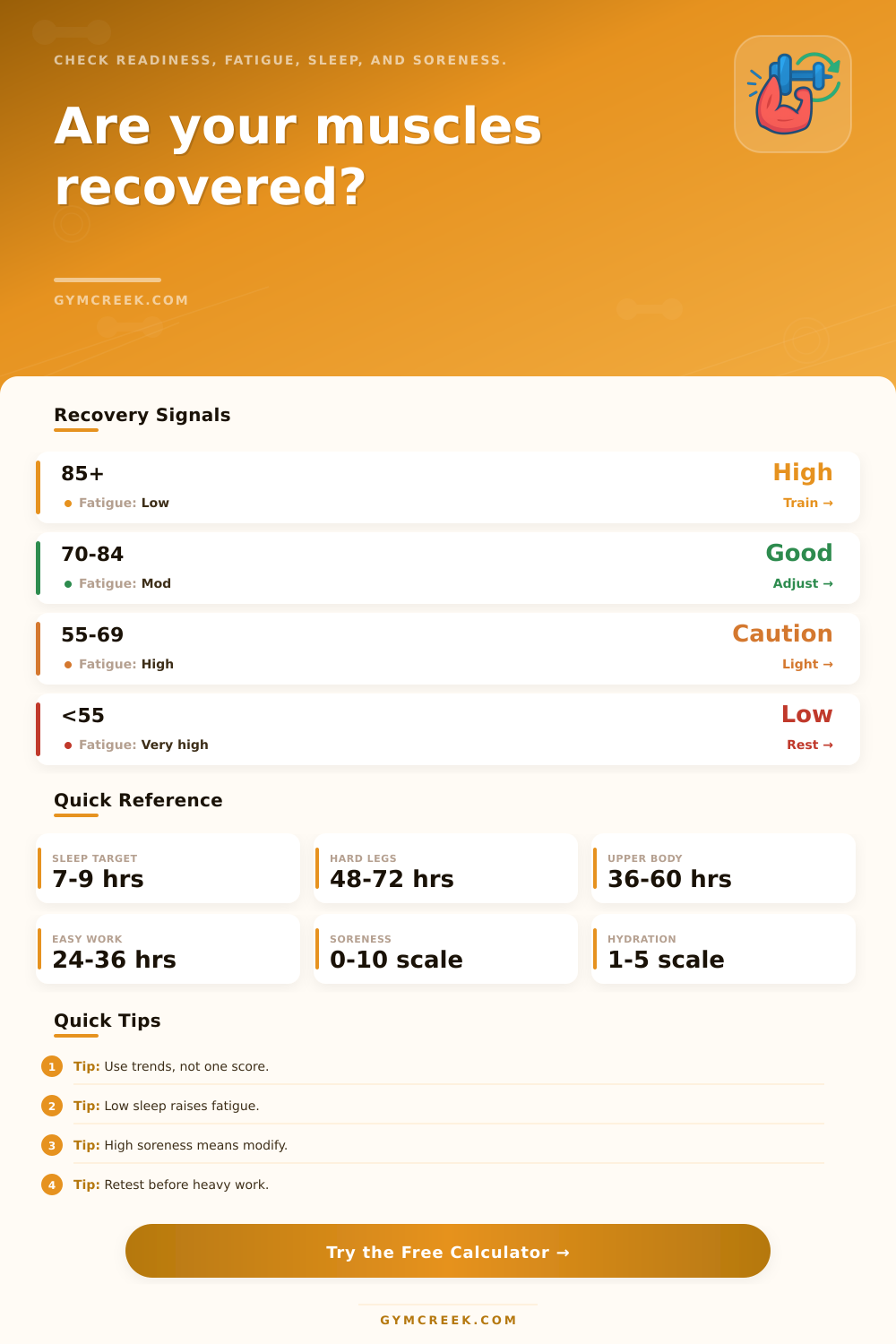
| Readiness | Score | Fatigue | Training Choice |
|---|---|---|---|
| High | 85-100 | Low | Normal hard session |
| Good | 70-84 | Moderate | Trim sets or load |
| Caution | 55-69 | High | Light technique work |
| Low | 0-54 | Very high | Rest or active recovery |
| Training Area | Base Window | Hard Session | Soreness Cue |
|---|---|---|---|
| Legs or glutes | 48 hours | 60-72 hours | Stairs feel slow |
| Back or posterior | 42 hours | 54-72 hours | Bracing feels heavy |
| Chest or push | 36 hours | 48-60 hours | Pressing feels tight |
| Shoulders or arms | 30 hours | 36-48 hours | Warmups ache |
| Full body | 48 hours | 60-84 hours | Whole-body fatigue |
| Conditioning | 24 hours | 36-48 hours | Leg spring is low |
| Signal | Low Risk | Watch | Modify If |
|---|---|---|---|
| Sleep | 7-9 hours | 6-7 hours | Under 6 hours |
| Soreness | 0-3 of 10 | 4-6 of 10 | 7+ of 10 |
| Stress | 1-2 of 5 | 3 of 5 | 4-5 of 5 |
| Energy | 4-5 of 5 | 3 of 5 | 1-2 of 5 |
| Formula Block | Inputs Used | Output | Purpose |
|---|---|---|---|
| Fatigue load | Intensity, volume | 0-100 | Session strain |
| Sleep support | Hours, quality | 0-100 | Recovery backing |
| Soreness drag | DOMS, muscle | Penalty | Local readiness |
| Time credit | Hours elapsed | Credit | Recovery progress |
💡Tips
Plug in your personal information into the calculator above and it do the math for you. Saving you a guesswork game of trying to figure out how fatigued you are beneath surface. You might be all fired up mentally to go heavy on the iron, but oh boy your body will have other ideas. Why? Because muscle remember what they’ve been through, even if our minds crave more.
Building muscle requires taking into account the type of workout, hydration status, nutritional support and quality of sleep we gets. Get that equation correct and you strengthen while not breaking yourself down.
How to Know If Your Body Is Ready to Train
Sleep. How well your nervous system reset depends on it. It’s about not just how many hours you got, but also the quality of that sleep. Sleeping eight hours doesn’t count if, for instance, you woke up every hour. Your body didn’t get into those deep healing phases required for recovery. The tool will capture the hours as well as quality score, giving you a realistic picture of your bodys preparedness.
You may have had a good night’s rest but still feel tired because life stress is high. Stress hormones such as cortisol will gets in the way of muscle repair and keep your system in a state of alertness. That constant background tension can add up over time.
Delayed onset muscle soreness generaly occurs within 24-72 hours after heavy exertion. While it sucks, it isn’t necessarily a sign that something is wrong, as it is often just a sign of inflammation and micro-tears, which are part of building. But when it’s excessive or impacts your range of motion, it can be a sign of other “compensation” injuries down the line, particularly in the chain. This chart below details what kind of localized soreness indicates you should skip the affected area and try another move (and keep the rest of your body moving), which is sometimes the smartest way to avoid the sore spot completly.
The rest of this is built on hydration and nutrition; if you haven’t fueled up sufficiently on those to support the repair process, then you can’t catch back up. Carbohydrates refill your most immediate source of energy (glycogen) for high intensity efforts, while protein supply amino acids required to repair the muscle fibers that has been torn down in training. Without enough of these inputs, your recovery period will be much longer because your body must work harder to simply keep functioning at baseline instead of adapting. This calculator takes both into account along with how long ago you trained.
Keep in mind that time only heals all wounds if you give it the tools to do so. Many falls into the trap of training their ego rather than their physiology, meaning they push past subtle clues of fatigue out of pride to break their own record or reach some arbitrary number on a spreadsheet. The truth is overtraining exists and it sneaks up on you gradually. You could see your resting heart rate start to creep upwards or feel a sudden lack of motivation. That’s when you should listen to your body, and often that means having the discipline to take another rest day even though you don’t want to.
Sitting there feels wrong, yet this leads to your performance rebounding stronger in the long-run.
Active recovery: This doesn’t mean sitting on the couch watching TV all day either; it’s about light movement that will help blood flow but won’t add too much stress to tissues. Some dynamic stretching and a gentle walk will help get rid of some waste from your muscles and loosen up some stiffness. It keeps things moving without using much energy. It acts as a bridge between intense training days and full rest days, helping you stay ready and loose for when you decide to push yourself again. Again, it’s about finding that sweet spot where you can support healing but don’t start another cycle of fatigue.
Bottom line: Fitness is a marathon, not a sprint. Intensity has its place but consistency trumps it all over time. Train hard for three weeks, completely ignore your recovery and burn out. You’ll fall behind faster then the way you would of by training moderately for three months.
Think of this as a tool to help inform your week-long planning, not dictate each individual rep. So take away what you can from the tool and let it show you the trends, helping you understand how your lifestyle choices impact your physical performance. Maybe you recover quicker when you get more sleep. Or maybe your body recovers more slowly if you’re under high-stress. The more you learn about your bodys quirks, the more empowered you are to make informed decisions. And walk into the gym knowing what to expect instead of walking in and being overwhelmed.