Muscle Protein Synthesis Calculator
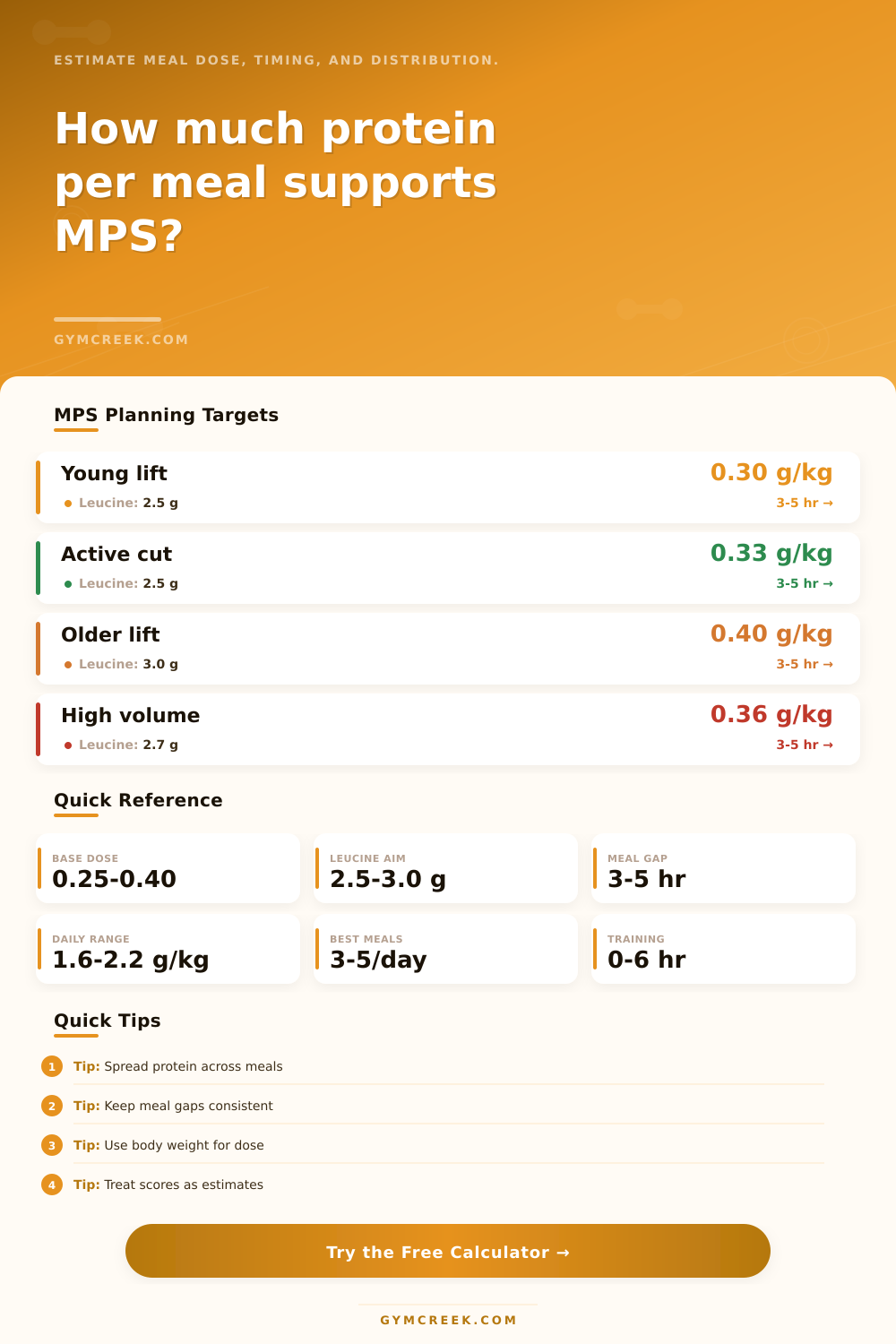
Estimate a per-meal protein target, leucine amount, meal spacing score, and daily protein distribution for lifting-focused nutrition planning.
📌Presets
Each preset fills a realistic lifting nutrition scenario and recalculates the MPS planning score.
⚙Calculator
MPS planning snapshot
Enter a meal and body weight to calculate the protein distribution model.
📊Fitness Metrics
📑Reference Tables
| Scenario | Meal protein | Daily protein | Primary cue |
|---|---|---|---|
| Maintenance lifter | 0.25-0.30 g/kg | 1.6-1.8 g/kg | Even spread |
| Muscle gain block | 0.30-0.36 g/kg | 1.8-2.2 g/kg | Consistent meals |
| Retention cut | 0.33-0.40 g/kg | 2.0-2.4 g/kg | Higher meal dose |
| Older lifter plan | 0.40 g/kg | 1.8-2.2 g/kg | Clear meal dose |
| Meal gap | Score | Use case | Planning note |
|---|---|---|---|
| Under 2.5 hr | 60 | Close meals | May overlap |
| 2.5-5 hr | 100 | Most plans | Good spacing |
| 5-6.5 hr | 85 | Long workday | Still workable |
| Over 6.5 hr | 70 | Long gap | Distribution dips |
| Food pattern | Leucine estimate | Example mix | Calculator use |
|---|---|---|---|
| Egg, dairy, meat | 8.5% | Complete meal | Higher density |
| Mixed omnivore | 8.0% | Meal plate | Default option |
| Grain mixed | 7.3% | Mixed bowl | Moderate density |
| Plant-focused | 6.5% | Legume grain | Lower density |
| Formula | Variables | Output | When used |
|---|---|---|---|
| Meal target | kg x factor | g protein | Per meal dose |
| Leucine | protein x % | g leucine | Meal quality |
| Distribution | daily vs target | 0-100 | Daily spread |
| Mifflin-St Jeor | kg, cm, age | BMR | Energy context |
💡Tips
Remember when you were done with your latest squat session? You were shaking, tired, and ready to eat something. Someone told you to get some protein into your body in under 30 minutes or else you’d risk wasting all that effort. This led to “I better eat now” otherwise I might be too late for my gains!
As it turns out, according to research on muscle protein synthesis, there’s no need to rush. The window is much wider different than we were led to believe, but total daily intake and how you spread it out matter far more than hitting a precise minute mark. What really counts isn’t so much when you eat as how much overall you eat.
How Much Protein to Eat Each Meal
And yet: No need for the clock app to become big. You just need to follow what works based off the basics of biology. Protein doesn’t digest as a continuous flow; it’s absorbed in waves. Every meal initiate the muscle-repair process, but only up to a point. Once that point has been hit, excess amino acids is either stored or used for other purposes (as fuel). This is why the quantity of protein you consume with each meal matter.
Most of us consume the majority of our day’s protein before noon and snack on low-protein foods until bedtime. Long stretches of time result in slowed-down muscle repair. What you want: Triggers every waking hour. If you don’t know whether or not your lunch was enough, use the calculator on this page. It’ll do the math for you based on your body weight.
Leucine is often the missing link in these conversations. This is the switch that turns on muscle building, but various foods has variable amounts of it. You can obtains higher doses with animal proteins such as dairy and eggs. You need less total protein intake to trigger it. With plant-based meals, you’d need to combine carefully, or eat more volume, to get that amount. If you’re on a grain-and-legume diet, then increase your per-meal goal accordingly. Depending on what kind of meal pattern you eat, there will be differences in your estimated leucine amount (reference table). There is a little difference but it is enough to avoid being under-dosed without realizing it.
Similarly, there’s the matter of meal spacing. Try not to go more than 5-6 hours without consuming some form of protein. Going longer then this creates a period of time in which your muscles can’t repair themselves. If you’re an office worker, then your lunch-and-dinner timing might require some careful planning. On the app, it tells you what your spacing score looks like: how close together your meals are on average. The higher the number, the better, that means your spacing keeps a strong signal. The lower the number, the worse, that means you’ve left a gap of opportunity in your day. It is not failure; it is just an opportunity lost.
Protein efficiency also shifts with age. Anabolic resistance occurs as we age, meaning our body respond to these signals a bit less efficient. In general, older lifters require higher amounts of protein per meal to achieve what a younger person achieves with lower amounts. It’s not a penalty, but rather a shift in how the body works that alters baseline requirements. To account for this, the calculator takes age into consideration when setting target ranges. You input your details and it set the bar accordingly.
You don’t get strong in minutes, it’s months of consistent work. Timing helps, yes. But effective delivery trumps all. Take out the guesswork for your meals with these tools. Calculate your dose. Calculate your leucine consumption. Space meals to keep the signal. After that, put your head down and crush some weights. Recover properly. Then worry about feeling hungry post-workout. Because we all do. Now, though, we know what to reach for without obsessing over time.