Workout Calculator to Gain Muscle
Estimate hypertrophy volume, daily calorie surplus, protein target, progression rate, and recovery warning from training age, body weight, target muscle gain, weekly sets, reps, effort, frequency, surplus, and recovery score.
📌Muscle-gain presets
Use presets as starting points, then replace every value with your current weekly plan for one target muscle or muscle group.
⚙Calculator inputs
Hypertrophy volume snapshot
Enter your current plan to estimate volume, nutrition support, progression, and recovery risk.
📊Metrics grid
📘Reference tables
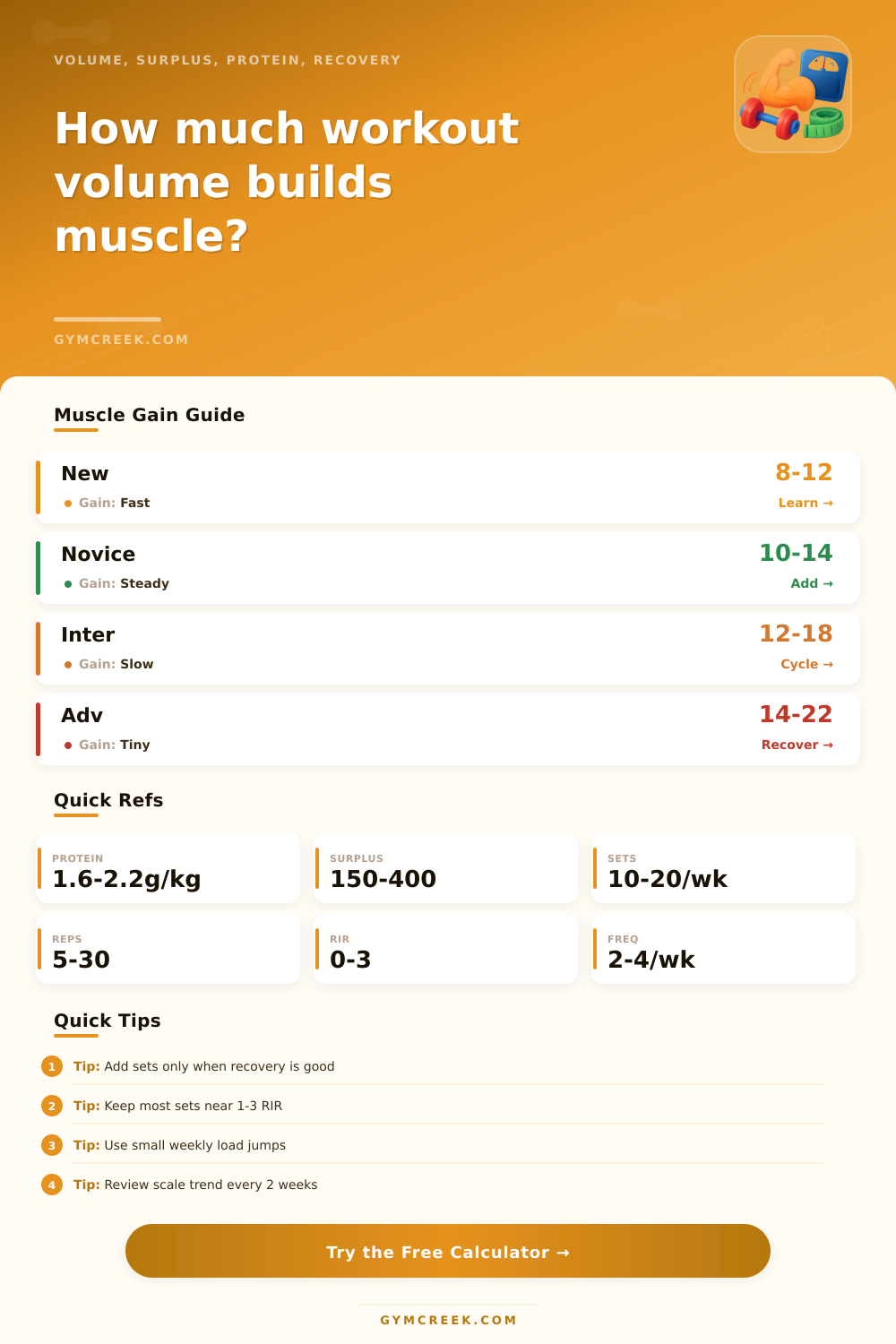
| Training age | Productive range | High caution | Practical cue |
|---|---|---|---|
| 0-6 months | 6 to 12 sets | 16+ sets | Prioritize technique, stable reps, and repeatable effort. |
| 6-24 months | 10 to 16 sets | 20+ sets | Add volume only when loads or reps are still progressing. |
| 2-5 years | 12 to 20 sets | 24+ sets | Use planned volume waves and watch joint feedback. |
| 5+ years | 14 to 22 sets | 26+ sets | Specialize one or two muscles instead of pushing all at once. |
| Goal pace | Daily surplus | Protein | Scale trend |
|---|---|---|---|
| Conservative | 100 to 200 kcal | 1.8 to 2.2 g/kg | Best for intermediate and advanced lifters. |
| Moderate | 200 to 350 kcal | 1.6 to 2.0 g/kg | Good lean-bulk default for most gym-goers. |
| Aggressive | 350 to 500 kcal | 1.6 to 1.9 g/kg | Useful for lean beginners with fast performance gains. |
| Too fast | 500+ kcal | Keep steady | Higher chance of unnecessary fat gain. |
| Effort | Stimulus | Fatigue | Best use |
|---|---|---|---|
| 3 RIR / RPE 7 | Moderate | Low | Early block work, new exercises, and high-frequency plans. |
| 2 RIR / RPE 8 | High | Moderate | Default hypertrophy target for repeatable hard training. |
| 1 RIR / RPE 9 | Very high | High | Later block work or fewer sets per session. |
| 0 RIR / RPE 10 | Peak | Very high | Use sparingly on safer movements, not every set. |
| Scenario | Load jump | Rep target | Adjustment |
|---|---|---|---|
| New or novice | 2.5% to 5% | Add 1 to 2 reps | Progress when all sets hit the top of the rep range. |
| Intermediate | 1% to 2.5% | Add 1 rep | Use double progression and hold form constant. |
| Advanced | 0.5% to 1% | Add reps slowly | Progress one lift, angle, or muscle priority at a time. |
| Recovery warning | Hold load | Hold or reduce | Deload 20% to 40% volume if performance drops. |
✅Muscle-gain tips
Building muscle require three specific process. These three processes includes stressing the muscle tissue, feeding the muscle tissue, and allowing the muscle tissue to recover. Many peoples succeed at two out of the three processes.
Because of this, many people dont see any changes in there muscle mass. Some people may include the stressing of the muscle tissue through training but fail to feeding the muscle tissue with proper nutrition. Other individuals may consistently feed their muscle tissue with a proper nutrition but fail to provide enough stress for their muscle tissue through training.
Three Steps to Build Muscle
As a result of failing to balance these three processes, those individual do not see any progress in their muscle mass over time. The calculator above allow an individual to define each of the variables in the muscle building process to help that individual close the gap between their training and their results. For example, an individual can define their training age so that the calculator can determine the rate at which they will produce muscle growths.
An individual’s body weight and their target weight gain will allow the calculator to determine the size of the caloric surplus that they should consume each day to gain that muscle without gaining body fat. An individual can enter the number of sets, reps, effort, and frequency that an individual perform during the week into the calculator to allow the calculator to determine if the muscle stress that they place on their muscles is appropriately to the other variables in the calculation. Additionally, the recovery score for an individual can help to determine if an individual is creating too much fatigue for their body to clear.
If an individual ignores their recovery score until they begin to decline in their performance, the calculator can help to indicate if their training is too intense for their body. Finally, the reference tables allows an individual to understand the values of each of the variables produced by the calculator. However, the reference tables do not allow an individual to determine the exact value of each variable.
These tables will allow an individual to understand how the variables interacts with one another. For instance, the tables can display how volume ranges become more productively as an individual gains more training experience. These tables will reflect an individual’s body weight and target weight gain to allow an individual to understand their target body weight.
An individual should not attempt to reach the middle of every range for their variable at the same time. Instead, an individual should use these tables to understand where their current training variables are in comparison than their goals. The calculator will allow an individual to understand each of these variables and provide an individual with a target for their training.
However, the output of the calculator is just a checkpoint in an individual’s training plan. For instance, if the calculator indicates that an individual has high volume and low recovery, the individual may keep their current number of weekly sets for two weeks to see if their reps and soreness decreases. Additionally, if the calculator outputs that an individual requires an aggressive caloric surplus but their target body weight gain is small, the individual may reduce the surplus that they consume each day to allow their body weight to increase at a smaller rate.
Thus, small changes is easier to recognize than large changes in an individual’s body weight. Furthermore, if an individual use the calculator repeatedly over time, they can track their performance. For instance, after training for several week an individual can return to the calculator to determine the difference between the predicted rate at which they will gain muscle and the actual rate at which that individual did gain muscle.
This gap between the predicted and actual number of sets allow an individual to shorten the distance between their training intention and their actual physical results.