Calorie Surplus for Muscle Gain Calculator
Set a muscle-gain surplus from training age, body composition, hypertrophy volume, target gain rate, maintenance calories, protein, and recovery score.
📌Muscle-Gain Presets
Presets load lifting-specific lean-bulk scenarios. This calculator is not a generic surplus tool; it checks whether the planned gain rate is supported by training age, sets, protein, and recovery.
⚙Calculator Inputs
Muscle-gain surplus snapshot
Enter your training profile to estimate a lean-bulk target.
📊Muscle-Gain Metrics
📑Reference Tables
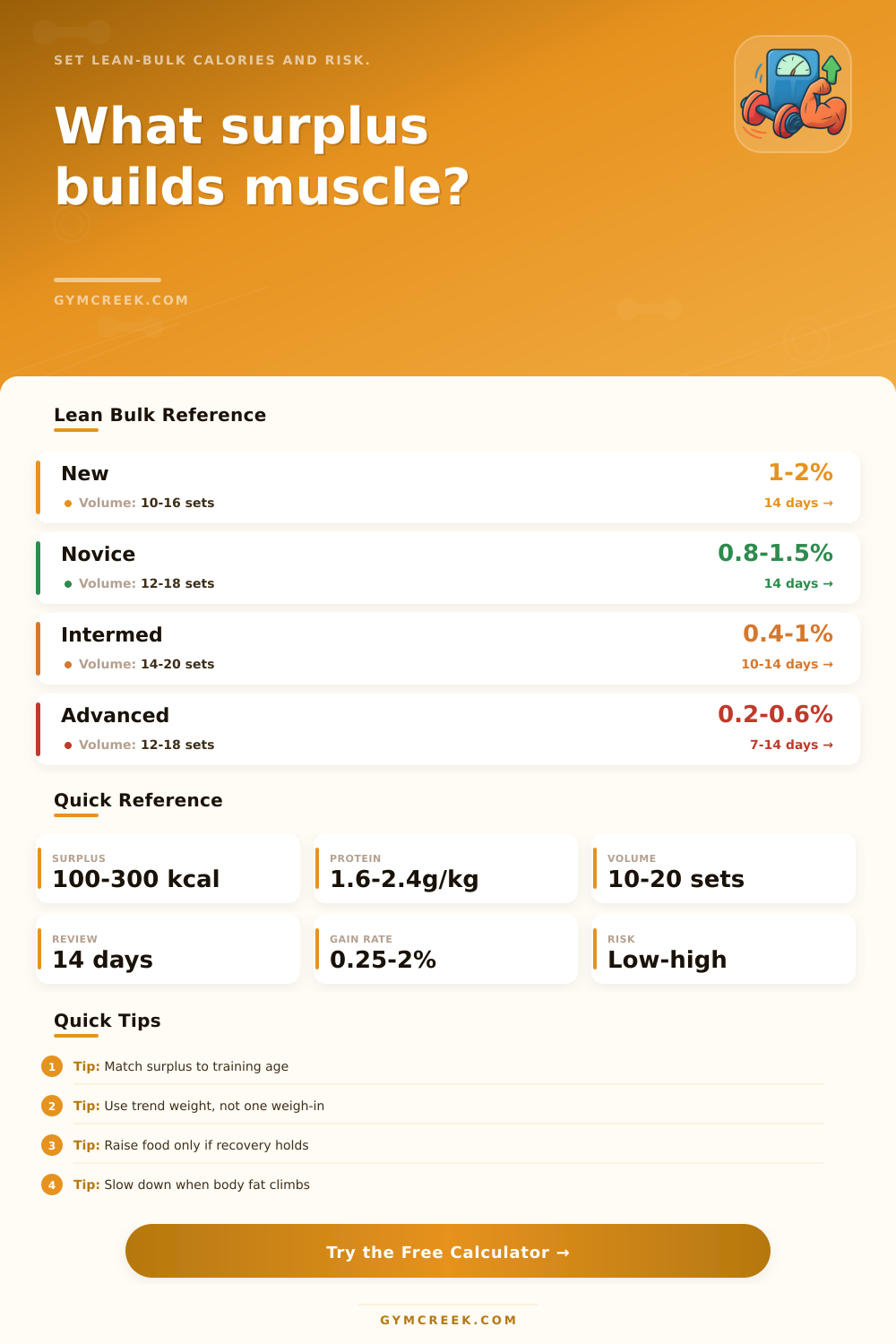
| Training age | Typical monthly gain | Surplus cue | Risk cue |
|---|---|---|---|
| 0 to 1 year | 1.0% to 2.0% body weight | Can use a larger lean surplus | Watch technique and consistency |
| 1 to 2 years | 0.8% to 1.5% body weight | Moderate surplus usually fits | Keep weekly trend controlled |
| 2 to 4 years | 0.4% to 1.0% body weight | Small surplus is often enough | Fast gain can add fat quickly |
| 4+ years | 0.2% to 0.6% body weight | Use tight surplus checks | Recovery and volume matter most |
| Weekly sets | Volume status | Surplus interpretation | Adjustment signal |
|---|---|---|---|
| 0 to 7 | Low | Surplus may outpace stimulus | Add sets before adding calories |
| 8 to 11 | Base | Works for newer or small blocks | Review performance weekly |
| 12 to 20 | Productive | Best match for most lean bulks | Hold calories if lifts progress |
| 21 to 28 | High | Needs strong recovery | Deload if performance falls |
| 29+ | Very high | More food may not fix fatigue | Trim volume if recovery drops |
| Input | Useful range | Calculator treatment | Lean-bulk note |
|---|---|---|---|
| Protein | 1.6 to 2.4 g/kg | Below range raises risk | Most lifters do not need more |
| Body fat | About 10% to 20% men | Higher values lower ceiling | Use a slower gain rate when high |
| Body fat | About 18% to 28% women | Same risk scoring, not diagnosis | Trend changes beat single reads |
| Recovery | 70+ score | Supports full surplus | Low recovery shortens cadence |
| Risk band | Cadence | Raise calories when | Lower calories when |
|---|---|---|---|
| Low | Every 21 days | Weight is flat and lifts stall | Waist climbs faster than lifts |
| Moderate | Every 14 days | Trend is under the gain range | Trend exceeds the gain range |
| Elevated | Every 10 days | Recovery and volume are strong | Gain is fast for training age |
| High | Every 7 days | Only after trend confirms need | Fatigue or body fat climbs |
💡Tips
A persons may desire to increase their muscle masses while maintaining their body fat. The amount of food that a person eat is not the only consideration in developing a plan for increasing muscle mass. The amount of food that an individual should consume will depend upon the body’s needs at any given time.
Factors such as training age, body fat percentage, the amount of work that an individual perform in the gym, and the quality of recovery will all play into the determination of the amount of food that each individual should consume to maximize muscle mass increases. For instance, the caloric surplus require to increase muscle mass in the first month of training may lead to increases in body fat after four month of training, as the body has changed and adapted to the training protocol. One tool that can assist an individual in determining the target calories and weight gain ranges for each individual is a structured calculator.
Find the Right Calories to Gain Muscle
A guess as to the amount of calories that an individual should consume will not take into account the various factors that influences the amount of calories that each individual should consume. An individual must enter the training age of an individual into the calculator, as an individual that has trained for eight months will have different requirements than an individual with eight years of training. The individual must also enter an individuals body fat percentage into the calculator, as an individual with a higher percentage of body fat will have more stored energy within their system.
An individual must enter the number of hard set that an individual performs each week into the calculator, as an individual with low levels of gym workouts will need more calories to promote muscle gain than an individual performing high volume of gym workouts. Recovery is another variable that should be entered into the calculator, as the amount of recovery will influence the ability of extra calories to become muscle rather than extra load upon the body. While sleep, stress, and joint soreness is components of recovery, they are not variables that can be measured on a scale.
The calculator will display the level of risk of overtraining with a suggested risk score, indicating whether the suggested training program is aggressive, moderate, or near the limit of an individual’s capabilities. Furthermore, the risk score will suggest how often the individual’s weight should be measured and how often the individual should adjust the calories to ensure that the surplus of calories is not left untouched for many month. Tables is provided within the calculator to assist individuals in understanding the amount of weight that they can gain.
For instance, the tables indicate that as an individual gains more experience with performing workouts, the rate of muscle gain slow over time. Furthermore, an individual cannot gain muscle at the same rapid rate then during the first year of training. The waist measurements of many individuals increases at a faster rate than their strength increases.
These tables allow the individual to understand these relationship without having to memorize the formulas that indicate these relationship. By running the numbers for each individual through the calculator, that individual can determine their priority within their training. For instance, some nutrition block may require leaner bodies, other require increased strength and endurance, and others may be more aggressive in their suggestions for gaining body mass if the body fat percentage is low.
While the calculator will not indicate what the individual’s priority within training should be, it will provide recommendations for what each individual’s body may require based off their stats and training goal. Furthermore, the individual may feel pressured to increase the calories consumed by the individual if the individual feel that their workouts with weights have been easy. The calculator will help an individual to understand such suggestion.
An individual should treat the caloric surplus with an understanding that it may change over time. By weighing the individual each morning, ignoring daily fluctuation in body weight, and calculating the average body weight of the individual over a seven day period, an individual can determine whether the calories should be increased. If the seven day average weight is below the targeted range, but the strength of the individual is stable, the individual should increase the calories slight.
If the average body weight is near the targeted range, but the waist measurements or fatigue of the individual is increasing, the calories should be held. These targets will provide a starting point for the individual’s caloric surplus, but the individual should watch the body over a two to three week period to determine if any change in calories are necessary. By repeating these steps, an individual can better ensure that the caloric surplus lead to increased muscle mass rather than weight.