Muscle Building Potential Calculator
Estimate current lean mass, frame-adjusted natural muscle potential, target scale weight, and a realistic lean-gain pace using body size, bone structure, body fat, and training age.
📌Muscle Potential Presets
Presets change sex, frame measurements, current body fat, training age, activity, and target leanness so the ceiling estimate moves for realistic reasons.
⚙Calculator
Muscle potential snapshot
Enter body size, frame measurements, body fat, and training history to estimate your current and remaining lean-mass range.
📊Fitness Metrics
📑Reference Tables
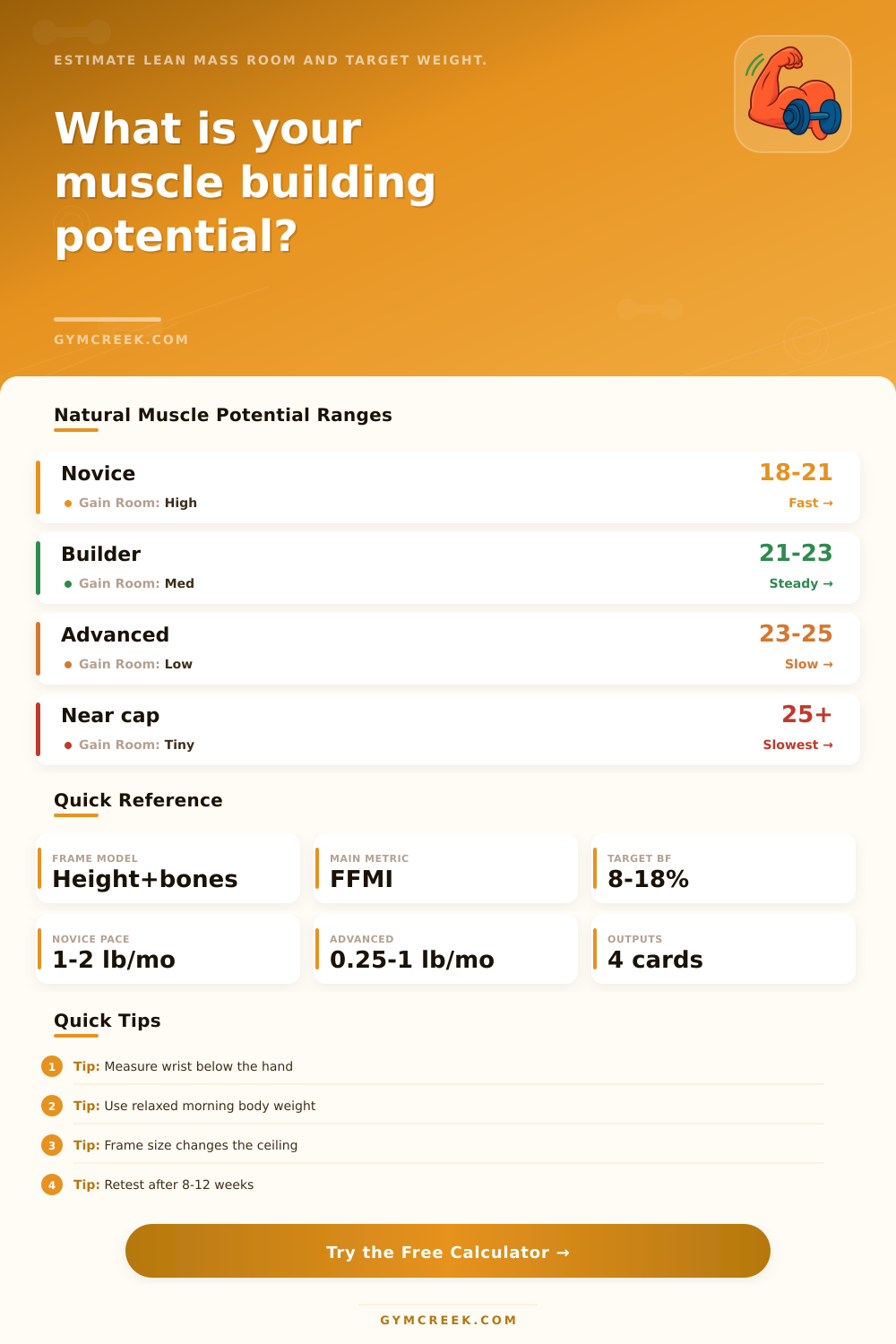
| Adjusted FFMI | Training read | Gain room | What to compare |
|---|---|---|---|
| Under 19 | Novice or lighter frame | Usually high | Lean mass trend |
| 19 to 21 | Developing muscularity | High to medium | Photos and strength |
| 21 to 23 | Solid intermediate | Medium | Waist and lifts |
| 23 to 25 | Advanced natural range | Low | Slow yearly change |
| 25+ | Near model ceiling | Very low | Measurement error |
| Training age | Male monthly gain | Female monthly gain | Typical note |
|---|---|---|---|
| 0 to 6 months | 1.5 to 2.2 lb | 0.8 to 1.3 lb | Fastest adaptation |
| 6 to 18 months | 1.0 to 1.6 lb | 0.5 to 1.0 lb | Steady novice |
| 2 years | 0.6 to 1.0 lb | 0.3 to 0.6 lb | Intermediate |
| 3 years | 0.3 to 0.6 lb | 0.2 to 0.4 lb | Advanced |
| 4+ years | 0.15 to 0.35 lb | 0.1 to 0.25 lb | Near ceiling |
| Scenario | Likely output | Watch item | Useful retest |
|---|---|---|---|
| New lifter | Large room | Body fat input | 8 to 12 weeks |
| Lean beginner | High FFMI room | Scale noise | Monthly average |
| Intermediate bulk | Moderate room | Waist gain | Training block |
| Advanced cut | Small room | Lean mass loss | After diet |
| Masters return | Frame room may remain | Recovery pace | 12 week trend |
| Formula | Inputs | Purpose | Output |
|---|---|---|---|
| Lean mass | Weight and BF% | Current base | Fat-free mass |
| FFMI | Lean mass and height | Muscularity index | kg per m² |
| Adj FFMI | FFMI and height | Height-normalized read | Comparable score |
| Frame model | Height, wrist, ankle | Potential estimate | Max lean mass |
| Mifflin-St Jeor | Age, sex, size | Calorie context | BMR and TDEE |
💡Tips
Muscle building potential is determine by several different factors beyond the amount of effort that a person put into training. A person’s physical structure, their recovery capacity, and the amount of time that they have trained already all play a role in their muscle building potential. A person’s height, wrist measurement, and ankle measurements are all a measurement of the size of there skeleton.
The size of a persons bone has a direct impact upon the amount of muscle that they can develop. Wider bones allow for the development of more muscle before the joint become uncomforatble, whereas narrower bones reach the limit of the amount of muscle that can be developed in that individual sooner. The body fat percentage of an individual also impact how that individual tracks their muscle growth.
What Affects Your Muscle Growth
The muscle mass of an individual is one component of the body weight of that individual. The scale weight of an individual is the combination of their muscle mass and their body fat weight. Because body fat weight is combined with muscle mass, the body fat weight of an individual can provide an unclar reading of their muscle mass growth.
By measuring their body fat percentage, an individual can separate their muscle mass from their body fat weight. Knowing these two components allow for an individual to decide whether to aim for slow lean gain in muscle mass, to focus on body recomposition, or to shift the focus towards fat loss. The training age of an individual also impacts their muscle building potential.
New trainees sees the fastest rate of muscle growth during the first six to eighteen month of training. After training for two or three years, an individual will find that the same training stimulus will provide more smaller gains in muscle mass for that individual over time. The muscle growth calculator also takes into account the training age of an individual to determine how much muscle an individual can still build.
Age is another factor that impacts the ability of an individual to gain muscle. An individual’s recovery capacity dont suddenly disappear as they age, but it does decline gradually over time. An individual who is forty years of age can still gain muscle mass as they age.
However, the rate at which they will build muscle will be slower then an individual who is twenty-five years of age. The difference in age will be seen in the length of time that an individual will take to recover from intense training session. As the ability to recover from intense training declines with age, an individual can plan their training to allow for adequate recovery to occur.
The table to the right categorize different types of lifter based off their measurements. Novice lifters have high amounts of potential for muscle gains. As they begin to gain muscle, their potential to gain muscle decreases.
Advanced lifters who have trained for many years will have a low potential remaining for muscle gains because those individuals have spent several years training to reach their current level of muscle mass. Most individuals will fall into the middle category based on their training experience. Seeing where an individual falls within these categories allow for the individual to understand their potential gains in muscle.
An individual should not treat the measurement of muscle gain as a fixed number. Body fat measurements may change due to hydration and glycogen level in the body. Frame measurement may change based on the placement of the measuring tape.
The purpose of these calculations is to create a reasonable range of weights for an individual to expect for their muscle gains. Depending on an individual’s training goal, their rate of muscle gains will change. An individual who chooses to perform a bulk training with a large calorie surplus will experience faster scale reading.
However, muscle bulk gains will lead to an increase in body fat. An individual who chooses body recomposition will maintain their body fat level but will experience slower gains in muscle mass that will be visible. These goal can be modified in the calculator to show the impact that each training goal will have upon muscle gains.
Small adjustment to a persons frame measurements will impact the ceiling for their muscle gains. An adjustment of a quarter of an inch to an individual’s wrist measurements will alter the ceiling that their body can create in relation to their muscle gains. An individual should retest their body fat and frame measurement every eight to twelve week.
Retesting every eight to twelve weeks will allow for the individual to recognize any changes to their body fat or wrist measurements, which will change their measurement of the amount of muscle that they have left to gain. Regularly measuring an individual’s muscle gains will allow for them to determine if their training plan is working. If the individual’s muscle mass increase, then their training plan is working.
If muscle mass and body fat both decrease in the plan of training, then adjustment need to be made to that training plan. Using the data from these measurements, an individual can determine the amount of muscle gains that they have left, and how long it will take to utilize that muscle gain potential.