Muay Thai Calorie Calculator
Estimate calories burned during Muay Thai training from body weight, round structure, session style, strike rate, clinch load, kick volume, rest, and training environment.
📌Presets
Each preset loads a realistic Muay Thai profile and recalculates the energy estimate immediately.
⚙Calculator
Muay Thai calorie snapshot
Enter session structure and intensity to estimate total Muay Thai calories.
📊Fitness Metrics
🧮Formula Cards
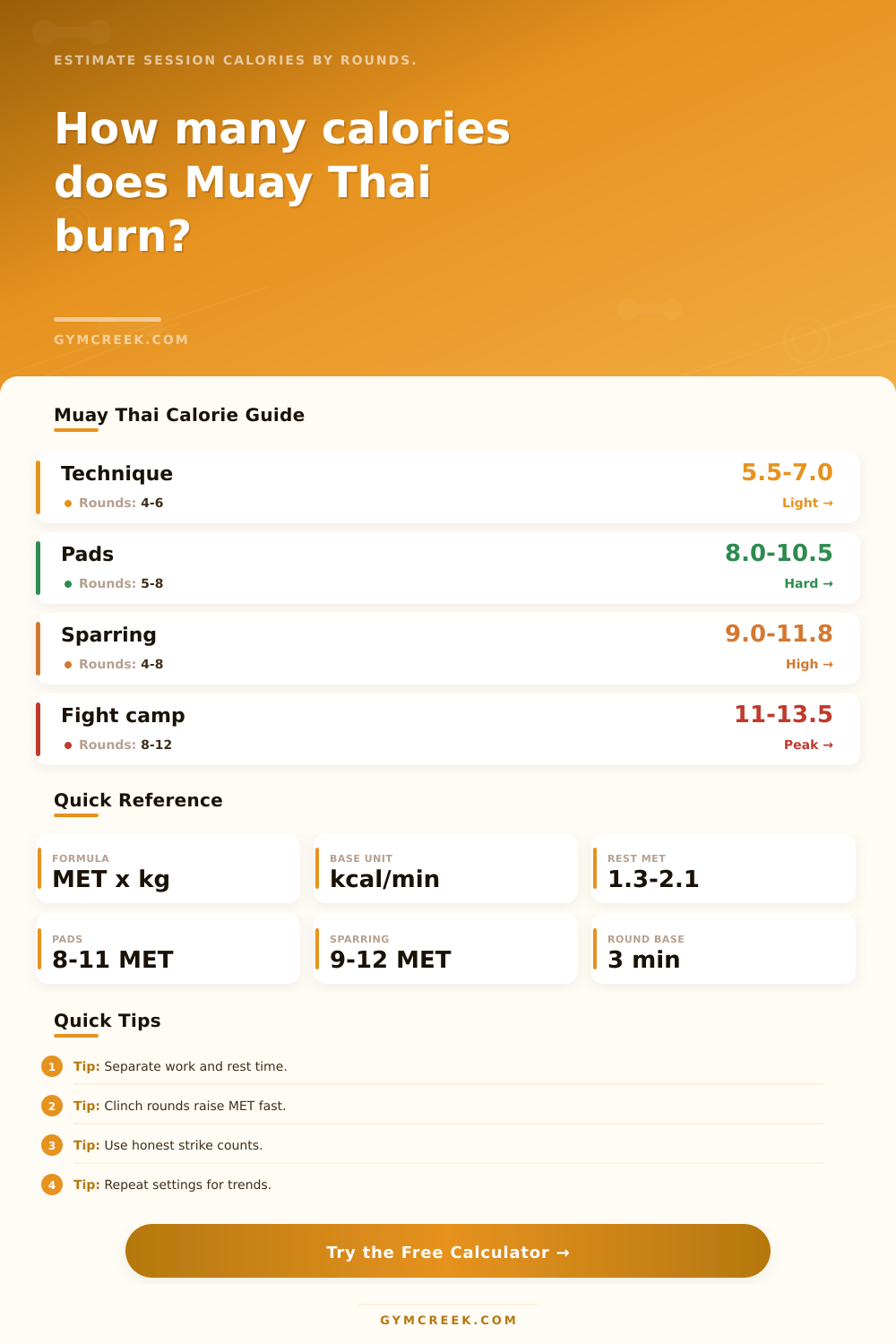
Calories per minute = MET x 3.5 x body weight in kg / 200. This converts the adjusted Muay Thai workload into active energy.
Base MET comes from session type and intensity, then strike rate, clinch share, kick share, partner resistance, and heat modify it.
Work calories use adjusted MET, rest uses recovery MET, and high-intensity sessions receive a small post-session carryover estimate.
Mifflin-St Jeor estimates BMR from weight, height, age, and gender; the selected activity multiplier turns it into TDEE context.
📑Reference Tables
| Session Type | Easy | Steady | Hard |
|---|---|---|---|
| Technique drilling | 4.8 MET | 6.0 MET | 7.2 MET |
| Bag and kick work | 6.0 MET | 8.2 MET | 10.4 MET |
| Pad work | 6.8 MET | 9.0 MET | 11.0 MET |
| Clinch rounds | 7.2 MET | 9.8 MET | 11.8 MET |
| Sparring | 6.8 MET | 9.6 MET | 11.6 MET |
| Fight camp simulation | 8.0 MET | 11.0 MET | 13.0 MET |
| Round Setup | Work | Rest | Best Match |
|---|---|---|---|
| Skill block | 5 x 2 min | 90 sec | Beginners |
| Class rounds | 8 x 3 min | 60 sec | Fitness class |
| Pad rounds | 6 x 4 min | 60 sec | Pad work |
| Fight camp | 10 x 3 min | 45 sec | Conditioning |
| Shark tank | 12 x 3 min | 30 sec | Peak load |
| Training Detail | Low | Moderate | High |
|---|---|---|---|
| Strike rate | Under 40/min | 40-89/min | 90+/min |
| Clinch share | 0-10% | 11-30% | 31%+ |
| Kicks and knees | 0-25% | 26-50% | 51%+ |
| Partner pressure | Solo work | Normal pads | Hard rounds |
| Formula | Variables | Output | When Used |
|---|---|---|---|
| MET kcal | MET, kg, min | Calories | Main burn |
| Rest kcal | Rest MET, kg | Break burn | Between rounds |
| Mifflin BMR | kg, cm, age | Baseline | Daily context |
| TDEE share | Calories, TDEE | Percent | Session size |
| Load score | MET, time | 0-100 | Training load |
💡Tips
Most people treat Muay Thai like it’s just a simple calorie deficit issue. Every time you hit the mats, you deliver some hard kicks. Every time you sweat, you think it’s burning fat off your body. More often than not, nope.
Energy expenditure in Muay Thai varies. It’s volatile. How much energy you burn during training depend on how hard you train and how well your partner resist you. It also depends on whether you’re striking or clinching, as both have different energy costs.
How to Burn More Calories in Muay Thai
There should be a clear line between when you’re resting and working. Moving with purpose vs. Standing around make all the difference. Enter variables in the calculator above. It will do the math for you. It divides your sessions into recovery and active work.
Why? Because resting at a lower metabolic rate reduces average burn. Resting at a low metabolic rate between round drastically lowers your average burn compared to continuous cardio. Your choice of session determine your baseline level of effort.
Gentle techniques put less strain on the brain and nerves. Calories burned? Yes they do. But they don’t spike it. Pad work does. Pad work is faster paced and has more purpose than technique drills.
Sparring also increase your heart rate even when you aren’t being physically active, it adds mental strain on top of the other factors. Most generic fitness tracker miss this completely.
The most important factor here is body weight. Heavier = harder to move. To allow for this, tool takes into account your bodyweight and scales result accordingly. It also includes unique dynamics of your round.
How much time are you spending clinched? Clinching is an isometric grind. It’s hard work recruiting big muscle just to maintain posture. You might get very few strikes. What does the tool do with that? Apply a modifier to base metabolic equivalent. It essentially acknowledges that grappling can be even tougher than striking in terms of pure fatigue.
Another key input is rate of strikes. In theory, this sounds great: Seventy strikes a minute. But quality trumps quantity. You can adjust based on how much resistance your partner give you.
Striking a heavy bag is much tougher then shadow boxing against thin air. And it’s even tougher pushing back against a pad holder who is actively fighting your motion. He adds resistance that increase the physical work done with each strike. Think of it as punching through a wall versus just waving your arms around.
Your environment does matter, too, though it’s a less significant factor. You train in a warm room? That means your body has to work harder to regulate its temperature. You wear all your gear? You’re still more thermoregulatorily stressed. Your body has to expend additional energy cooling off.
The calculator takes small multiplier into account. It’s marginal. But those marginal gains add up, and they make a noticeable difference across twelve rounds of fight camp volume.
But how do you interpret the output? Interpret it as a guide to your training load. Your hunger is NOT the only thing you should of considered. When the tool indicate a high systemic demand with a high calorie burn, it means you should fuel accordingly. Ignore the recovery cost, and you risk burning out. Ignore the recovery cost, and you risk getting injured.
The page has reference tables that help put numbers in context. They tell you what sort of calories to expect based off your style of training. They tell you that a high level fight camp session and a beginner technique class involve two very different metabolic worlds.
Athletes underestimate how hard they’re working most of the time. They believe hard just means hard. Sparring hard is not the same as hard technique work. The former build power and endurance, while the latter builds skill.
If you know what it realy costs you, then you can better plan out your training week. You may discover you need to take more rest days because three intense sparring session are excessive. Or maybe you find out that those conditioning classes are far more demanding than your pad work.
“Burn more calories? Sure, that’s a side effect. But it’s also not the point. The point is to train smarter. When you know how much energy (i.e., energy used) each session require, you can dial in your effort-recovery ratio.
No more blind training. Now we’re training with data. And that changes everything. The sweat is the same. The result is better.