MTB Crank Arm Length Calculator
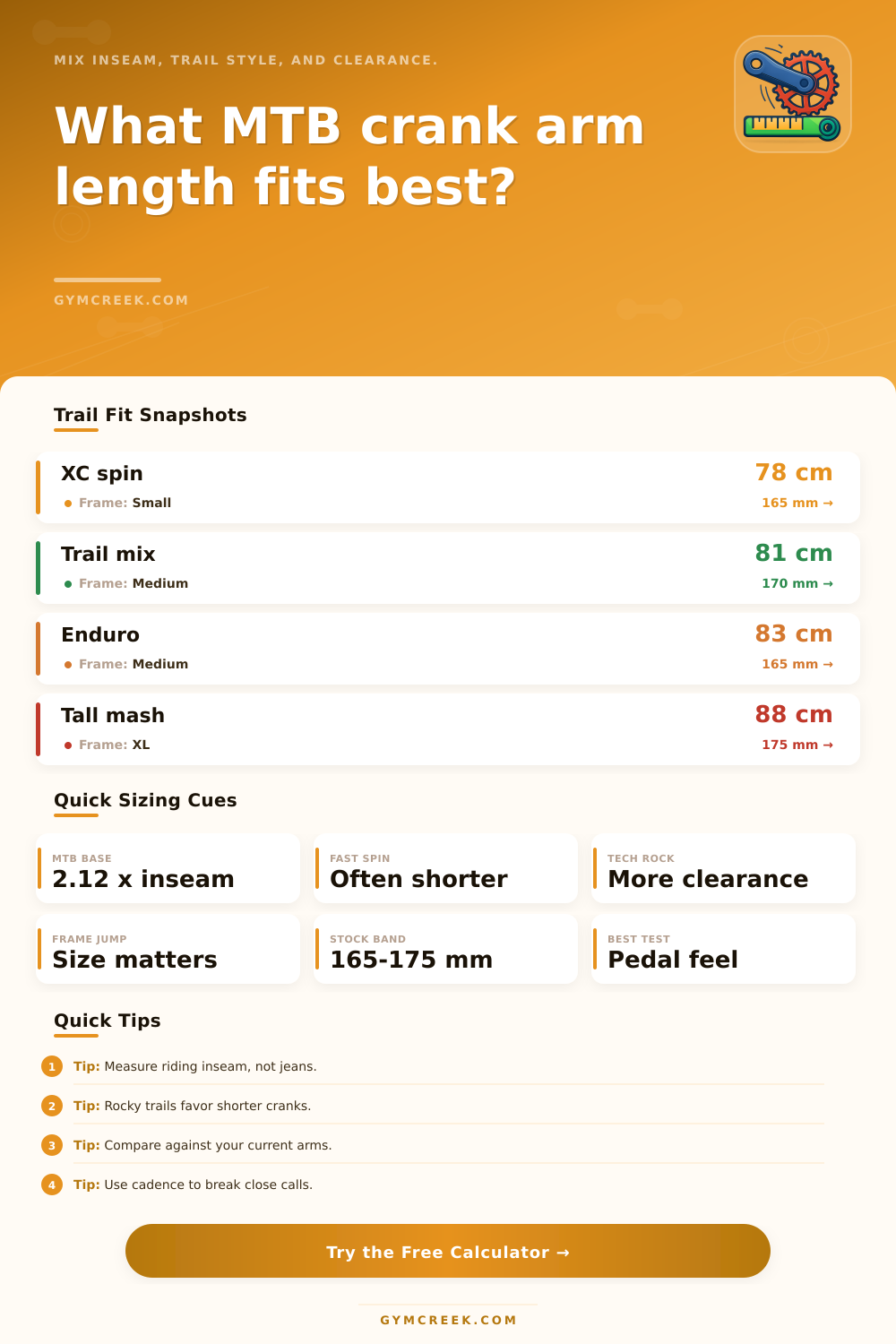
Start with inseam, then var frame bracket, terrain roughness, cadence, and ground-clearance priorities pull the result toward a crank length that makes sense for real mountain bike pedaling.
Trail-Ready Presets
These presets cover cross-country, trail, enduro, bike-park, and long-leg builds so the calculator feels grounded in real MTB sizing decisions instead of generic road-bike assumptions.
MTB Sizing Inputs
MTB crank recommendation
Enter rider details to estimate a practical mountain bike crank length.
Crank Metrics Grid
Reference Tables
| Inseam | Baseline | Stock band | Read |
|---|---|---|---|
| 74-78 cm | 157-165 mm | 160-165 mm | Smaller riders usually start short |
| 79-83 cm | 167-176 mm | 165-170 mm | Most medium trail bikes live here |
| 84-88 cm | 178-187 mm | 170-175 mm | Taller legs still get capped by terrain |
| 89-93 cm | 189-197 mm | 175-177.5 mm | Long leverage exists, but strike risk matters |
| Terrain | Bias | Main reason | Typical call |
|---|---|---|---|
| XC race | 0 mm | Efficiency first | Stay near base |
| Downcountry | -2.5 mm | Faster trail cadence | Slight trim |
| Mixed trail | -5 mm | Roots and timing errors | Shorter is common |
| Enduro | -7.5 mm | Clearance on steep tech | Noticeably shorter |
| Bike park | -5 mm | Body movement and chunk | Short with control |
| Marathon | +2.5 mm | Long seated torque | Stay long if clear |
| Context | Shorter cue | Longer cue | Why |
|---|---|---|---|
| Cadence | 92+ rpm | Below 78 rpm | Fast circles reward easier leg travel |
| Pedaling style | Spinner | Masher | Torque riders often accept more lever |
| Tight corners | High priority | Low priority | Short cranks buy timing margin |
| Steep climbs | Line choice | Seated torque | Technique decides the better tradeoff |
| Frame | Bias | Often ships with | Notes |
|---|---|---|---|
| XS | -5 mm | 160-165 mm | Short cockpit fits shorter circles |
| Small | -2.5 mm | 165-170 mm | Shorter riders still need clearance |
| Medium | 0 mm | 170 mm | Most neutral stock setup |
| Large | +2.5 mm | 170-175 mm | Longer lever can feel normal here |
| XL | +5 mm | 175 mm | Tall riders still should check strike risk |
Trail Tips
Crank lengths is another critical component of a mountain bike as it impacts the way that a person interacts with the bike. If the crank arm is too long for that particular mountain bike, for instance, the person may experience pedal strikes. Pedal strike occur when the crank arm or pedal of the mountain bike strikes a rock or root on the ground.
As a result of pedal strike, the bike may wobble, and that wobble may cause the rider to lose there balance. Thus, selecting the correct length for the crank arms is necessary to avoid these problems. One of the first factors that a person should consider is their inseam length.
How to choose the right crank length for your mountain bike
The inseam length is the measurement from the floor to the pubic bone of the person while they are barefoot. The inseam length multiplied by 2.12 will provide the length of a crank arm that a person may require. For example, if a person has a short inseam length, they may require a crank length of 160 or 165 millimeter.
If, however, a person have a long inseam length, they may require a crank length of 175 millimeters. The terrain that a person may ride, however, may impact the length of the crank arms that is selected. For instance, shorter crank arms will provide more ground clearance for rocks and roots, which will prevent the issue related to pedal strike.
The second factor to consider is the size of the mountain bike’s frame. Frames come in a variety of sizes, and the size of that mountain bike will impact the length of the crank arms. For example, if a person owns a bike with a small or compact frame, they may want to selecting a crank arm that is shorter to prevent their knees from contacting the top tube of their mountain bike while descending or climbing steep hills.
Conversely, if a person owns a bike with a larger and extra-large frame, the person may be able to use longer crank arms to provide additional leverage when riding their mountain bike. Along with inseam length, frame size, and terrain type, a person may also consider their pedaling cadence and their pedaling style when determining the length of their desired crank arms. For example, if a person prefers to utilize a high cadence (at or above 90 revolutions per minute), shorter crank arms may reduce fatigue for that individual.
Similarly, if a person prefers to use more torque with their pedals (at or below 75 revolutions per minute), longer crank arms will provide the individual with the leverage that they require for their preferred pedaling style. A person can also consider their equipments. For instance, if a person uses shoes with flat pedals and thick soles, those pedals will be higher off of the ground.
Thus, shorter crank arms would be required for a person that desires to avoid pedal strike. Similarly, if a person uses tires that lower the bottom bracket of their mountain bike, the distance between the pedals and the ground will be less. Thus, the individual with these tire choice will again require shorter crank arms.
Finally, a person should test out each of these different lengths of crank arms while on the trail. The person can check their hip angle while riding their bike down steep hills, and they can check for instances of pedal strike while riding over rocks or roots on the trail. Additionally, the angle of the pedals may impact the angle of the persons saddle, so rechecking the height of the saddle is necessary.
If a person notices any discomfort in their knees while riding, they may want to change to shorter crank arms as this will help to open their hip angle. Thus, testing the length of the crank arms will allow the individual to make sure that the crank arms are the more correct length for their body while also providing ground clearance as necessary.