Calories Burned Mountain Climbers Calculator
Estimate mountain climber calories, contacts per minute, active density, core conditioning score, and weekly burn from your exact set structure.
⚡Mountain Climber Presets
Presets load realistic body weight, contact totals, cadence, duration, set and rest structure, climber style, core tension, intensity, and weekly sessions.
⚙Calculator Inputs
Mountain climber calorie snapshot
Enter your contacts, cadence, and set structure to estimate burn and conditioning load.
📊Metrics Grid
📑Reference Tables
| Climber style | Base MET | Core factor | Best use |
|---|---|---|---|
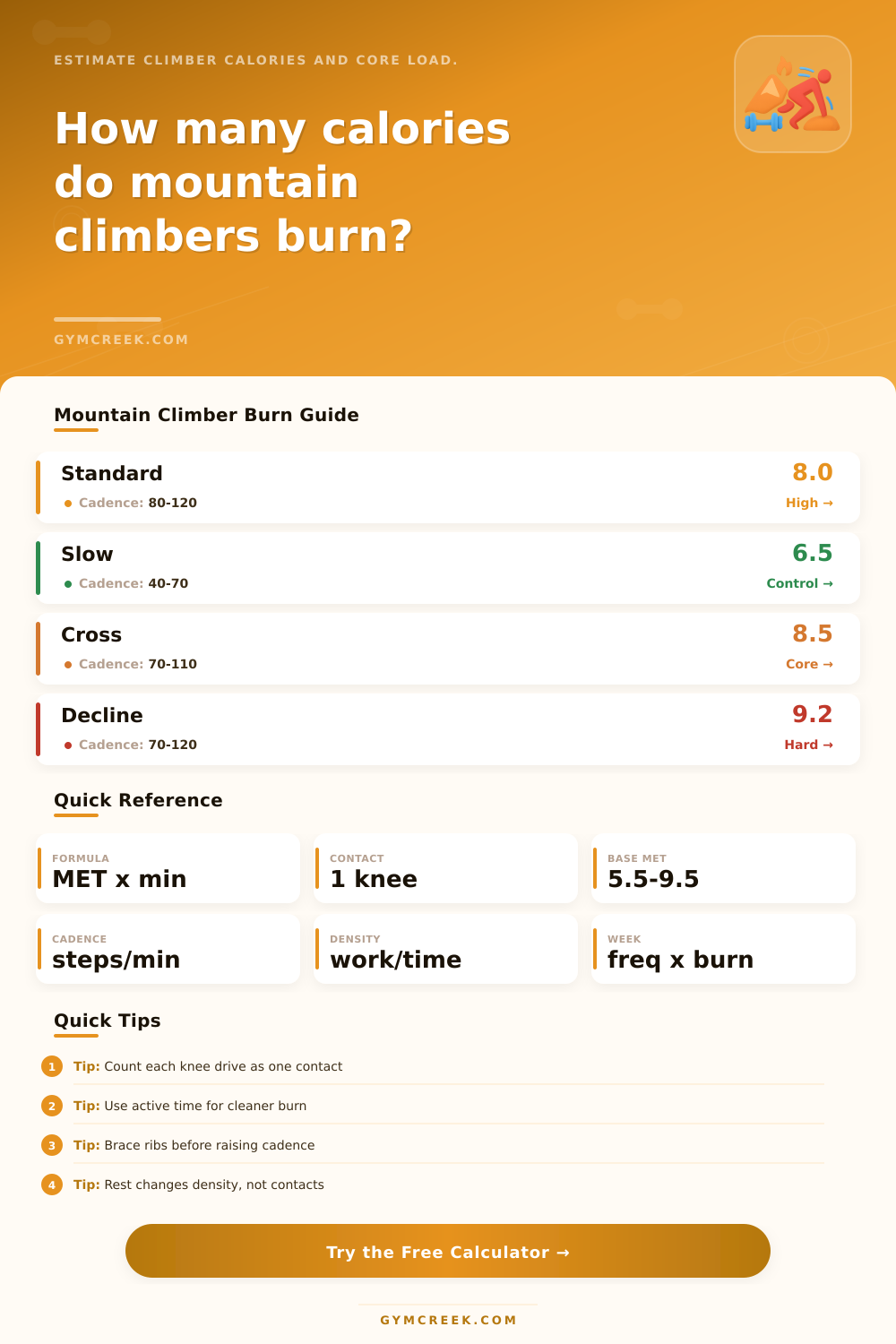
| Standard mountain climber | 8.0 | 1.00 | General conditioning |
| Slow controlled climber | 6.5 | 1.12 | Technique and bracing |
| Cross-body climber | 8.5 | 1.18 | Obliques and rotation control |
| Slider mountain climber | 7.5 | 1.22 | Low-impact core control |
| Decline mountain climber | 9.2 | 1.24 | Harder shoulders and core |
| Cadence range | Contacts/min | Session feel | Use result this way |
|---|---|---|---|
| Control pace | 40-70 | Technique-first | Core tension focus |
| Steady pace | 71-100 | Moderate cardio | Repeatable sets |
| Hard pace | 101-140 | High conditioning | Interval work |
| Sprint pace | 141+ | Very demanding | Short finishers |
| Active density | Meaning | Planning cue | Common setup |
|---|---|---|---|
| Under 35% | Rest-heavy | Add work gradually | Skill practice |
| 35-55% | Balanced | Good repeatability | Circuits |
| 56-75% | Dense | Watch form | Conditioning blocks |
| Over 75% | Very dense | Use short blocks | Finishers |
| Formula piece | Inputs | Output | Purpose |
|---|---|---|---|
| MET calories | MET, kg, min | kcal | Energy estimate |
| Active time | steps / cadence | minutes | Work duration |
| Density | active / total | percent | Session structure |
| Core score | style, brace, pace | 0-100 | Conditioning context |
💡Tips
Mountain climbers are a physical exercise that involve moving your body through a series of knee drive while you hold a plank position. While the exercise of mountain climbers may look simple to an average observer, mountain climbers actualy involves a variety of different element that provide cardiovascular, conditioning, and strength benefits to the body. Because there are different level of intensity that can be incorporated into the exercise, however, two individuals that perform the same number of sets of mountain climbers may experience different benefit from the exercise.
Body weight is a factor in the benefits of mountain climbers. Because mountain climber involve moving your body against the force of gravity, the more an individual weigh, the more force must be exerted to move the body. This additional force, however, also causes those of greater body weight to slow down more quick during there sets of mountain climbers.
What Makes Mountain Climbers Work Better
Individuals of less body weight are able to maintain a higher rate of knee drives for longer period, which change the density of the exercise. The structure of the sets that individuals perform during mountain climbers also change the benefits of the exercise. While the number of contact with the floor will remain the same during the rests between sets, the total length of time of the training session will increase with the inclusion of those rest periods.
Thus, the length of time of training sessions of ten minutes, for example, will change based on the number of sets of mountain climbers that is performed during that session. A calculator can help to determine the amount of active mountain climber time and density that an individual can tolerate without having to perform the calculation in their head. Finally, the different style of mountain climbers can provide different benefits to an individual’s conditioning.
Cross-body mountain climbers, for instance, will increase the workload for the oblique muscle. Decline mountain climbers will place more load on the shoulder of the individual performing the exercise. Slider version of mountain climbers may reduce the impact on the joints of the body, but will increase the required control of the individuals body during those set.
While the difference in each of these styles may not be significant when performed as a single set, the difference compound over the course of a week of training. Density, or the level of tension with which an individual’s core muscle are braced is another element that can have a significant impact upon the benefits of mountain climbers. If the core muscles are not braced tight, the body may extend into the lower back or allow the hips to rise.
These movement reduce the amount of work that is required of the muscles of the abdomen to perform the exercise. If, however, the core is braced and the pelvis is kept stable, the body experiences more conditioning benefits and more energy is required to perform the exercise. Thus, including a setting for core tension within a calculator will allow individuals to better understand the benefit of mountain climbers.
The volume of mountain climber set that are performed during the course of a week is yet another element to consider in planning an individuals conditioning program with mountain climbers. Performing three sets of mountain climbers per week will provide some conditioning benefit, but performing five or six set per week will require the individual to reduce the density of those sets to prevent injury to the body. Thus, a calculator that can multiply the benefit of each individual set by the number of sets performed each week can help individuals to understand the impact of mountain climbers upon their training week.
Because most individuals that perform mountain climbers are unaware of the importance of each of these variable, individuals may experience an increase in the number of contact that they perform with the floor, but with a decrease in density of their sets. The individual can track the number of contact per minute, as can the density of their training. Thus, tracking these variable will allow individuals to recognize both their conditioning and their improvement in strength and endurance.
The use of a calculator that determines the benefits of mountain climbers will force the individual to consider the relationship between the number of contact performed during the exercise, the length of time spent resting between sets, and the number of sets that are performed each week. By obtaining an understanding of each of these variable, individuals will be able to adjust there training with mountain climbers to increase the benefit of the exercise.