Mountain Climber Calorie Calculator
Estimate calories burned from body weight, knee-drive style, cadence, plank quality, shoulder load, work and rest intervals, rounds, and weekly frequency.
📌Mountain Climber Presets
Each preset changes body size, knee-drive style, cadence, form quality, interval timing, and weekly frequency before calculating.
⚙Calculator
Mountain climber calorie snapshot
Enter cadence, plank quality, intervals, rounds, and body weight to estimate the session.
📊Metrics Grid
🧮Calculation Logic
Calories per minute = MET x 3.5 x body weight in kg / 200. This is the core active-work estimate.
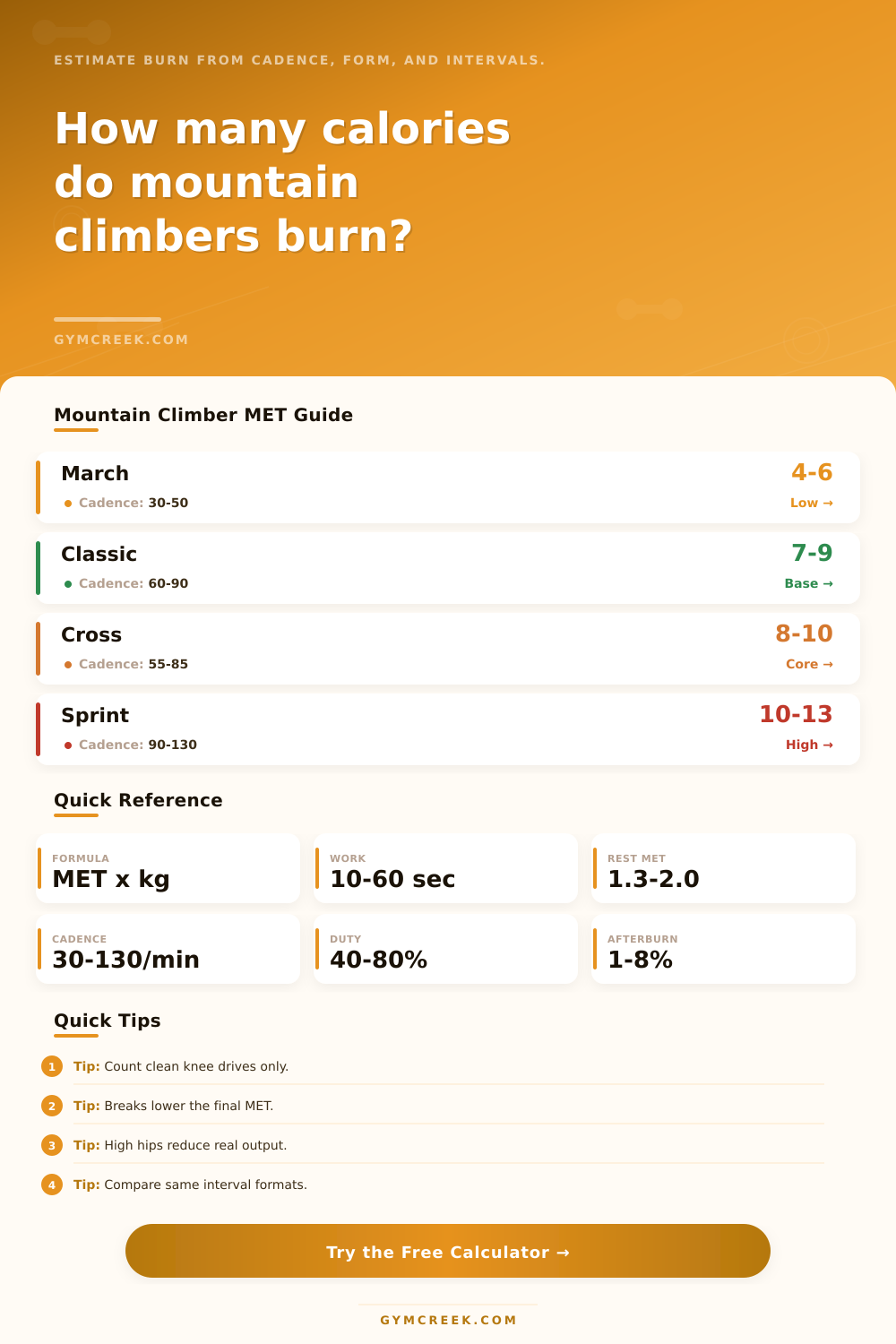
Slow marches start lower, classic climbers sit in the middle, and fast sprint or slider versions use higher base MET values.
Cadence compares your knee drives per minute against a target for that style, then plank quality adjusts how much work is sustained.
Rest uses a low recovery MET, while dense hard intervals add a small post-exercise oxygen cost estimate.
📑Reference Tables
| Knee-Drive Style | Base MET | Typical Cadence | Primary Bias |
|---|---|---|---|
| Slow plank march | 4.8 MET | 30-50 per min | Control and entry-level conditioning |
| Classic climbers | 7.8 MET | 60-90 per min | Balanced cardio and trunk demand |
| Cross-body climbers | 8.4 MET | 55-85 per min | Oblique and rotation control |
| Slider climbers | 9.4 MET | 45-80 per min | Core tension with constant friction |
| Fast sprint climbers | 10.6 MET | 90-130 per min | High-output interval conditioning |
| Plank Quality | Modifier | What It Means | Calculator Effect |
|---|---|---|---|
| Frequent breaks | 0.82x | Stops, piking, or foot pauses | Lowers active MET |
| Basic plank | 0.94x | Mostly steady with some sway | Slightly lower MET |
| Solid neutral | 1.00x | Repeatable rhythm and trunk position | Baseline estimate |
| Strict brace | 1.06x | Controlled knees and stable shoulders | Raises MET modestly |
| Elite fatigue form | 1.12x | Clean reps late in hard intervals | Highest form modifier |
| Interval Setup | Work | Rest | Density Read |
|---|---|---|---|
| Skill practice | 15-25 sec | 35-60 sec | Low density, better for learning form |
| Classic circuit | 30-45 sec | 15-30 sec | Moderate to high calorie rate |
| Tabata set | 20 sec | 10 sec | High density if cadence holds |
| Long finisher | 45-60 sec | 30-60 sec | Fatigue management matters most |
| Formula Piece | Variables | Output | Used For |
|---|---|---|---|
| MET kcal | MET, kg, min | Calories | Active work burn |
| Cadence factor | Drives per min | Multiplier | Pace adjustment |
| Duty cycle | Work, rest | Percent | Interval density |
| Mifflin BMR | kg, cm, age | Calories | Daily context |
💡Tips
Drop down onto a plank and begin driving your knees towards your chest. At first, it feels like any other repetition during your workout: the first half-minute flies by. Then at the one-minute mark, your core begins to shake and your shoulders burn. You question whether you’re merely punishing yourself for punishment’s sake or if this exercise actualy has any impact on your metabolism.
Mountain climbers appear simple. It’s a plank with a few small variations, right? But because mountain climbers requires core stability, cardiovascular endurance, and coordination at the same time, they becomes difficult to measure.
Why Mountain Climbers Are Hard to Measure
If you move slowly and control your pace, fewer calories will be burned than if you frantically sprint through repetitions. Engaging more muscle fibers requires a rigid, stable plank; sagging hips and a tilting pelvis will do little for calorie-burning. Depending off movement style, calories burned can vary significantly. But most folks assume that if they spend “X” amount of time on the floor, then they’ve burned “Y” number of calories. That’s bogus.
Density matter more than duration. A high-density, low-rest set will produce a much different metabolic equivalent compared to a low-intensity, high-rest workout. By entering in your exact cadence and interval structure into this calculator, it’ll crunch the numbers for you. It recognizes that rest reduces your overall burn rate (but also gives you the ability to push harder when you’re actualy working). So it find balance within these two opposite influences to provide an accurate estimation.
You don’t have to be a physiologist to grasp the give-and-take here. You simply have to realize that density beats duration.
With a classic mountain climber, you keep your knees pointed straight ahead, using your hip flexors and rectus abdominis muscles. Cross-body climbers brings your knee toward your opposite elbow, using your obliques as well, creating a rotational aspect. More stabilizing muscles recruited. More neural drive required. So while it’s a subtle shift in direction, it increase the energy needed.
And then there’s the sprint variation. That’s when things get fun (and heart rate skyrockets) because now we’re not just doing core conditioning but cardiovascular work too. The chart on the page details the shift in base metabolic rates from low-intensity march versions up to high-output sprint styles. Knowing which one you’re doing will help you set appropriate expectations for how much energy you’ll expend.
The plank quality is something people don’t pay attention to. As you get tired, it’s easy to allow your hips to sink. Then, as your pelvis tilts forward, you’re no longer using your core to brace against gravity and stabilize your spine. You’re allowing your ligaments and hip flexors to bear the load. That decrease the muscle demands of the movement.
The fix is letting you choose the quality of your plank. If you can keep a braced, strict position despite getting tired, your muscles should of work extra hard to maintain that position. That’s why calorie burn is greater. If you’re breaking position regularly, then the estimate will be lower.
In other words, it forces you to deal with the truth: Are you doing the exercise perfectly, or just chasing volume? Better to do fewer reps perfectly than more reps poorly.
The other variable that tripped folks up was cadence. In the heat of the moment it gets confusing as heck to try and count each and every knee drive. Just count the ones where you’re really driving hard with intent. Don’t do half reps. That’s not going to engage your core very well and you’ll just end up flailing those leg around in the air.
Your cadence tells the calculator whether or not you’re meeting the target intensity given what style you chose. Say you choose a sprint variation but move at a slow march pace. The calculator will dial down the estimated burn because you weren’t really sprinting. So it keeps you from overestimating how much you’ve burned. It keeps the data honest.
At the end of the day, however, mountain climbers are just tools. And tools only work if we know how to wield them. They will help you burn calories, get your heart rate up, and build core endurance. These numbers give us a snapshot. But the real story is what they feel like in our muscles.
Are you breathing heavy? Is your core fatigued? That is good. Do it again. Concentrate on the quality of the drive. Stabilize your hips. Respect the rest periods. Let the math do the rest.