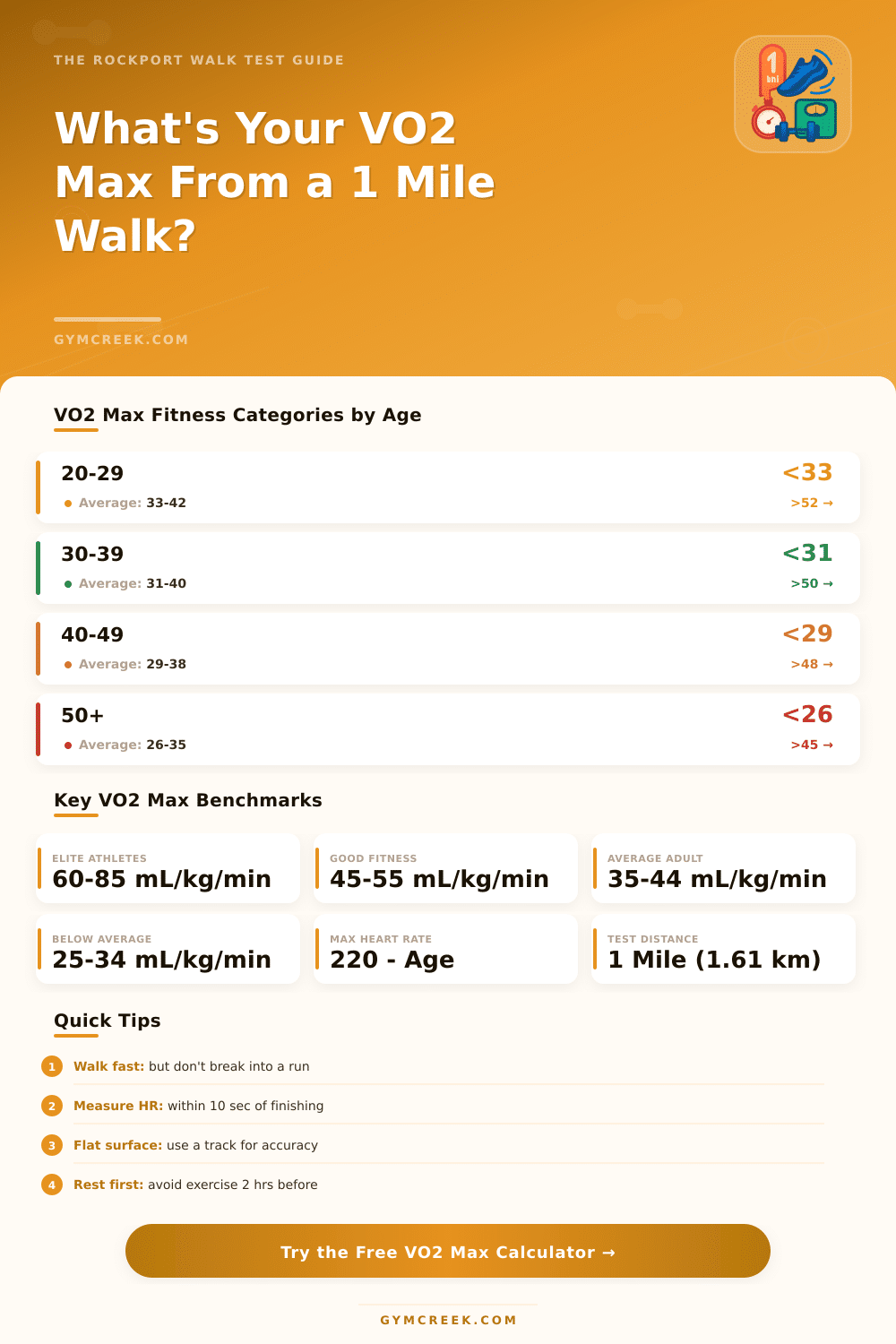
🚶 1 Mile Walk Test VO2 Max Calculator
Estimate your cardiorespiratory fitness using the Rockport Walking Test. Walk 1 mile as fast as possible, then record your time and heart rate.
| Age Group | Poor | Below Avg | Average | Above Avg | Good | Excellent |
|---|---|---|---|---|---|---|
| Males 20-29 | <33.0 | 33.0-36.4 | 36.5-42.4 | 42.5-46.4 | 46.5-52.4 | >52.5 |
| Males 30-39 | <31.5 | 31.5-35.4 | 35.5-40.9 | 41.0-44.9 | 45.0-49.4 | >49.5 |
| Males 40-49 | <30.2 | 30.2-33.5 | 33.6-38.9 | 39.0-43.7 | 43.8-48.0 | >48.1 |
| Males 50-59 | <26.1 | 26.1-30.9 | 31.0-35.7 | 35.8-40.9 | 41.0-45.3 | >45.4 |
| Males 60+ | <20.5 | 20.5-26.0 | 26.1-32.2 | 32.3-36.4 | 36.5-44.2 | >44.3 |
| Females 20-29 | <28.0 | 28.0-31.4 | 31.5-35.6 | 35.7-38.9 | 39.0-44.0 | >44.1 |
| Females 30-39 | <27.0 | 27.0-30.9 | 31.0-34.9 | 35.0-37.9 | 38.0-41.9 | >42.0 |
| Females 40-49 | <25.0 | 25.0-28.9 | 29.0-32.9 | 33.0-36.9 | 37.0-41.0 | >41.1 |
| Females 50-59 | <21.0 | 21.0-24.4 | 24.5-28.9 | 29.0-32.8 | 32.9-37.0 | >37.1 |
| Females 60+ | <17.5 | 17.5-20.1 | 20.2-24.4 | 24.5-30.2 | 30.3-31.4 | >31.5 |
Source: American College of Sports Medicine (ACSM) Normative Data
Max HR estimated at 190 bpm (220 – age 30). Adjust zones using your own max HR.
| Athlete Type | VO2 Max (mL/kg/min) | Notes |
|---|---|---|
| Elite Distance Runner | 70-85+ | World-class marathoners, cross-country skiers |
| Competitive Cyclist | 65-75 | Tour de France category riders |
| Recreational Runner | 50-65 | Regular 5K-10K runners |
| Active Adult | 42-55 | Regular gym-goers, team sport players |
| Average Healthy Adult | 35-45 | Moderate activity, light cardio |
| Sedentary Adult | 25-35 | Desk job, minimal exercise |
| Deconditioned | <25 | Little to no regular physical activity |
| Fitness Level | Expected 1 Mile Time | Post-Walk HR (Approx.) | Est. VO2 Max |
|---|---|---|---|
| Very Fit | 10:00 – 12:00 min | 100-120 bpm | 48-60+ |
| Above Average | 12:00 – 14:00 min | 120-135 bpm | 40-50 |
| Average | 14:00 – 16:00 min | 135-150 bpm | 33-42 |
| Below Average | 16:00 – 19:00 min | 150-165 bpm | 26-34 |
| Poor | >19:00 min | 165+ bpm | <26 |
1. Use a flat track — a 400m athletics track (4 laps = 1 mile) is ideal.
2. Measure HR immediately — count beats for 10 seconds then multiply by 6. Heart rate drops quickly after stopping.
3. Don't run — even if you feel like it. The test is validated only for walking pace.
4. Avoid heavy meals, caffeine, and exercise for at least 2 hours before the test.
5. Wear proper shoes and walk on a consistent surface.
DISCLOSURE: This post may contain affiliate links, meaning when you click the links and make a purchase, I receive a commission. As an Amazon Associate I earn from qualifying purchases.

VO2 max shows the biggest amount of oxygen that the body is able to use during physical work. Think of it like the horsepower of a car. It measures the ability of the body to take oxygen during exercise.
The word comes from “V” for amount, “O2” for oxygen and “max” for biggest.
What is VO2 max and how to improve it
It holds the rank of the most reliable marker for heart health and oxygen ability. The more oxygen folk manage to take during motion the more easily the exercises feel and the more long one can last. Big VO2 max means that the body well grabs oxygen from the air and moves it to the muscles.
VO2 max shows how well the heart pumps blood to the muscles and how well those muscles pull oxygen from the blood. When one breathes oxygen, it starts chemical processes in the muscle cells. The value is shown bye means of milligrams of oxygen for every kilo of body weight for every minute.
The most reliable way to check it is in a lab. Athletes work on a treadmill, a still bike or a rowing machine, wearing a special mask or tube bound to a device that measures oxygen. They exercise at full force.
There is also the Cooper-test, in that one runs or walks as fast as it is possible during exactly 12 minutes, and the covered distance relates to VO2 max. Runners and coaches of running can guess it, although it is not always exact.
Genes play a main part in VO2 max. Even so almost every person can improve it with enough work near the oxygen limit. Training with high intensity and intervals ranks among the best ways to raise it. Intervals of one to six minutes with same periods of work and rest are usually seen as VO2 max work.
Range of intensity helps too. Work in zone 2 proved that it improves it over time.
When VO2 max grows, the resting heart rate usually drops. At exercise with same force, the normal heart rate should drop. Here is a good sign about progress.
But VO2 max can be trained quickly and lost quickly. Too much work with high intensity can lead to overtraining.
VO2 max does not give the full picture about lasting activity. Speeds at oxygen threshold and lactate threshold do show activity more well, because they think about many factors together. VO2 max is only one part of the jigsaw.
The highest heart rate also drops by 0.6 to 0.8 beats per minute per year during aging. Women have a bit lower oxygen carrying skill because of lower hemoglobin levels and slightly smaller bodies, butboth men and women can grow VO2 max by the same amounts with training.