Mifflin-St Jeor BMR Calculator
Estimate basal metabolic rate, daily energy needs, target calories, BMI context, and macro ranges from sex, age, height, weight, activity, goal rate, protein preference, and training days.
Estimated daily energy result
| Formula | Equation | Variables | Use in calculator |
|---|---|---|---|
| Male BMR | 10W + 6.25H - 5A + 5 | W kg, H cm, A years | Basal estimate before activity multiplier. |
| Female BMR | 10W + 6.25H - 5A - 161 | W kg, H cm, A years | Basal estimate before activity multiplier. |
| TDEE | BMR x activity factor | 1.20 to 1.90 multiplier | Estimated maintenance calories. |
| Goal calories | TDEE plus weekly energy change / 7 | Goal rate and direction | Sets target intake for loss, maintain, or gain. |
| Activity level | Multiplier | Training pattern | Common signal |
|---|---|---|---|
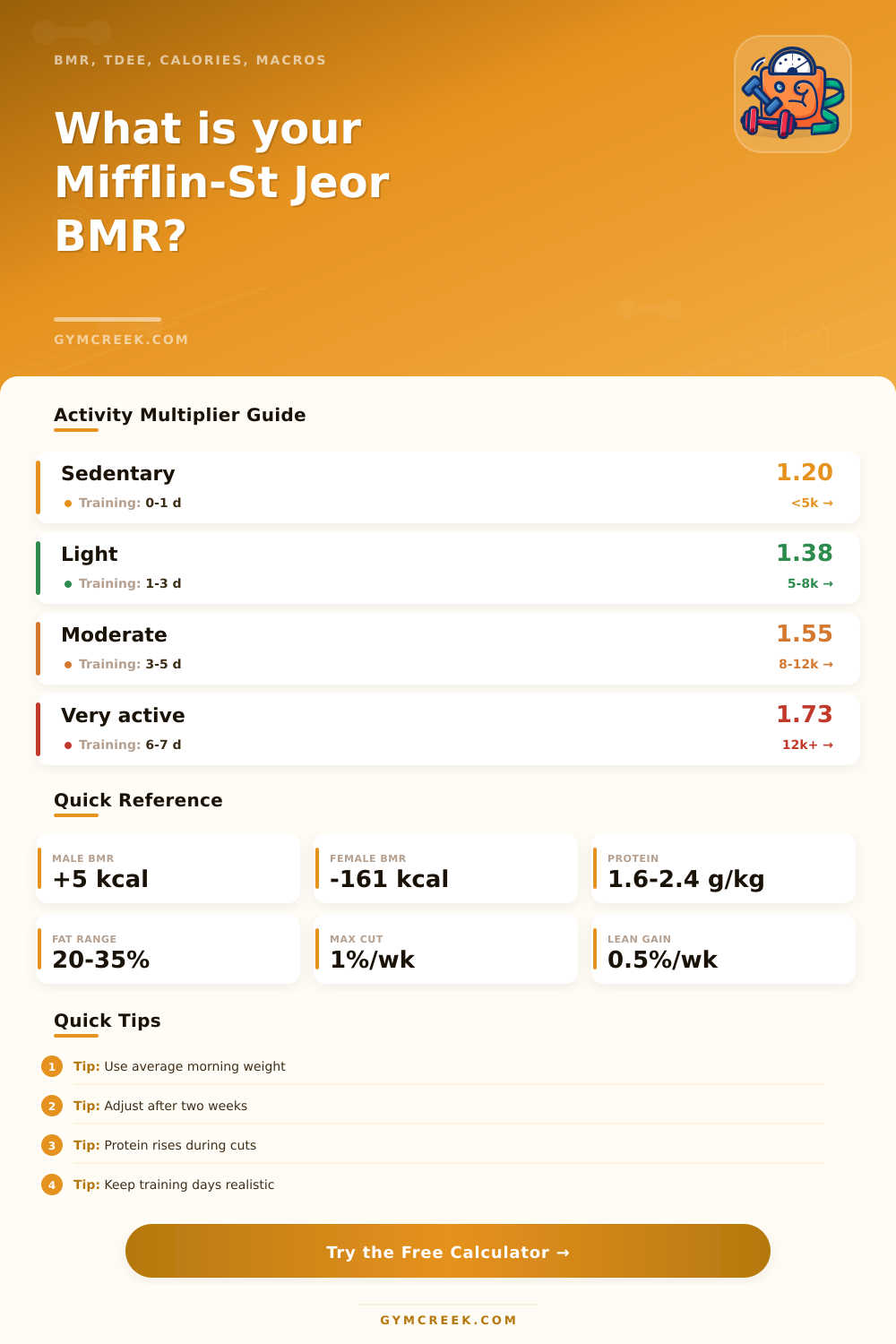
| Sedentary | 1.20 | 0 to 1 easy sessions per week | Mostly seated days and low steps. |
| Lightly active | 1.375 | 1 to 3 sessions per week | Regular walking or light lifting. |
| Moderately active | 1.55 | 3 to 5 sessions per week | Consistent training plus active days. |
| Very active | 1.725 | 6 to 7 harder sessions per week | High volume training or demanding work. |
| Extra active | 1.90 | Daily training and physical job | Athlete-level output with little rest. |
| Goal context | Protein range | Fat range | Carb approach |
|---|---|---|---|
| Maintenance | 1.4 to 2.0 g/kg | 25% to 35% calories | Remainder after protein and fat. |
| Weight loss | 1.8 to 2.4 g/kg | 20% to 30% calories | Higher on training days when possible. |
| Muscle gain | 1.6 to 2.2 g/kg | 20% to 35% calories | Useful for performance and volume. |
| Very high protein | 2.2 to 2.6 g/kg | 20% to 30% calories | Best reserved for short, leaner cuts. |
| Measure | Range | Energy context | Planning note |
|---|---|---|---|
| BMI under 18.5 | Underweight band | Avoid aggressive deficits | Professional guidance is especially important. |
| BMI 18.5 to 24.9 | Normal band | Small changes usually work best | Track performance, sleep, and hunger. |
| BMI 25 to 29.9 | Overweight band | Moderate deficit may be suitable | Waist, strength, and trend weight add context. |
| BMI 30 or higher | Obesity band | Medical context may matter more | Use the estimate as a starting point only. |
The reason that there are different answer on these calculators is due to the fact that each equation make certain assumptions about the amount of energy that the human body burns at rest. One of the more common equation is the Mifflin-St Jeor equation, which measure the metabolic rates of various individual more accurately than the older equations. Using such an accurate equation will allow you to better understand whether you need to consume more calories to fuel your training, or less calories to lose fat.
To calculate your resting energy expenditure (REE) with this equation, you must enter your sex, age, height, weight, and activity levels. Each of these variable has the potential to change the outcome of the calculation. Your age will contribute to a reduction of approximately five calories each year to your REE.
How the calorie calculator works
Your sex will contribute to a constant number of calorie to your calculation. Your height and weight will contribute to your REE because your body have the amount of tissue that determines your REE. Finally, your activity level will impact your REE as well, and is often one of the variables that many individuals incorrectly adjust.
Your activity level range from a level of sedentary work on a desk to being very active in your performance of physical work and physical training. Your activity level will have a major impact on the amount of energy that your body burn each day, and you should choose the activity level that best represents your bodys activity. For instance, if you train three to five day per week, but spend the majority of your day in a seated position, you should select the moderate activity level instead of the very active level of activity.
Beyond activity level, you are also able to program your goal and the rate at which you would like to adjust your bodys weight each week. If you choose to use a calorie deficit or surplus, the calculator will automatically adjust your target calories according to the rate at which you would like to lose or gain body mass. Your Body Mass Index (BMI) will also be calculated with these inputs, indicating to you the range within which your goal weight fall.
These numbers should not replace the advice from medical professional, but they will give you a starting point for your caloric needs. In addition to your caloric target, the calculator also provide you with recommendations regarding the amount of protein that you should consume daily. If you are attempting to lose weight, consuming more protein than medium level is recommended to ensure that your body does not break down muscle tissue for fuel.
If, however, you are attempting to maintain your weight, a medium level of protein is recommended. The calculator also calculate the amount of fat and carbohydrate that you should consume each day, based off the calories calculated from the protein target. You are also able to adjust for the number of day each week that you train.
For instance, if you lift weight four days per week and rest for the remaining days, your body will require different calories depending on whether you are performing strength training. The calculator will show you these difference, allowing you to decide if you want to increase your carbohydrate intake when you are training. To ensure that your calories are providing the benefits that you desire from your diet, you should weigh yourself each morning at the same time for one week, and then use the average of those weight to compare with your target weekly rate of change.
If your weight is changing at a faster or slower rate than your target after two weeks, you should adjust your activity level multiplier (not your chosen equation). This adjustment will lead to more accurate results. These numbers should never be exact and should not be considered as a fixed number to consume each day.
You may vary in the number of calorie that you burn each day due to variations in the amount of sleep that you get, the amount of stress that you experience, and the amount of physical training that you perform. These numbers will lead you to a target calorie intake, but you must monitor your bodys response to this target. If your inputs and your changing weight are all within your parameter after two weeks, your target calories will be effective.