MEV MAV MRV Calculator
Estimate phase-specific weekly hard sets for one muscle using current volume, progression week, soreness, performance, pump, stress, frequency, and deload signals.
📌Presets
Each preset represents a real hypertrophy planning situation and recalculates a weekly set target for the selected muscle.
⚙Calculator
Volume landmark snapshot
Enter your weekly sets and recovery signals to estimate the next target.
📊Fitness Metrics Comparison
📈Phase-Specific Volume Range
📑Reference Tables
| Muscle | MEV | MAV | MRV |
|---|---|---|---|
| Chest | 8 | 12-20 | 22 |
| Back / lats | 10 | 14-22 | 25 |
| Quads | 8 | 12-18 | 22 |
| Hamstrings | 6 | 10-16 | 20 |
| Glutes | 6 | 10-18 | 24 |
| Side delts | 8 | 12-24 | 30 |
| Biceps | 6 | 10-18 | 22 |
| Triceps | 6 | 10-18 | 22 |
| Calves | 8 | 12-22 | 26 |
| Signal | Add Sets | Hold Sets | Cut Sets |
|---|---|---|---|
| Soreness | 0-1 | 2-3 | 4-5 |
| Performance | Improving | Stable | Dropping |
| Pump quality | 0-2 with good recovery | 3-4 | 5 with soreness |
| Joints | 0-1 | 2 | 3-5 |
| Phase | Set Zone | Goal | Adjustment |
|---|---|---|---|
| Intro | MEV to low MAV | Resensitize | +0 to +2 |
| Build | Low to mid MAV | Progress | +1 to +3 |
| Push | Mid to high MAV | Challenge | 0 to +2 |
| Peak | High MAV to MRV | Test ceiling | -4 to +1 |
| Frequency | Sets / Session | Fit | Watch |
|---|---|---|---|
| 1 day | 6-10 | Maintenance | Long sessions |
| 2 days | 5-9 | Most muscles | Soreness |
| 3 days | 4-8 | Specialization | Joint stress |
| 4+ days | 3-6 | High MAV | Overlap fatigue |
💡Tips
Volume is another training variable that an individual must manages during a mesocycle. However, managing training volume is difficult due to the fact that high levels of training volume can lead to fatigue and stall progress in the individual’s training program. Many individuals adds sets to their training program because the training program require more set.
Yet, adding sets without a plan to recover from the additional sets can lead to shoulder pain or stalled performance on exercises like the bench press. To manage training volume, an individual must understand where their training volume sit in relation to the body’s capabilities. Using a map of the training volume, an individual can avoid overtraining and undertraining their muscles.
How to Manage Your Training Volume and Recovery
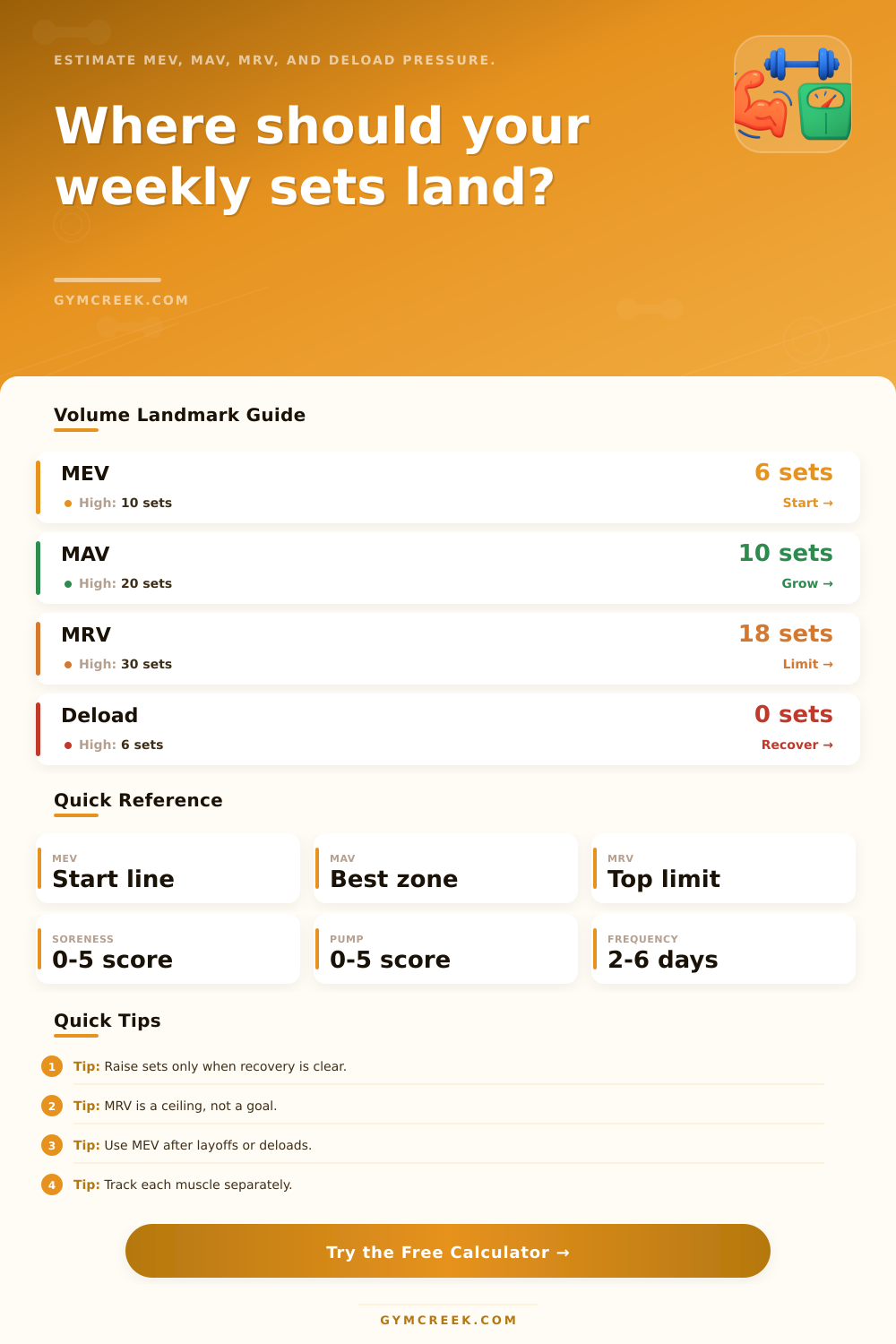
The map for training volume have three specific levels: Minimum Effective Volume (MEV), Maximum Adaptive Volume (MAV), and Maximum Recoverable Volume (MRV). The MEV is the lowest number of sets that will stimulate the muscles to grow. The MAV is the range of training volumes that will allow an individual to produce the most growth in their muscle groups.
Finally, the MRV is the highest amount of training volume that an individual can perform before their training volume outrun their ability to recover from the training that they perform. The signals that an individual must track to manage training volume include soreness, performance trends, pump quality, and joint feel. Soreness indicates whether an individual is still experiencing the fatigue from their previous training volume.
Performance trends allow an individual to monitor whether they are performing their sets at the appropriate level for muscle growth. Additionally, pump quality and joint feel is two signals that the training journal cannot measure but are helpful in determining training volume. Both sleep and life stress is additionally important signals for tracking training volume because they directly impact an individual’s ability to recover from the training that they perform.
The management of training volume change based on the phase of the mesocycle that an individual is performing within their training program. An individual’s mesocycle phases will dictate the amount of training volume that they should use within their training program. During the early weeks of a mesocycle following a deload, an individual should train within a range closer to their MEV.
During the middle phase of the mesocycle, an individual should increase their training volume to reach their MAV. However, they should only add sets to their training program if their recovery are positive. During the final weeks of a mesocycle, an individual may want to increase their training volume closer to their MRV.
However, they should only perform training within this range for a few weeks at most as the MRV is meant to be a warning signal, not a goal that an individual should aim to reach within each training program. An individual can incorporate another training variable that will impact training volume: the frequency with which an individual trains. Frequency refers to the number of training sessions that an individual performs to complete the total number of sets that they train with.
The higher the frequency with which an individual trains, the more training volume an individual can perform. This is due to the fact that higher training frequencies will allow for an individual to train with fewer sets per session while still performing the same total number of training sets for that particular muscle group. Additionally, high training frequencies may allow for an individual to recover their joint from the high training volumes that they perform.
However, training volume per session should not be too high with high training frequencies as an individual may feel fine training with eight sets distributed over three training sessions but may feel crushed when training performs eight sets in only two training sessions. An individual should never live at the MRV for their training volume. Additionally, they should never aim to reach the MRV as a goal for each training session.
An individual’s goal for their training program should be to train within their MAV for the majority of their training program. They should only train an individual’s training volume to reach the MRV if all of their recovery indicators are positive. An individual should never allow their training volume to increase if their soreness increase, their performance decline, or if the quality of their joint movement decline.
Additionally, an individual’s training volume should use the suggested training volume for that week as a starting point only. This isnt a signal for that individual’s training program to train at that volume for the rest of that training cycle. The management of training volume consists of creating a loop that an individual can use to manage training volume.
This loop requires an individual to enter their training volume and recovery signals into a training management tool that will output a suggested target for that individual’s training program. Using this target, an individual can test the suggested training volume for a few training sessions. Based on the results of these training sessions, the individual can decide if any adjustments is needed to that individual’s training volume.
This type of training program is more valuable than the individual could find from reading training manuals. Additionally, the map for training volume will only be effective if an individual constantly refer to the map to ensure that their training volume is within the parameters that the training program suggests.