METs Treadmill Calculator
Estimate treadmill METs, oxygen cost, calories, grade load, and vertical climbing from speed, incline, body weight, duration, and measured MET overrides.
📌Presets
Presets load full treadmill profiles and recalculate immediately.
⚙Calculator
Treadmill MET snapshot
Enter a speed, grade, weight, and duration to estimate treadmill workload.
📊Treadmill Metrics Grid
📑Reference Tables
| Intensity class | MET range | Treadmill example | Training note |
|---|---|---|---|
| Light | 1.6-2.9 METs | Easy walking or warm-up | Comfortable recovery effort |
| Moderate | 3.0-5.9 METs | Brisk walk, low incline | Steady aerobic work |
| Vigorous | 6.0-8.9 METs | Fast walk uphill or easy run | Breathing noticeably harder |
| High | 9.0-11.9 METs | Running or steep incline | Hard sustained workload |
| Very high | 12.0+ METs | Fast run or steep hill run | Advanced fitness demand |
| Equation | Speed range | Grade term | Best use |
|---|---|---|---|
| ACSM walking | About 1.9-3.7 mph | 1.8 x speed x grade | Walking and hiking-style treadmill work |
| ACSM running | Jogging and faster | 0.9 x speed x grade | Running gait above walking speed |
| Auto mode | Any entered speed | Chooses by speed | Quick general estimates |
| Known MET | Any speed | Uses your MET input | Lab result, device value, or protocol stage |
| Preset | Speed | Grade | Typical METs |
|---|---|---|---|
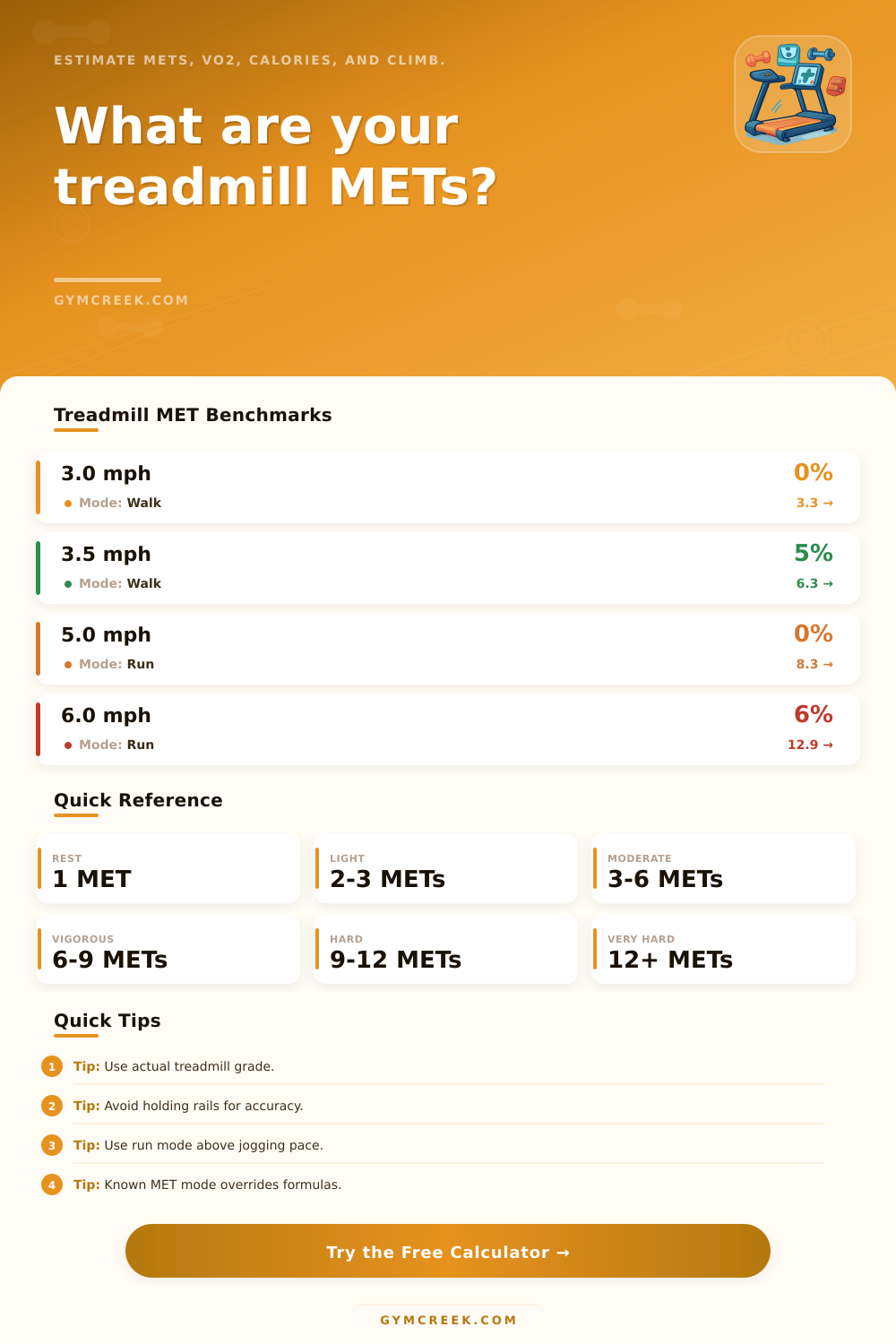
| Flat Fitness Walk | 3.0 mph | 0% | About 3.3 |
| Brisk 5% Grade | 3.5 mph | 5% | About 6.3 |
| Incline Hike | 3.0 mph | 12% | About 9.0 |
| Easy Jog | 5.0 mph | 0% | About 8.3 |
| Hill Run | 6.0 mph | 6% | About 12.9 |
| Formula | Variables | Output | Use |
|---|---|---|---|
| Speed conversion | mph x 26.8224 | m/min | Prepares ACSM equations |
| Walking VO2 | 3.5 + 0.1S + 1.8SG | mL/kg/min | Walking treadmill oxygen cost |
| Running VO2 | 3.5 + 0.2S + 0.9SG | mL/kg/min | Running treadmill oxygen cost |
| MET conversion | VO2 divided by 3.5 | METs | Converts oxygen cost to workload |
| Calories | VO2 x kg x min / 200 | kcal | Estimates session energy |
💡MET Calculation Tips
Treadmill consoles leave most staring blankly wondering if they’re exercising their heart or simply heating up their muscles. Enter METs: They’re the standardized measure of intensity, reflecting how hard it is to do something different than resting. This makes them a universal language of effort; no matter what pace, you know how hard you’re working. After you plug in your speed and grade into the calculator above, it do the math to let you know if that incline walk qualifies as vigorous exercise.
Add in the fact that each step involves fighting gravity and suddenly, Incline matter a lot more. The usual formula treat walking and running differently because they use different types of muscle fibers. When moving slower than about four miles per hour, the incline is weighted heavily in calculation. Once you begin jogging, the numbers changes to account for energy delivery while under load.
How to Measure Your Workout Effort
Energy delivery isn’t always about speed. Intensity is also measured by how much support you’re getting from handrails. When you grip the rails, it lower the energy you use. You aren’t pushing your legs as hard and your core isn’t engaged. Because no one in real world has perfect form, the tool adjusts for that kind of behavior. If your goal is to accurately measure the amount of cardiovascular stress you’re putting on yourself, then this adjustment are important.
Some find it confusing that calorie estimates are based off a person’s body mass. Because heavier people requires more calories per unit time (there’s more of them to lug around), they’ll also burn more during equal periods of exertion. The tool takes the guesswork out of personal energy use by scaling the total calories based on your inputted weight. How you use this will determine if you treat those numbers as net burn or gross output toward your daily energy balance.
Speed by itself doesn’t convey much context, but vertical climb do. To put it another way, you might not feel so good about just watching numbers scroll by on a treadmill without knowing if you’re actualy training. But knowing you gained two thousand feet of elevation in half-an-hour conveys a real sense of volume overcoming gravity. That’s how it can help compare various kinds of exercise, both outdoors (hiking, stair climbing) and indoors (on treadmills). It’s a reasonable bridge between those data set.
Look up reference tables that indicates the point where light aerobic activity transitions to hard work. On recovery days, keep your heart rate in the light range so it’s easy to breathe. In the moderate range, it’s just enough to sustain steady conditioning (you can still talk). The vigorous range is when you can’t catch breath and are fully focused on moving. Knowing your zone allows you to build a balanced week rather than train as hard as you could of each day.
These concepts is easy to apply without being a physiologist. Simply learn which number represent meaningful effort. The calculator turns a grade and speed into a number that can be measured. It removes the marketing noise. What’s left? It is raw information about your workload. Knowing how to measure it is half the battle.
When you stand on the belt, don’t look at the motivational message flashing on the screen. Instead, focus on how the incline and speed pushes you while keeping your form intact. The tool gives you an idea of how hard (but not too hard) to push yourself. Why? Because it assesses true bodily stress. When you’ve dialed in the right effort, your lungs will let you know.