METs to Calories Calculator
Estimate exercise calories from MET value, body weight, duration, session count, and intensity adjustments.
📌Duration and Bodyweight Presets
Presets load realistic MET values, duration, body weight, active time, and weekly frequency so you can compare sessions quickly.
⚙Calculator Inputs
MET calorie estimate
Enter your body weight, MET value, and duration to estimate exercise calories.
📊MET Snapshot
📑Reference Tables
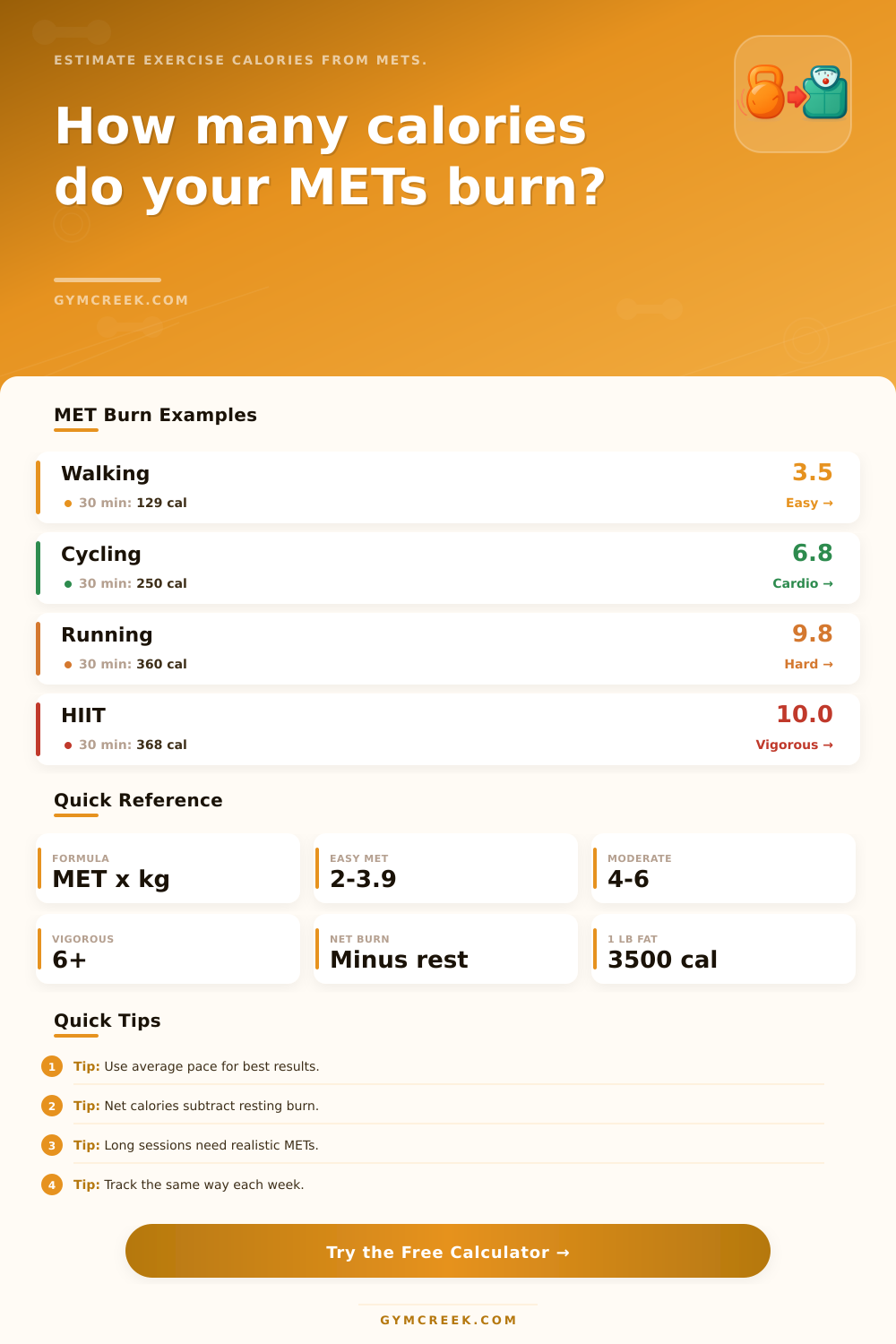
| Activity | Typical MET | 30 Min at 170 lb | Intensity |
|---|---|---|---|
| Walking 3 mph | 3.5 | 142 cal | Light to moderate |
| Brisk walking | 4.3 | 166 cal | Moderate |
| Resistance training | 5.0 | 193 cal | Moderate |
| Cycling moderate | 6.8 | 262 cal | Moderate to hard |
| Running 6 mph | 9.8 | 378 cal | Vigorous |
| HIIT intervals | 10.0 | 386 cal | Vigorous |
| MET Range | Category | Session Feel | Examples |
|---|---|---|---|
| 1.0 to 1.9 | Resting | Very easy | Standing, light chores |
| 2.0 to 3.9 | Light | Comfortable | Easy walking, mobility |
| 4.0 to 5.9 | Moderate | Steady effort | Brisk walk, lifting |
| 6.0 to 8.9 | Hard | Breathing deeper | Cycling, swimming |
| 9.0 plus | Vigorous | Very demanding | Running, HIIT, rowing |
| Formula | Equation | Use | Output |
|---|---|---|---|
| Gross calories | MET × 3.5 × kg / 200 × min | Total exercise burn | Session calories |
| Net calories | (MET - 1) × 3.5 × kg / 200 × min | Active burn above rest | Net calories |
| Calories per hour | MET × 3.5 × kg / 200 × 60 | Compare activities | Hourly rate |
| Weekly burn | Session calories × sessions | Training frequency | Weekly calories |
| Profile | Weight | Session | Expected Burn |
|---|---|---|---|
| Light walker | 140 lb | 3.5 MET, 30 min | 129 cal gross |
| Gym lifter | 185 lb | 5.0 MET, 60 min | 441 cal gross |
| Steady cyclist | 170 lb | 6.8 MET, 45 min | 413 cal gross |
| Recreational runner | 155 lb | 9.8 MET, 30 min | 362 cal gross |
💡Tips
After working out, you look at yourself in the mirror. Was it even worth it? Maybe the number on the scale hasn’t budged in days; heck, your muscles is sore now. But “feeling sore” isn’t the same as “getting results.” How do you take all this hard work and turn it into something real; calories burned without having to purchase an expensive wristwatch that’s more costly then your tennis shoes?
Enter metabolic equivalents. These help you convert your vague sense of effort into objective metrics you can record and monitor over time. It’s a clever idea with a lot of power behind it. One MET is defined as the amount of energy expended while sitting still on the couch. Walking casually will triple that; running sprints can push you into double digits.
How to Track Your Workout Results
Plug in your activity level (time) and your bodyweight, and calculator takes care of the rest for you. Which is nice, because most folks think “calories burned” is entirely about time, that’s not true. Because you’re moving more mass around under influence of gravity, a heavier person will burn way more energy performing the exact same activity than someone lighter. The calculator asks you your body weight up-front so it can take that into account… What matters isn’t some kind of average, but your own unique physiology.
Another one is intensity. Minutes of exercise aren’t all alike. The minutes spent doing resistance training don’t burn at the same rate as the minutes spent resting in-between your set. Those will be closer to resting then lifting. That is why it’s important to use the active time as input. When you drop down that percentage, it drops down the overall burn as well which allows you a more accurate depiction of what did occur in the gym. It stops us from thinking that just because we’ve got a solid hour logged, it must of been all at peak exertion levels. Most workouts contains a mixture of harder work with shorter rest periods. Averaging it all out helps plan better.
Then there’s the question of net versus gross calories. Gross calories encompass all the calories you burned within that time period: those from activities, and those that would’ve been burned anyway, sitting around reading a book in bed. Net calories change that base line so you can see above and beyond the work that you did. It’s sort of like tipping a waiter. Your meal costs X dollars; that’s the food. Then you tip, because they gave you good service. Net calories represent amount of additional calories you added to your day beyond maintaining your weight. Gross calories give you an idea of the overall calorie burden you’re putting on your body while exercising.
If you get too rigid about using reference tables, you’re going to find yourself misled. The data in these tables is AVERAGES from controlled studies of people following set speeds and paces within defined populations. Fitness level, terrain, and your own actual pace will adjust those figures. Even walking at a constant pace burns more calories uphill compared to downhill. Cycling against a headwind will completely change things. Treat the tables as a guide, not gospel. If you have a good sense for how easy or hard your workout was relative to what the standard description suggests it should feel like, adjust the intensity multiplier accordingly. This minor adjustment could be the difference between an estimate that is accurate versus one that sounds completly off.
Long term tracking isn’t about being precise; it’s about being consistent. To identify trends you want to be exact. When you use the same method every week, then you can see how your energy output (relative to performance or weight) change over time. Did you get more efficient? Lose some weight? Decrease your session calories even though your time remains the same? It’s not about calculating perfectly, it’s about understanding what you’re doing.
Too frequently, we view exercising as a split, either I was going hard, or I wasn’t. But it’s far more gray than that. When we break every workout down by the parts, we get a clearer picture of what shapes our routines. This turns vague goals into concrete behaviors. Suddenly, you realize that 30 minutes of fast-paced walking accumulates differently from 20 minutes of intense strength training. The metrics aren’t passing judgment; they simply show us our next step.