METS Calculator
Estimate gross calories, net exercise calories, oxygen demand, MET-minutes, and weekly activity load from activity intensity and body weight.
📌Activity Presets
Each preset loads a realistic activity MET value, duration, body profile, and weekly frequency, then calculates immediately.
⚙METS Inputs
METS session snapshot
Enter your activity, MET value, and duration to estimate energy demand.
📊Fitness Metrics Grid
📑Reference Tables
| Intensity | MET Range | Talk Test | Example |
|---|---|---|---|
| Resting | 1.0 MET | Rest | Sitting quietly |
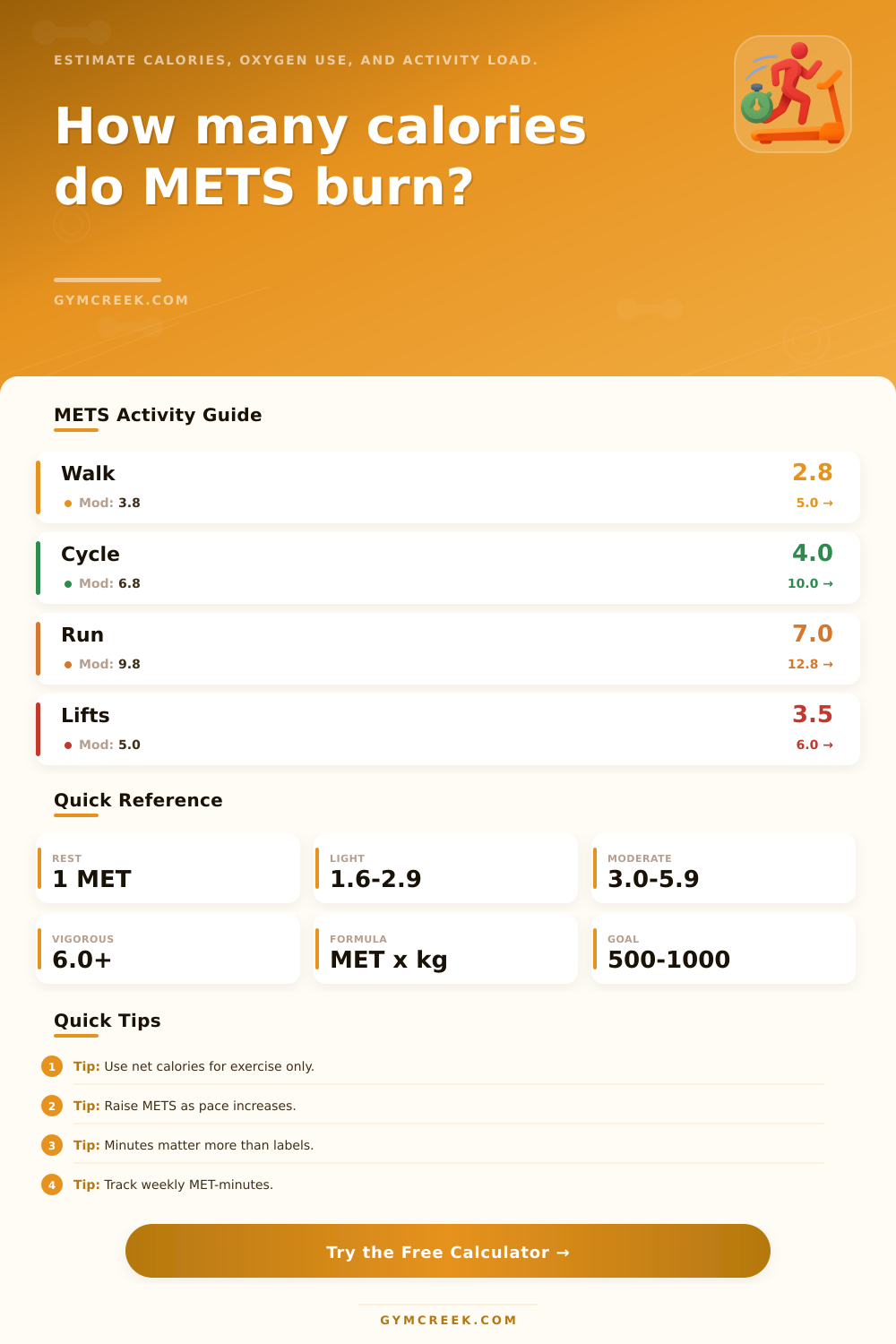
| Light | 1.6-2.9 | Easy talk | Casual walking |
| Moderate | 3.0-5.9 | Can talk | Brisk walking |
| Vigorous | 6.0-8.9 | Short phrases | Jogging, cycling |
| Hard | 9.0+ | Few words | Fast running |
| Activity | Light | Moderate | Vigorous |
|---|---|---|---|
| Walking | 2.5 MET | 3.8 MET | 5.0 MET |
| Running | 7.0 MET | 9.8 MET | 11.5 MET |
| Cycling | 4.0 MET | 6.8 MET | 10.0 MET |
| Strength | 3.0 MET | 5.0 MET | 6.0 MET |
| Rowing | 4.8 MET | 7.0 MET | 8.5 MET |
| Formula | Variables | Use | Output |
|---|---|---|---|
| Gross kcal | MET x kg x hr | Total session | Calories |
| Net kcal | (MET - 1) x kg x hr | Exercise only | Calories |
| VO2 | MET x 3.5 | Oxygen rate | ml/kg/min |
| Oxygen L | VO2 x kg x min | Session demand | Liters |
| MET-min | MET x minutes | Weekly load | Volume |
| Weekly Goal | MET-Minutes | Typical Mix | Notes |
|---|---|---|---|
| Starter | 300-499 | Light plus walks | Build gradually |
| Health base | 500-999 | 150 min moderate | Common target |
| Endurance | 1000-1999 | Longer sessions | Recover well |
| High load | 2000-2999 | Sport training | Watch fatigue |
| Very high | 3000+ | Daily training | Plan easy days |
💡Tips
It’s tempting to think of exercise as an easy trade: I spend X amount of time/effort, and get Y units of health back. But that kind of mindset generaly doesn’t work out very well since it neglects the price we pay in movement. How do you know how many calories you’re burning? Intuitively, maybe by checking how sweaty and/or tired you feel, except those are imperfect signs of energy use. Adrenaline can be misleading too; your heart rate go up both when you’re stressed, and also when you’re running really hard.
Metabolic equivalents (METs) is designed to help solve this problem. A MET is defined as your metabolic rate while you are exercising divided by your metabolic rate at rest. Sitting motionless in a chair burns about one MET. That means if you run vigorously, it might take six or seven METS worth of energy. The beauty of using METs is that they provides us with a standard unit of measurement of intensity, no matter our size or shape. So you can compare the relative intensity of two exercises.
How to Use METs to Track Your Exercise
And then there’s this: this page has a calorie-burn calculator that takes all those airy-fairy ratios and makes them into real figures for you to use. It wants your body weight, and here’s why: Physics doesn’t give a hoot what you think. Moving the same distance requires more energy if you weigh more then if you weigh less. It is basic work (lifting things up) plus acceleration (overcoming gravity). More work are necessary when lifting and accelerating more mass.
It breaks down gross calories vs. It also breaks down net exercise calories. Gross calories are amount of energy you’d burn even if you sat still for that long. This is the energy needed to keep your heart beating and your lungs going for that same amount of time. Net calories adjust out that baseline so you’re only looking at the additional energy cost of the activity itself. If you’re keeping tabs on calories in vs. Calories out, that’s important. Don’t want to count breakfast toward how much walking you’ve done if half those calories were just getting rid of toxins in your liver while you walked over to the fridge.
The problem with intensity labels is that they’re relative. Something that’s a warmup for one individual could be grueling for another. The MET value removes the emotion and goes right to physiology. For example, during your strength training, the MET score will vary depending on how you lift. You might use heavy weights with long rest periods or high reps with no rest in between.
The charts below provide a breakdown of typical daily activities categorized by light, moderate, and vigorous intensities. These are a handy lookup table. No need to memorize all the coefficients for each potential activity. As you’ll notice, cycling indoors may rate differently than cycling outdoors (depending upon terrain and wind resistance), which adds another level of mathematical difficulty.
Typically, most health recommendations suggest about 150 minutes of moderate activity per week. If you stick to the moderate zone, that’s equivalent to 500, 1000 MET-minutes per week. To use the calculator, just multiply your score for each intensity level by length of your session and count up the number of times per week you do this. Now you’ve got a clear goal in front of you, not a fuzzy description of what “being healthy” means. You can clearly see how long it takes. How many hours of walking or cycling at a steady pace do I need to reach my target?
Instead of obsessing over calorie counting (which usually doesn’t work anyway), you’re measuring the total amount of physical activity. When creating a habit, consistency matters more than intensity. A single hour-long heroic workout once a month isn’t as good as three steady half-hour sessions during the same week. Try various combinations of duration and frequency until you land on something that actualy matches your real-life schedule, not some perfect world where life runs like clockwork.
Other outputs include oxygen demand, or how much oxygen you need during the workout. This relates back to cardiovascular fitness. The more fit you are the more efficient your muscles become at extracting oxygen and the higher volume of blood pumped per beat of your heart. You may be burning as many calories running at a particular speed but your perceived effort decreases.
The calculator uses an average efficiency unless adjusted, meaning elite athletes can expect to have lower submaximal METs than beginners while at rest. Remember it’s not about the exact number on the screen. It’s about creating a baseline from which to measure progress. Plug it in, start with what you know you can do, and see how adding more (or less) intensity (or frequency) changes your weekly total. You’re still doing the same math. But now it’s different for you. That’s when the real fitness occurs.