Metabolic Rate Calculator for Weight Loss
Estimate BMR, total daily energy expenditure, a weight-loss calorie target, and the deficit needed for a realistic weekly pace.
📌Presets
Presets load full scenarios with units, demographics, activity, planned exercise, and target loss pace.
⚙Calculator
Weight-loss metabolism snapshot
Enter your stats and calculate a target.
📊Fitness Metrics
📑Reference Tables
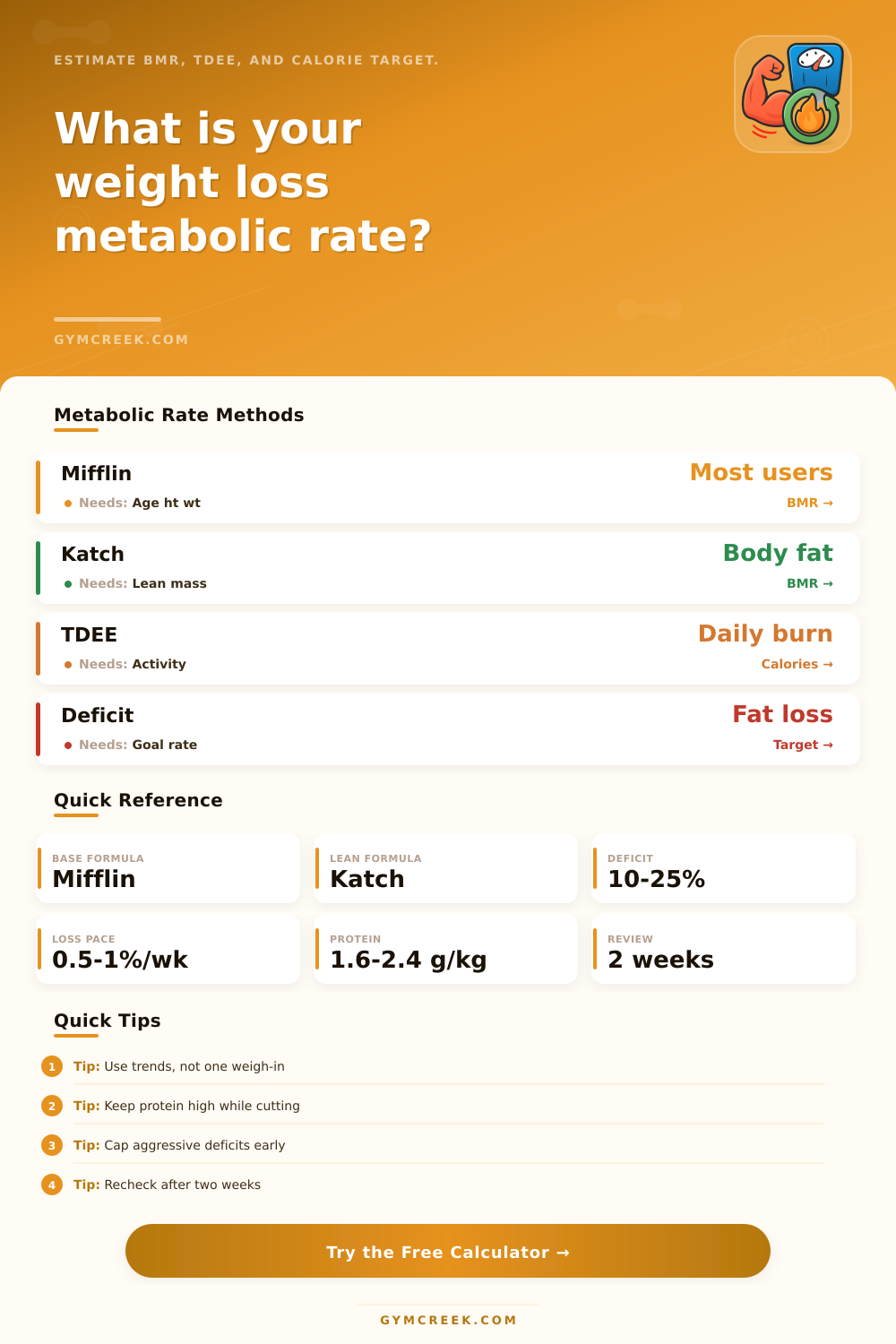
| Formula | Equation basis | Best use | Watch-out |
|---|---|---|---|
| Mifflin-St Jeor | Weight, height, age, sex | General BMR estimate | No lean-mass input |
| Katch-McArdle | Lean body mass | Known body fat estimate | Depends on body fat accuracy |
| Activity TDEE | BMR times multiplier | Daily calorie planning | Multipliers can overlap exercise |
| Deficit target | TDEE minus calories | Weight-loss pacing | Too large can hurt recovery |
| Loss pace | Weekly target | Deficit cue | Typical fit |
|---|---|---|---|
| Conservative | 0.25-0.5% | Small | Lean or busy lifters |
| Moderate | 0.5-1.0% | Steady | Most weight-loss phases |
| Aggressive | 1.0-1.5% | Large | Short blocks only |
| Diet break | 0% | None | Recovery or maintenance |
| Activity level | Multiplier | Common signal | Use when |
|---|---|---|---|
| Sedentary | 1.20 | Under 5k steps | Mostly seated |
| Light | 1.375 | 5k-8k steps | Light training |
| Moderate | 1.55 | 8k-12k steps | Regular training |
| Very active | 1.725+ | 12k+ steps | Hard training or labor |
| Macro guardrail | Cutting range | Metric range | Reason |
|---|---|---|---|
| Protein | 0.7-1.1 g/lb | 1.6-2.4 g/kg | Lean mass retention |
| Fat floor | 0.25-0.4 g/lb | 0.55-0.9 g/kg | Diet quality support |
| Carbs | Remainder | Remainder | Training fuel |
| Review | 2-3 weeks | 2-3 weeks | Trend correction |
💡Tips
It’s morning, you step on the scale. The number is the same as it was two weeks ago. But you’ve walked an extra few thousand steps. You cut out treats on weekends. Still no results. Your metabolism must be broken, right? Wrong. Chances are, you’re just making guesses about your metabolic rate instead of calculating it.
Enter: the metabolic rate calculator. These tools help fill gap between what you want to do and what happens in real life. If you want to lose fat, a metabolic rate calculator will tell you roughly how many calories per day that require. The first step in altering body composition is understanding the numbers. More specifically, you must understand basal metabolic rate (BMR) and total daily energy expenditure.
Why Metabolic Rate Calculators Help You Lose Weight
BMR is amount of calories you need to stay alive at rest. That means it accounts for breathing, brain function and cell repair. Everything else on top of that is what’s referred to as total daily energy expenditure. That’s things like walking, lifting weights and commuting. A lot of folks mix this up, they either under- or overeat, not seeing the results right away.
Once you put in some basic info about yourself and your activity level, the calculator do all the number crunching. No more guessing which multiplier applies to your lifestyle. Why? Because different formulas rely on different assumptions about your body composition. Because formulas make different assumptions and will be better (or worse) depending on calculations.
For most people, the best formula is called the Mifflin St Jeor equation. That means it predict energy needs based off sex, age, height, and weight reasonably accurately. If you’re not precisely sure of your body fat percentage, this is a great choice.
If you have that number, perhaps from a DEXA scan or by taking caliper measurements, then you should of use the Katch McArdle equation, which uses only lean body mass for its calculation. Since lean body mass burns more calories at rest than fat tissue do, knowing that number makes a big difference in baseline calculation. And that’s also why two people can look different yet have the same number on scale, they likely have different maintenance calories.
Most people make mistakes with their activity multipliers. We tend to overestimate how much we move. If you only go to the gym two times per week and spend all day sitting at a desk, picking “Very Active” as your level will create a fake surplus. And that’s not going to help you get leaner.
The categories are spelled out in reference table on the page. Pick an accurate multiplier based off how often you train and how many steps you take each day. When tempted to pick the highest value (“Oh yeah, I’m real active!”) so you can eat more food, remember: Drop some pounds? Accuracy > Optimism.
Then there’s the issue of calories burned through daily movement (NEAT). Those little twitches, standing during a phone call, fidgeting while reading. They add up. Don’t ignore them; it will cause your calorie budget to plummet.
Chasing quick losses is not as protective of muscle mass as setting a reasonable pace, such as losing no more than one percent bodyweight weekly. A rapid drop of over a pound a week will frequently involve loss of both lean tissue and water. The sweet spot for most sustainable, lasting transformations are between half and one percent per week. That’s enough to keep you feeling full without excessive hunger, and it also enables intense training while eating plenty of protein.
The tool estimates that timeframe based on how well you expect to stick to your diet and the maximum calorie deficit you want. Will your plan survive contact with reality? Find out now.
Nobody hits their calories precisely every single day, all the time. Creating some margin for error preserves motivation during busy weeks. When you restrict calories, your protein consumption acts as insurance against muscle loss. It also helps keep you full at mealtime. When energy availability declines, higher protein demands protects your strength. Because exercise causes tissue damage, these amino acids is necessary for recovery.
Keep fat intake above a minimum level so that hormonal systems function properly. Whatever space is left are filled with carbohydrates. Check in with yourself every couple of weeks so you have sufficient time to see trends before locking yourself into a losing strategy for months on end. Usually, if the scale fails to budge (and your energy level plummets), this indicates either an overly aggressive calorie deficit or sloppy tracking.
The key is not to get hung up on day-to-day fluctuation, but rather to understand what you’re measuring. At the end of the day, it’s all about consistent energy balance over an extended period of time. Perfect adherence doesn’t matter for one day.
These calculators spit out some starting points for your map. But remember: the real landscape is what your body hands you each morning. Take those numbers as a guide, not hard-and-fast law. Make adjustments according to how you feel in the gym and whether or not your clothes fit. Most importantly, be patient. Whether you’re eager for results or not, biological change takes time.
Three weeks of consistent effort later, stand back on that scale. Finally, the needle will shift in the desired direction.