Metabolic Equivalent Calculator
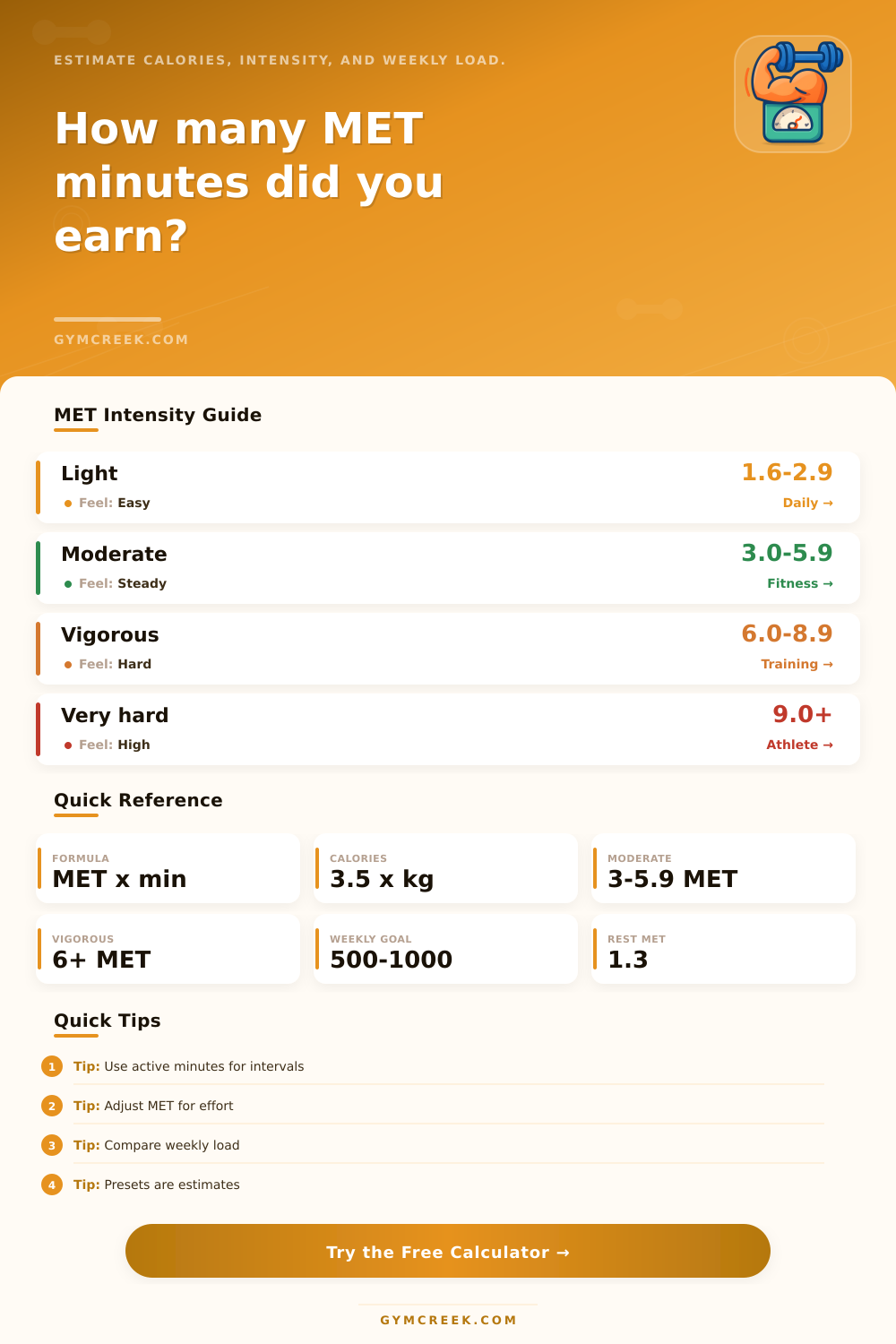
Estimate calories, MET-minutes, intensity category, activity equivalents, and weekly training load from body weight, duration, effort, and active-rest split.
📌MET Presets
Presets load common activity MET values, effort modifiers, rest splits, and weekly frequency. You can override the MET value directly.
⚙Calculator Inputs
MET session snapshot
Enter activity details to estimate calories and weekly load.
📊Metrics Grid
📑MET Reference Tables
| Activity | Light | Moderate | Vigorous |
|---|---|---|---|
| Walking | 2.3 slow | 3.5 brisk | 5.0 uphill |
| Cycling | 4.0 casual | 7.0 steady | 12.0 fast |
| Running | 6.0 easy jog | 9.8 6 mph | 11.8 7.5 mph |
| Swimming | 4.8 easy | 5.8 laps | 7.8 hard laps |
| Strength | 3.5 lifting | 5.0 tempo | 6.0 circuit |
| Category | MET range | Session feel | Weekly use |
|---|---|---|---|
| Sedentary/rest | 1.0-1.5 | Resting | Not training load |
| Light | 1.6-2.9 | Easy movement | Recovery and daily activity |
| Moderate | 3.0-5.9 | Steady breathing | Base fitness minutes |
| Vigorous | 6.0-8.9 | Hard to talk | Training sessions |
| Very vigorous | 9.0+ | High strain | Intervals or sport |
| Weekly MET-min | Read | Typical pattern | Planning note |
|---|---|---|---|
| Under 500 | Low | Short or light week | Build gradually |
| 500-999 | Baseline | Public-health range | Good general target |
| 1000-1999 | Active | Regular training | Monitor recovery |
| 2000-2999 | High | Long or vigorous week | Plan easy days |
| 3000+ | Very high | Endurance or sport block | Progress carefully |
| Metric | Formula | Uses | Notes |
|---|---|---|---|
| Active kcal | MET x 3.5 x kg / 200 x min | Exercise burn | Uses adjusted MET |
| Rest kcal | 1.3 x 3.5 x kg / 200 x min | Planned rests | Low recovery estimate |
| MET-minutes | MET x active min | Training load | Rest shown separately |
| Equivalent time | Session MET-min / compare MET | Activity swap | Same relative work |
| Weekly load | Session MET-min x frequency | Weekly planning | Compare week to week |
💡Tips
Another way to compares the relative intensities of exercise sessions is to utilize the concept of the Metabolic Equivalent of Task, or MET. One MET represent the amount of energy that a persons burns while sitting quiet. Any activities that require more energy than sitting will have MET value that are higher than one.
Because MET values can take into account the effort, time, and body weight of an individual performing exercise, MET values makes it possible to track the physical activity of an individual over time. MET values can be used to compare activities. For instance, it is possible that a forty minute brisk walk will burn the same amount of energy as a twenty-minute jog.
Using METs to Measure Exercise
To calculate MET values for these types of activity, one must choose the MET value for the activity. Additionally, an individual can use intensity modifiers to reflect the effort that an individual put into the exercise relative to the describe effort for that type of activity. Furthermore, it is also necessary to consider the rest periods that an individual took during the exercise; while no energy are burned during these periods of rest, the individual still spend time in the exercise session.
Because the energy expenditure of an activity increase with body weight, body weight must also be considered when using MET values. A 200-pound lifter will burn more calories then a 140-pound runner during a twenty-minute exercise session. Furthermore, it is also possible to use MET values to determine the total number of MET-minutes that an individual burn each week during exercise.
For instance, health recommendations are that each individual should aim for between 500 and 1000 MET-minutes each week. During training blocks, however, an individual may aim for more than 2000 MET-minutes each week. Referencing tables can be used to determine the MET values for many exercise activities.
These tables exists as a means of providing individuals with a standard value of MET for various physical activities. However, care must be taken when selecting the MET value for an activity, as the difference between MET values for moderate and vigorous activities are significant. For instance, while a steady jog may have a MET value of seven, competitive soccer games may have a MET value of eight; thus, the soccer game will burn more energy and lead to more fatigue then the game of jogging.
It is common for individuals to make errors in assigning MET values to activities. For instance, if an individual participate in an interval exercise session, some of the minutes within that exercise session may be dedicated to rest periods. Because MET values for those rest periods will be lower than those assigned to the exercise period, counting those minutes as if they had the same MET value as the exercise period will lead to inflation of the calculated MET value for that exercise session.
Thus, care must be taken to use a rest percentage within an MET calculator. Additionally, the MET values will reflect the high MET value for the active periods of exercise and a low MET value for the rest periods. The level of difficulty of an activity can also impact the MET value of that activity.
For instance, hiking on flat ground is not the same as hiking on steep mountains with a loaded pack. Though these activities may both be categorized as “hiking,” the intensity modifier can adjust the MET value assigned to the activity; the MET value can be increased or decrease by ten or twenty percent to account for the level of difficulty of the activity. MET values can be used to calculate the total number of MET-minutes that is burned during a week.
MET-minutes is calculated by multiplying the MET value of a specific exercise session by the number of times that exercise was performed during that week. The result of such calculation can be compared with each of the categories within the reference tables to ensure that an individual is meeting minimum health requirements or if the MET value is high enough to require additional recovery day each week. Finally, it is also beneficial to use MET values to compare the feeling of a specific exercise session to the MET value that is calculate from those mathematical values.
If the feeling of an exercise session matches the MET value for that exercise session, an individual understand their effort during that session. However, if those two values do not match, it is possible that the terrain change during the exercise session, the individuals fitness level increase, or adjustments should of been made to the future exercise sessions.