Metabolic Age Calculator
Estimate metabolic age from body size, lean mass, resting heart rate, waist ratio, activity, and recovery habits.
📌Presets
Presets load realistic body stats, activity levels, waist measurements, resting heart rates, and weekly training patterns. You can edit any field.
⚙Calculator
Metabolic age snapshot
Enter your stats and calculate your estimated metabolic age.
📊Fitness Metrics
📑Reference Tables
| Age gap | Reading | Common signal | Next check |
|---|---|---|---|
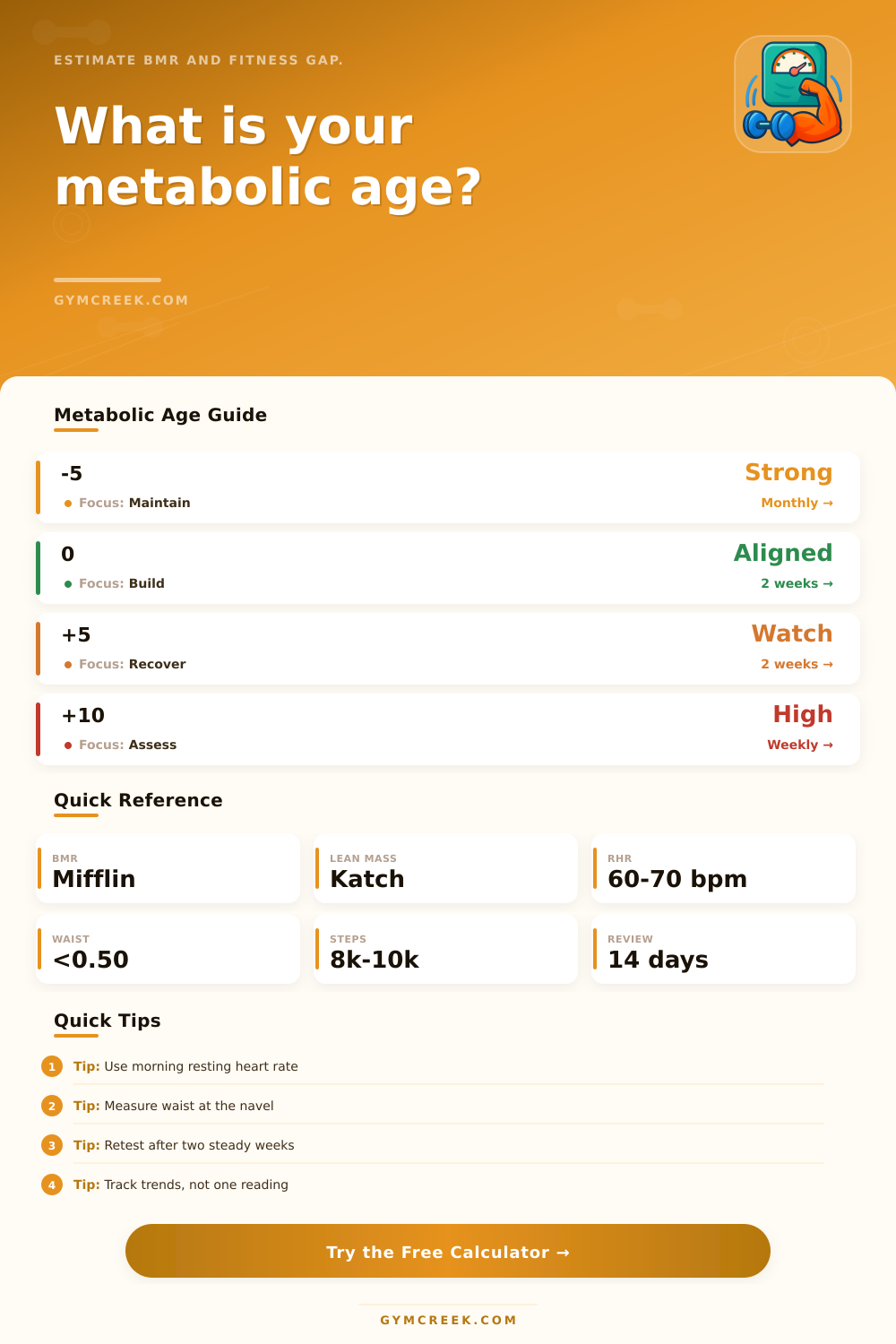
| -5 years or lower | Younger | Strong fitness markers | Monthly trend |
| -4 to +4 years | Aligned | Similar to current age | 2 to 4 weeks |
| +5 to +9 years | Elevated | Recovery or composition drag | 2 weeks |
| +10 years or more | High | Multiple markers lagging | Weekly trend |
| Marker | Lower range | Middle range | Higher range |
|---|---|---|---|
| Resting heart rate | 50-60 bpm | 61-75 bpm | 76+ bpm |
| Waist-to-height | <0.45 | 0.45-0.52 | 0.53+ |
| Daily steps | 10k+ | 6k-10k | <6k |
| Sleep average | 7-9 hr | 6-7 hr | <6 hr |
| Formula | Uses | Inputs | Best when |
|---|---|---|---|
| Mifflin-St Jeor | BMR baseline | Age, sex, size | No body fat data |
| Katch-McArdle | Lean mass BMR | Body fat % | Body fat known |
| Activity multiplier | TDEE estimate | BMR and activity | Daily burn context |
| Age solve line | Age comparison | BMR and size | Metabolic age estimate |
| Scenario | Expected pull | Why it shifts | Watch |
|---|---|---|---|
| More lean mass | Younger | Higher BMR per kg | Training load |
| High waist ratio | Older | Composition penalty | Trend, not daily |
| Low RHR | Younger | Cardio efficiency | Fatigue spikes |
| Low sleep | Older | Recovery penalty | Weekly average |
💡Tips
Nope, it’s not your birthday. But it’s probably close. Do you have any clue about your metabolic efficiency? Metabolic age attempt to show how well your body burn fuel. Forget vanity metrics such as what scale says; think of it as a health audit, a peek under the hood of your body to see if it’s running like brand-new car, or more like an older model due for some tune-ups.
The tool above do all the work for you… It uses body composition data and lifestyle factors to give you a snapshot that no calorie counter alone can provide.
What Is Metabolic Age?
Lean mass is the core mechanism at work here: Muscle tissue is metabolically expensive, whereas fat tissue is relatively cheap. When you enter your body fat percentage into our calculator, it use what’s known as Katch-McArdle formula. In essence, it asks how many calories your active tissue requires simply for survival.
Why does that matter? Because two individuals may weigh exactly the same thing come Monday morning but, by Tuesday night, they’ll have burned wildly different numbers of calorie. One person has spent years accumulating dense muscle fiber; another, more fat tissue. Their basal metabolic rate (BMR) could differ by dozens of calories per day. Which compounds into huge differences over months and years.
Another key factor in this equation is resting heart rate, which shows how well your heart work. Generally speaking, the lower the number, the less your heart has to works to pump blood while you are resting. In general, this tend to correlate with being more fit overall. Best way to measure is first thing upon waking in the morning and ideally before you’ve had your coffee jolt or stress kicked in.
The reference tables on page break this down well in terms of levels of performance. They help put your number in perspective than average numbers. If yours hovers around the upper seventies and above, the system call it out. It could potentially being dragging down your metabolic score. This doesn’t necessarily mean there’s anything wrong with you. It just means there might be room to improve through stress management or some sort of aerobic conditioning.
Next, let’s look at recovery habits. How well do you bounce back from exercise? Sleep and regular movement influence recovery. Chronic short sleep raises cortisol levels which can break down muscle and encourage fat storage, essentially a tax on your metabolism. To offset this load, the calculator takes into account not just your average hours of sleep, but also how often you train. So if you’re moderately active but getting solid rest, the math will probably reveal a younger metabolic age than someone who lifts weights five days per week but only gets five hours of sleep a night. In other words, it checks whether your lifestyle support your ambition or fights against it.
For example, it gives you an approximation of where your visceral fat is distributed, which can be determined without costly medical imaging via waist-to-height ratio. As a general rule of thumb, this should ideally be less than half of your height. Abdominal fat secretes inflammatory markers that impede our metabolism. Once you input your measurements, the calculator will spit out the value for you. No need to pull out a calculator and do some math while you lie on the ground with a measuring tape around your waist! You get a rapid sense of how good (not necessarily “how much”) your body composition is.
Everyone gets hung up on this number, forgetting about distance between here and there. If your numbers indicate an earlier age, that’s negative (you’re looking younger than you have an ID card for). If they point to a later one, that’s positive (you’ve drifted off course toward poorer functioning). What if you’re really 50 but you want to be biologically 25? That’s fine! But then the question becomes: How can I close that gap consistantly? Can I make tweaks to my inputs… Maybe adjust sleep goals, maybe alter activity level, to shift things in the right direction? And that’s when health advice goes from vague to something we can do something about. It is something concrete to work with.
The best way to get the most accurat view of whether you’re progressing isn’t by zeroing in on any particular piece of data; it’s getting a trend line over time, which lets you know what’s really going on over the weeks. That is because the body works slowly. Your data should of do the same.