🔥 Calorie Deficit Calculator for Men
Calculate your personalized daily calorie target to lose fat effectively — based on your BMR, TDEE, and fat loss goals.
| Age Group | Avg BMR (kcal/day) | Low Range | High Range |
|---|---|---|---|
| 18–25 yrs | 1,900–2,100 | 1,750 | 2,300 |
| 26–35 yrs | 1,800–2,000 | 1,650 | 2,200 |
| 36–45 yrs | 1,700–1,900 | 1,550 | 2,100 |
| 46–55 yrs | 1,600–1,800 | 1,450 | 2,000 |
| 56–65 yrs | 1,500–1,700 | 1,350 | 1,900 |
| 65+ yrs | 1,400–1,600 | 1,250 | 1,800 |
| Activity Level | Multiplier | Example | Typical TDEE |
|---|---|---|---|
| Sedentary | x 1.2 | Desk job, no gym | 2,000–2,400 |
| Lightly Active | x 1.375 | Walk 30min/day, gym 1–2x | 2,200–2,700 |
| Moderately Active | x 1.55 | Gym 3–5x/week | 2,500–3,000 |
| Very Active | x 1.725 | Daily hard training | 2,800–3,500 |
| Extra Active | x 1.9 | Athlete / labourer + gym | 3,200–4,200 |
| Category | Body Fat % | Visual Description | Health Risk |
|---|---|---|---|
| Essential Fat | 2–5% | Extremely lean, veins visible | High (too low) |
| Athletic | 6–13% | Defined abs, striations | Low |
| Fitness | 14–17% | Some ab definition | Very Low |
| Average | 18–24% | Soft, some belly fat | Low–Moderate |
| Obese | 25%+ | Significant belly fat | Moderate–High |
| Goal | Protein | Carbs | Fat |
|---|---|---|---|
| Muscle Preservation | 35–40% | 35–40% | 20–25% |
| Aggressive Fat Loss | 40–45% | 30–35% | 20% |
| Low Carb Cut | 40% | 15–20% | 40–45% |
| Balanced Deficit | 30% | 40% | 30% |
| Deficit / Day | Loss / Week | Loss / Month | Muscle Risk |
|---|---|---|---|
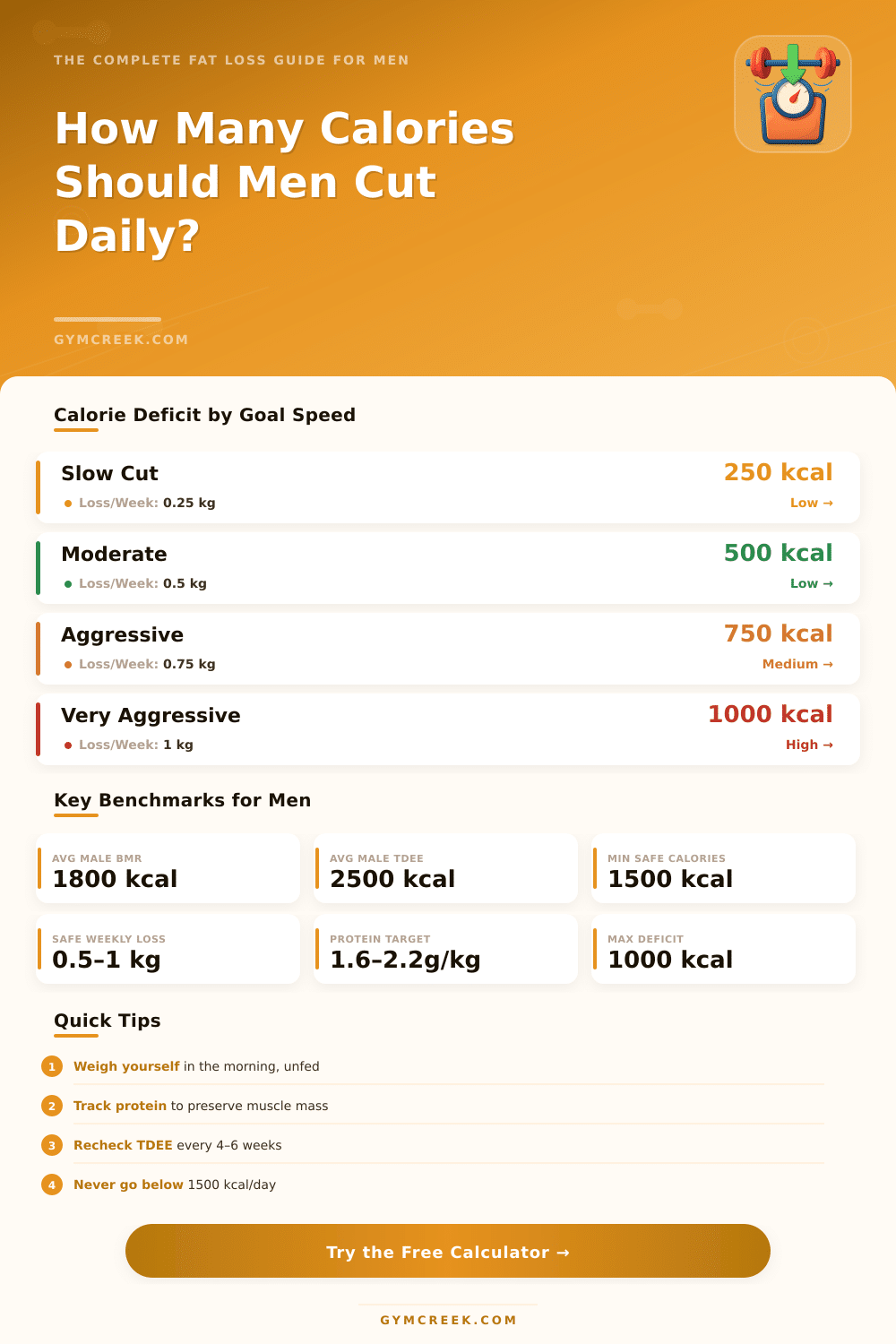
| ~250 kcal | ~0.25 kg (0.5 lb) | ~1 kg (2.2 lb) | Very Low |
| ~500 kcal | ~0.5 kg (1 lb) | ~2 kg (4.4 lb) | Low |
| ~750 kcal | ~0.75 kg (1.5 lb) | ~3 kg (6.6 lb) | Moderate |
| ~1000 kcal | ~1 kg (2.2 lb) | ~4 kg (8.8 lb) | Higher |
Your body reaches Calorie deficit when it uses more energy than you give to it through food. Consider Calorie as fuel, your body needs it for every task, from keeping your heart beating to processing food and simply breathing. While you maintain such deficit, your body dips into its fat stores to cover the gap.
DISCLOSURE: This post may contain affiliate links, meaning when you click the links and make a purchase, I receive a commission. As an Amazon Associate I earn from qualifying purchases.

For Men, experts widely do not advise to go under 1 500 calories daily without close control. Here the key point though: even if a guy simply sits the whole day without motion, his body quietly burns around 2 000 calories. So if he picks 1 700 while his body uses 2 000, that creates a 300-Calorie gap right there.
How to Make a Safe Calorie Deficit
Healthy deficit normally falls between 200 and 500 calories under what you usually eat to keep weight. If you push it to 500 calories a day, you can expect loss of one pound each week… Because to lose a pound needs around 3 500-Calorie total deficit.
Although many folks find that 500 a day is quite a lot. Most of the time, hitting 300 to 500 calories under normal level is enough to lose weight, without leaving you hungry or tired.
Assume that some guy burns 2 500 calories in a typical day. If he eats around 2 000, that forms a 500-Calorie gap, that is manageable. That smarter method really helps to protect muscles without harm.
Small and steady changes beat drastic changes, when dealing with reaching long-term results.
Going too hard with deficit brings real dangers. If you cut calories too sharp for too much time, your metabolism can slow down, lack of nutrients comes up and you ultimately lose muscles together with the fat. Big deficits mess up your hormones, mood and even how your body works inside.
Muscle loss becomes almost unavoidable, when things reach such extremes.
Do not forget about nutrients. Proteins deserve the most attention… Aim for around 1,5 grams for every kilo of your weight.
For Men, the fat intake should not fall under 50 grams daily; go lower and the production of testosterone takes a hit. The remaining calories then come from carbs, best the complex kind, saving simple sugars for after you end the diet. High protein in deficit together with regular training?
It forms the main recipe for losing fat, while you preserve muscles.
You really need to track what you eat. The only reliable way to make sure that you really are in deficit, is to log everything during a week, average it, then compare with your daily Calorie use. Online calculators for TDEE help make that more simple.
But warning: labels on foods can err by 20 to 25 percent, so always leave a bit of room.
Drop one heavy food item; for instance a donut or brownie… And spare around 250 to 350 calories. Add 150 to 300 minutes of activity each week to give a firm base for lasting weight loss.
One extra pound of muscle? It burns around 45 to 50 extra calories each day, which adds up surprisingly quicklyduring time.