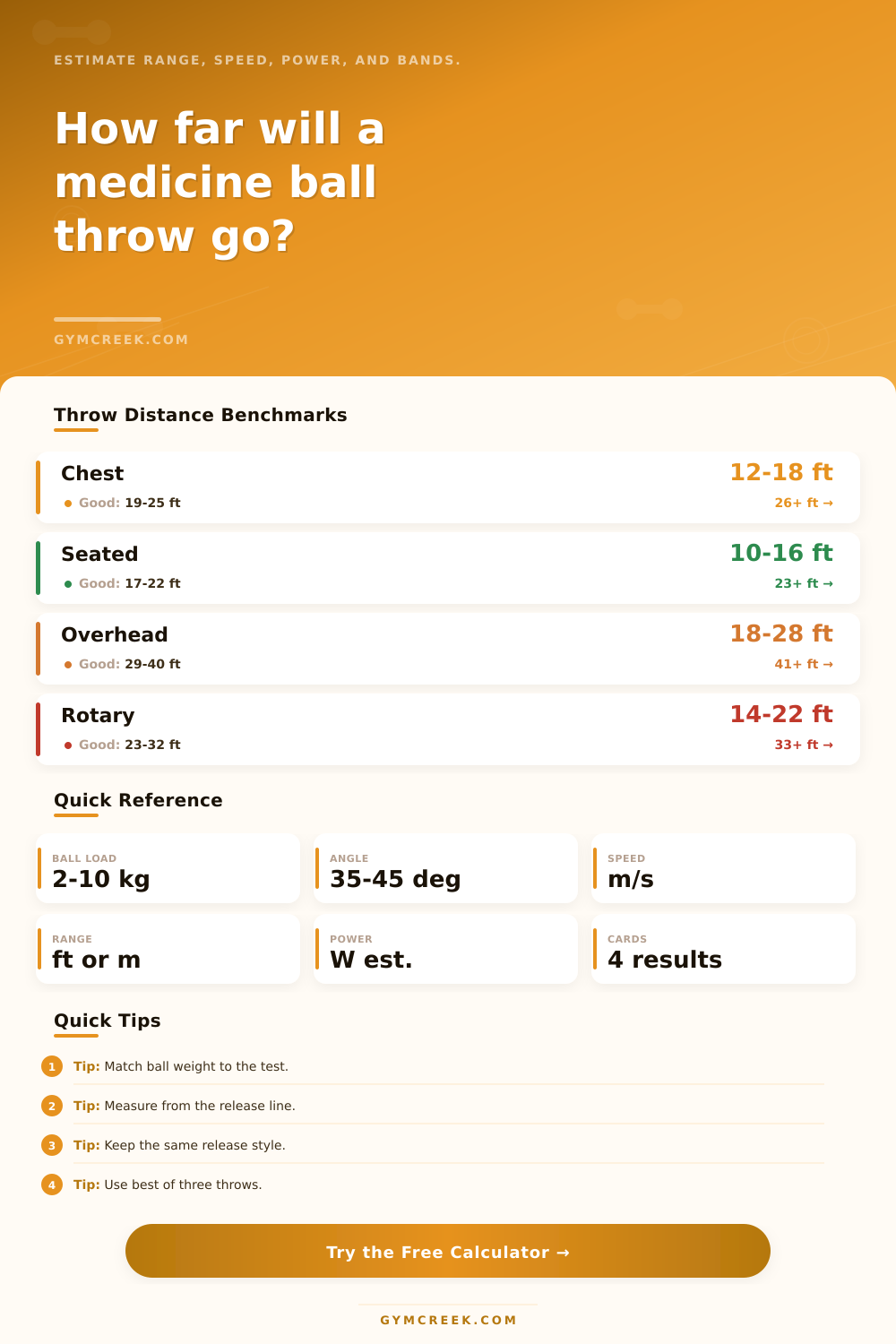
Medicine Ball Throw Distance Calculator
Estimate medicine ball throw distance from release speed, angle, height, ball weight, throw style, and test setup, then compare power and momentum markers.
📌Presets
Each preset loads a realistic athlete, medicine ball load, release angle, measured throw, and style modifier.
⚙Calculator
Medicine ball throw snapshot
Enter a valid ball load, release speed, angle, and release height to estimate throw distance.
📊Throw Metrics Grid
🧮Formula Cards
📑Reference Tables
| Throw Test | Developing | Good | Power Marker |
|---|---|---|---|
| Standing chest pass | 12–18 ft | 19–25 ft | 26+ ft |
| Seated chest pass | 10–16 ft | 17–22 ft | 23+ ft |
| Overhead forward | 15–24 ft | 25–34 ft | 35+ ft |
| Overhead backward | 18–28 ft | 29–40 ft | 41+ ft |
| Rotational side throw | 14–22 ft | 23–32 ft | 33+ ft |
| Ball Load | Metric | Best Fit | Watch For |
|---|---|---|---|
| 4–6 lb | 2–3 kg | Youth or speed work | Too light for max power |
| 8–10 lb | 4–5 kg | Most field tests | Use the same ball |
| 12–16 lb | 6–7 kg | Strength-biased throw | Speed may drop sharply |
| 18–22 lb | 8–10 kg | Advanced power work | Technique must stay clean |
| Angle Zone | Likely Effect | Useful For | Common Fix |
|---|---|---|---|
| 25°–32° | Fast, low flight | Chest pass tests | Finish taller |
| 33°–42° | Balanced range | Most throws | Keep speed high |
| 43°–50° | More hang time | Overhead throws | Avoid floating |
| 51°+ | Vertical loss | Rare test setups | Drive outward |
| Formula | Variables | Output | Use |
|---|---|---|---|
| Range | v, angle, h | Distance | Projected throw |
| Inverse range | distance, h | Needed speed | Measured test |
| Kinetic energy | mass, speed | Joules | Ball output |
| Relative power | power, body | W/kg | Body-size context |
💡Tips
If you’ve been around sport at all, you’ve probably witnessed this scene: An athlete winds up, a coach blows a whistle, and a heavy leather ball hurtles through the air. On one hand, it appears as raw athleticism; on the other, it’s a physics problem. Explosive power is measured by the medicine ball throw. And with no context, it can be difficult to understand what this means.
You may be able to throw it twenty feet and feel good about your performance. Your teammate could only manage eighteen feet and think they’re a failure. The distance doesn’t tell whole story. The variables that affect flight path are key to knowing how well you’re performing.
Why the Medicine Ball Throw Matters
Once you input your release speed estimate, ball weight and body metrics into the calculator, it do the math for you. You don’t have to guess at what’s going on with aerodynamic stuff.
One thing many folks think is true, a steeper throw will go farther then any other angle. While there is some truth to that, it’s a misconception most of the time. Getting a higher angle mean increased hang time, but without being able to maintain your level of force output, it actualy robs the ball of forward speed. Typically, the sweet spot for maximum distance is between thirty-five and forty-five degrees. That’s because this range offers enough vertical lift to keep the ball in the air while still getting the necessary horizontal drive to make ground. Too high an angle, and the ball peaks out and falls short. Too low an angle, and it’ll hit the floor before it has a chance to travel far.
Besides the angle, the other thing about a ball is how heavy it is. If you have a light ball, then you can get it moving pretty quickly at the end of your release, increasing its momentum, but it might not engage those fast-twitch fibers as effectivey. On the flip side, if you go too heavy on the ball, then it will slow your release down, reducing your distance even though it has more mass. This tool estimates your watts. This is a good way to find that sweet spot: heavy enough to engage the fast twitch fibers, but not so heavy that it kills your release speed.
Why is it a good metric? It adjusts your performance based off bodyweight. So while an athlete who weighs one-hundred-fifty pounds and another weighing two-hundred may throw roughly the same distance, the smaller athlete are creating more power in relation to his or her bodyweight. And that makes a difference when measuring progress over time or developing a training program.
This has a major impact on your score. A lot of people can make an awesome throw one time and never be able to repeat it. With the calculator, you’re able to put in a tiredness adjustment that will take into account how much worse you’ll perform when making repeated attempts. In other words, nobody is going to lay down maximum effort 12 times in a row. That’s a realistic addition, as it will take into account the wear-and-tear and give you a better idea of your sustainable power versus your peak one-rep max. It makes you consider durability just as much as explosiveness.
As you review the tables of reference points listed on this page, you’ll notice there are categories such as the rotational shot or the chest pass. These categories is based on which muscles are recruited. For example, the rotational throw use the glutes and hips. The chest pass is more core and upper-body transfer. Getting frustrated comes from comparing your results to the wrong benchmark. You want to compare to other athletes of a similar build and using the same protocol.
In the end, however, the medicine ball throw are a diagnostic test. It tells you what part of your body leaks power. Maybe you lack rate of force development, which means low speed but a great angle. Maybe something in your technique is wrong, such as having high speed but poor distance. Your data provides the diagnosis; your feel and eyes will provide the fix.
Trust yourself and use the tool as a way to set a starting point, then let your body do the rest. That initial thud on the ground isn’t the finish line: it’s the start of the conversation. You should of used this sooner.