McQuaig Mental Agility Test Calculator
Estimate practice score, percentile band, pacing, completion, accuracy, and role benchmark fit for McQuaig-style mental agility practice results.
📌Practice Presets
Presets load realistic practice outcomes. Edit the inputs to match your own timed practice test before using the estimate.
⚙Calculator Inputs
Mental agility practice snapshot
Enter practice-test results to estimate score, pacing, accuracy, and benchmark readiness.
📊Practice Metrics Grid
📑Reference Tables
| Scaled score | Practice band | Typical signal | Next review focus |
|---|---|---|---|
| Under 20 | Foundation | Timing or core item types need work | Untimed review, then short timed sets |
| 20-24 | Developing | Enough accuracy to build from | Raise completion without guessing wildly |
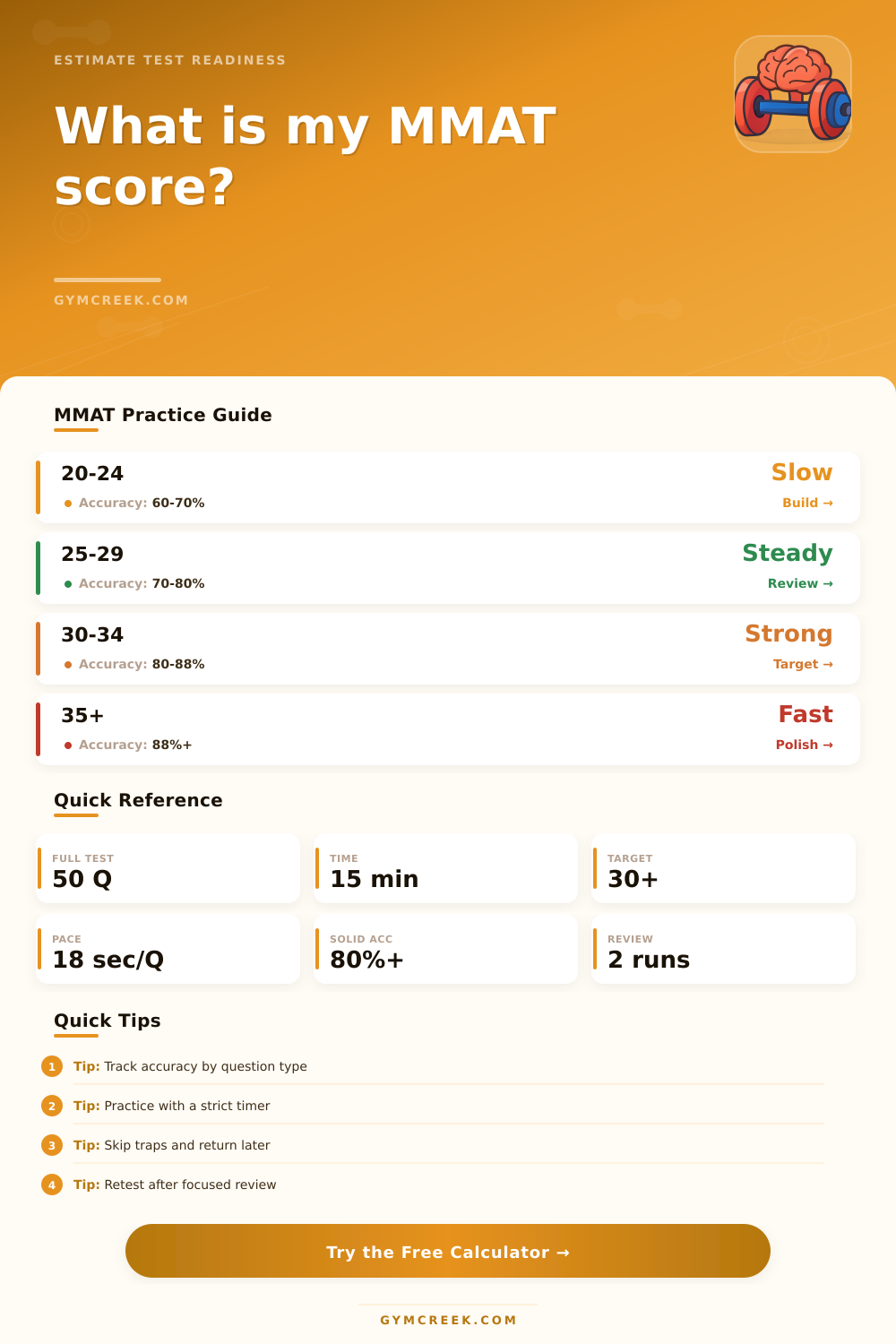
| 25-29 | Competitive | Solid general applicant range | Find the weakest question family |
| 30-34 | Strong | Good speed and accuracy blend | Reduce avoidable misses |
| 35 plus | Very strong | Fast, accurate, and complete | Keep pace consistent under pressure |
| Role setting | Planning target | Why it matters | Watch point |
|---|---|---|---|
| General applicant | 25 / 50 | Balanced baseline for mixed roles | Do not overfit one practice test |
| Administrative / coordinator | 23 / 50 | Accuracy and steady processing | Avoid rushing simple items |
| Sales / client-facing | 26 / 50 | Quick pattern recognition and decisions | Keep accuracy above 70% |
| Supervisor / team lead | 28 / 50 | Broad reasoning and prioritization | Balance verbal and numerical scores |
| Analyst / problem solving | 31 / 50 | Higher reasoning load and precision | Numerical misses matter more |
| Technical / operations | 30 / 50 | Detail, logic, and paced execution | Check pattern and sequence items |
| Manager / senior role | 32 / 50 | Fast judgement across mixed items | Watch overconfidence on hard items |
| Format | Target pace | Completion note | Practice use |
|---|---|---|---|
| 50 questions / 15 min | 18 sec per question | About 3.33 attempts per minute | Best final rehearsal format |
| 30 questions / 10 min | 20 sec per question | About 3 attempts per minute | Useful mid-length check |
| 20 questions / 6 min | 18 sec per question | High pressure short drill | Good for speed blocks |
| Custom practice | Limit divided by questions | Use a consistent timer | Compare like with like |
| Metric | Formula | What it estimates | Limit |
|---|---|---|---|
| Raw score | Correct answers | Simple practice result | Not official reporting |
| Adjusted score | Correct minus wrong penalty | Guessing risk | Penalty is user-selected |
| Scaled score | Adjusted / total x 50 | Compares different practice lengths | Assumes similar difficulty |
| Percentile | Normal estimate around practice mean | Relative performance band | Not a normed MMAT report |
| Readiness index | Score, accuracy, pace, completion, balance | Practice readiness signal | Needs repeated tests |
💡Tips
The vast majority of folks view timed cognitive tests as sprints. Grab your pencil, look up at the clock, and attempt to race eyes around the page until the time runs out. Because it’s in your face, that seem like the right thing to do. But it’s also the largest mistake you’ll make when practicing for a McQuaig Mental Agility Test. The timer isn’t measuring how quickly you can panic. It’s looking for someone who can think clearly and process information with a bit of time pressure. These is two very different skill sets, and one will lead to a lower score more quicklier than the other.
After inputting your practice performance (above), the calculator will do the rest for you. It won’t simply spit out how many correct responses you got; it will look through nuance that’s typically obscured by a plain old scoring sheet. It assess your pace, precision, and sectional weighting all at once. That matters, since a high score resulting from reckless guesswork on difficult questions has a different structure than a moderate one derived from methodical thinking. Those differences translate into the tool’s assessment of your relative percentile band. Plus your fit within the overall benchmark distribution. Does this mean you’re prepared for work as an analyst? Or have you merely lucked into getting most of the simple stuff right?
How to Prepare for the Test
The key prep is understanding the inputs. How do you parse correct (abstract/verbal/numerical) responses? Each candidate has a blindspot, either abstract or numerical or verbal. For example, you’re good at reading between the lines fast but can’t handle the number series well. Or you nail the spatial ones but misinterpret some small nuance in the word analogy. The system flag this imbalance. The adjusted metric will show how vulnerable you are if your verbal is strong but your numbers isn’t. It keeps you from being falsely confident about averaging out a weak point.
Intuition also doesn’t help with pacing. There’s about eighteen seconds per question in the traditional format. It sounds like very little time, but if you don’t linger, it’s actualy more than enough. Test-takers tend to take two minutes on an abstract reasoning problem and then rush subsequent ten to make up for lost time. You can see this time vs. Completion breakdown on the calculator to better understand how to adjust based off your pace. If you’re spending too much time but getting questions right, the calculator alerts you that you should of practice faster. If you feel like you’re missing some obvious traps but you still go quickly, it flags that you should slow down and review deliberatly. This kind of feedback loop is key to turning raw ability into consistent performance.
This is why they have those reference tables on the page. They gives you a reasonable target to shoot for. These are outlines of what various types of roles usually expect from their applicants. For example, administrative jobs may value consistent but not necessarily blazingly-fast processing speeds with no need for high-level pattern recognition skills. Meanwhile, senior management jobs requires lightning-quick decisions over a variety of items. This allows you to know if you’re aiming for a weak spot that needs serious improvement, or a strong spot that only requires fine-tuning. This changes the objective from achieving perfection to reaching some sort of practical benchmark.
As much as possible, practice should be like a test. Use a strict timer. Consider each practice period a test. Don’t stop during the test to google the answer. Mark your best guess and move on. That’s especially where the confidence input on the calculator can help. It requires you to confess which ones were shots in the dark versus those that made sense. Those high scores built upon low confidence have shaky foundations. They crumble when exposed to the pressure of a real test because they weren’t founded on true understanding.
And in the end, mental agility really is something we can teach ourselves. With practice in different kinds of questions and feedback (even if it’s negative feedback) about our mistakes, we gets better at this. And that’s where the calculator comes in. It gives us that instant feedback loop. Instead of fuzzy test-anxiety feelings, we have hard data points we can address. We begin to understand precisely how our accuracy change as we strive for speed and exactly where our time goes. This is how we go from random guesses to strategic tests, and that’s what will set you apart.
Ultimately, that’s why you’re taking this: so you can walk in knowing your reading speed, your weak spots, and what you need to work on. Have you been able to practice enough so that you can turn off the clock and just read the question? You’ll be more comfortabley; that will make the test feel more like a routine. And that mental switch is sometimes all the difference between performing and just being there.