Mayhew 1RM Calculator
Estimate one-rep max strength with the Mayhew equation, then translate the result into training maxes, rep equivalents, confidence, and rounded loading targets.
📌Mayhew Test Presets
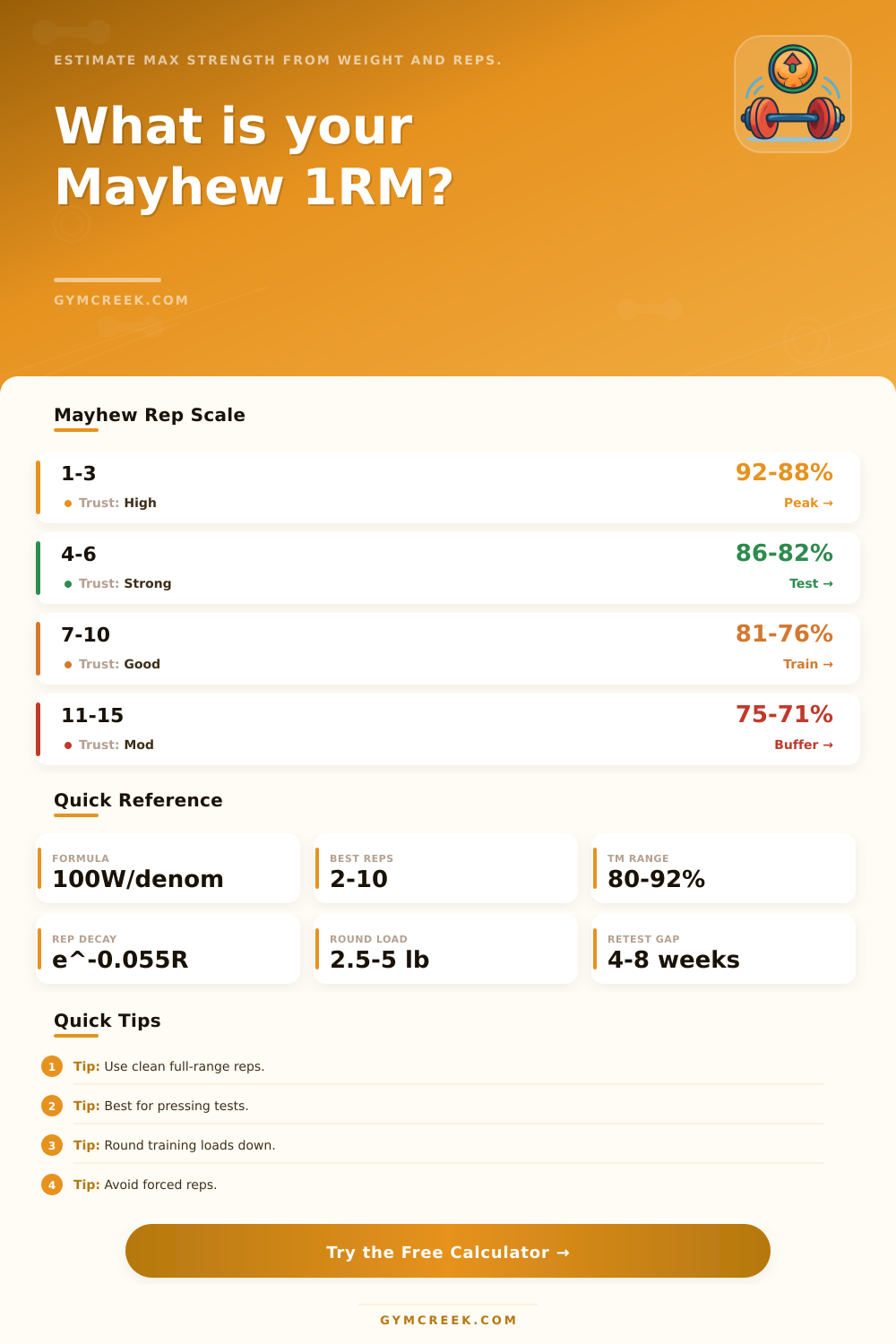
Each preset uses the Mayhew equation only: 1RM = 100W / (52.2 + 41.9e^(-0.055R)).
⚙Calculator Inputs
Mayhew strength snapshot
Enter a tested set to estimate max strength and training loads.
📊Mayhew Metrics
📑Reference Tables
| Clean reps | Formula denominator | Estimated load share | Reading |
|---|---|---|---|
| 1 | 91.9 | 91.9% of 1RM | Mayhew still predicts above the tested single |
| 3 | 87.8 | 87.8% of 1RM | Good for heavy but not maximal sets |
| 5 | 84.0 | 84.0% of 1RM | Strong practical testing range |
| 8 | 79.2 | 79.2% of 1RM | Useful when reps stay technical |
| 10 | 76.4 | 76.4% of 1RM | Upper end of strong confidence |
| 15 | 70.5 | 70.5% of 1RM | Use a larger training buffer |
| Planned load | Mayhew-equivalent reps | Best use | Planning cue |
|---|---|---|---|
| 90% of estimate | About 2 reps | Heavy skill practice | Use only when warmed up well |
| 85% of estimate | About 4-5 reps | Strength top set | Keep one clean rep in reserve |
| 80% of estimate | About 7 reps | Volume strength | Stable bar path matters |
| 75% of estimate | About 11 reps | Back-off work | Fatigue changes accuracy |
| 70% of estimate | About 15 reps | Estimate only | Treat as lower confidence |
| Training max choice | When to use | Confidence need | Mayhew note |
|---|---|---|---|
| 75-80% | After time away | Low to moderate | Good when the test had high reps |
| 82-87% | General strength block | Moderate | Works well after 5-10 rep tests |
| 88-92% | Focused strength block | High | Best after crisp low-rep sets |
| 93-95% | Short peak block | Very high | Use only with recent heavy practice |
| Scenario | Test style | Main output | Why it matters |
|---|---|---|---|
| Bench Five Builder | Moderate reps | Block setup | Stable Mayhew range for most lifters |
| Paused Triple Check | Low reps | Heavy estimate | Pause lowers confidence buffer slightly |
| High-Rep Warning | 12+ reps | Estimate only | Endurance effect grows quickly |
| Dumbbell Conversion | Total load | Press context | Stability limits may reduce transfer |
💡Mayhew Notes
The Mayhew equations allows you to estimate your one-rep max. The Mayhew equation takes the weight that you lifted for a specific number of repetitions and translates that to your one-rep max. You can use the Mayhew equation instead of performing a single one-rep max lift. The Mayhew equation is useful because it allows you to determine your one-rep max without lifting the weight that represent your one-rep max. The calculator include above allows you to complete the calculations of the Mayhew equation without having to solve the exponential equation yourself. The Mayhew equation works because the equation models the diminishing output of strength that occurs with fatigue in the bodies.
The larger denominator of the equation represent the decreasing strength as the repetitions performed increases. The Mayhew equation is the most accurate in the range of repetitions in the middle of the possible number of repetitions that can be performed. The Mayhew equation is more accurate in this range because the form and strength of lift performed do not degrade during this range of repetitions.
Find Your One-Rep Max with the Mayhew Equation
Most people choose a repetition range of three to ten repetitions for a number of reasons, the most important of which is that data is the most reliable within this range of repetitions. The inputs that you have to provide to the calculator are important to the accuracy of the equations outcome. You must select the type of lift that you performed because the outcome of a paused lift will not be the same as a touch and go lift.
You must account for your physical readiness because if your nervous system is tired, you will be able to lift less weight. Your preferred repetition rate is also an input because if your repetitions are slow or difficult it will impact the one-rep max that you can lift. These parameter will lead to a confidence score for the outcome of the calculator.
The training max percentage is a value that you must choose after the tool calculates the one-rep max. This percentage will dictate the amount of your calculated one-rep max that you will use during your training session. A percentage that is set low will allow for the performance of more technical lift during training, while a higher percentage suggest that you have experience in lifting heavy weights. The load factor that the tool applies to the training max percentage is based off the confidence score for the one-rep max percentage that the tool calculates.
Body weight is used as a factor to calculate your relative strength, or how much of your body weight you are able to lift. Relative strength is a comparison of the body weight to the weights lifted. An individual who can only lift their body weight isnt lifting as much strength as an individual who can lift only a small fraction of their body weight.
This ratio does not replace the one-rep max calculation, but provides context to the information provide by that calculation. The reference tables included with the calculator allow you to see the percentage of your one-rep max that can be performed for a specific number of repetitions. A set of five repetitions will typically fall into a zone where technique is maintain, but a set of fifteen repetitions may approach the limit of the effectiveness of the Mayhew equation.
The tool will flag a high number of repetitions with a caution zone, as the Mayhew equation is less accurate with high repetitions than with a moderate number of repetitions perform. The reverse calculation is performed in the opposite direction to the Mayhew equation. The reverse calculation will allow you to calculate how many repetitions you can perform for a given weight.
Athletes or weightlifters who would like to ensure that they can lift a specific amount of weight during there training sessions may use this calculation. Common mistake with the Mayhew equation include treating the outcome of the equation as an exact number. Because the outcome of the equation is a directional estimate of your one-rep max, small changes to your bodys condition or your performance of the exercise can have a big impact upon your actual one-rep max. You must account for the confidence score and the posture of the lift in these situation, otherwise the estimate provided by the Mayhew equation will not be as reliable as possible.
In the long run, the Mayhew equation provide value to those who use it regularly. By retesting your one-rep max every four to eight week, you can monitor your strength. By monitoring your one-rep max, you can learn whether certain repetition range are more effective than others.
Furthermore, you can learn whether your training max percentages are appropriate to your goal. Overall, the Mayhew equation provides a means of translation from the work you have performed to the numbers you can use to plan your future training.