Maximum Heart Rate Calculator
Estimate maximum heart rate from age, sex, formula choice, resting heart rate, tested max HR, training status, sport type, and medication caution, then compare HR zones and training caps.
📌Heart Rate Presets
Presets load realistic training profiles. Adjust the values after loading, especially if you know a tested max HR or take medication that changes heart-rate response.
⚙Calculator Inputs
Maximum heart rate snapshot
Enter age, resting HR, formula choice, sport, and training status to estimate HRmax and zones.
📊Metrics Grid
📑Formula Tables and Exact Rules
| Formula | Rule | Best fit | Calculator use |
|---|---|---|---|
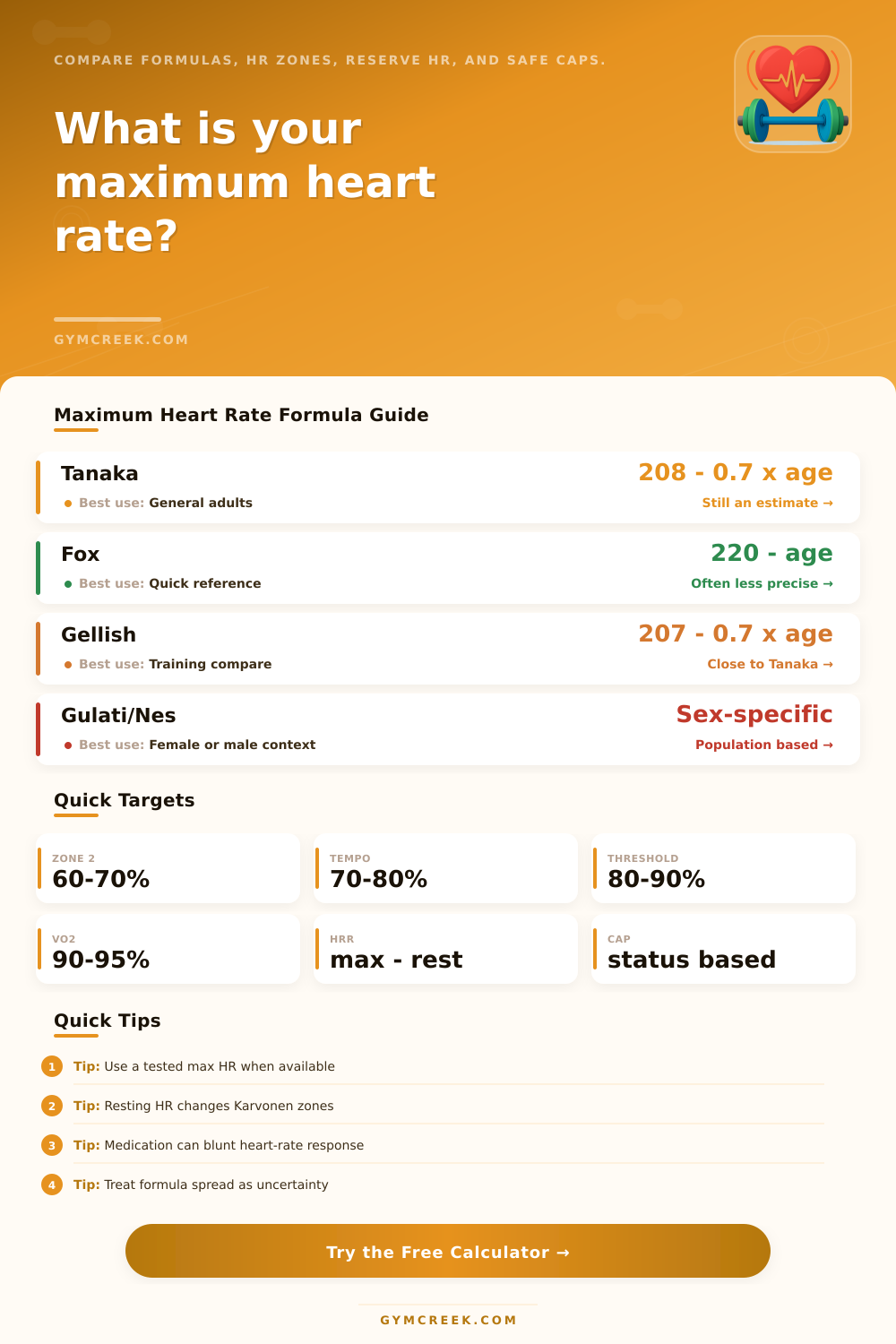
| Tanaka | 208 - 0.7 x age | General adults | Included in average and available as a primary choice |
| Fox | 220 - age | Simple reference | Shown for comparison because many plans still quote it |
| Gellish | 207 - 0.7 x age | Exercise training comparison | Included in formula spread |
| Gulati | 206 - 0.88 x age | Female adults | Used as sex-specific estimate when sex is female |
| Nes/HUNT | 211 - 0.64 x age | Male sex-specific context | Used as sex-specific estimate when sex is male |
| Inbar | 205.8 - 0.685 x age | Additional adult comparison | Included in average and spread |
| Zone | % of max HR | Karvonen / HRR rule | Typical use |
|---|---|---|---|
| Recovery | 50-60% max | 50-60% HRR + resting HR | Easy warm-ups, recovery, return days |
| Zone 2 aerobic | 60-70% max | 60-70% HRR + resting HR | Base endurance and steady aerobic work |
| Tempo | 70-80% max | 70-80% HRR + resting HR | Moderate sustained work |
| Threshold | 80-90% max | 80-90% HRR + resting HR | Hard sustainable intervals or tempo blocks |
| VO2 / peak | 90-95% max | 90-95% HRR + resting HR | Short hard intervals for trained athletes |
| Profile | Base cap | Sport adjustment | Caution |
|---|---|---|---|
| Beginner | 85% of selected max | Walking/swimming may reduce cap further | Use talk test and gradual progression |
| Returning from layoff | 80% of selected max | HIIT is capped more conservatively | Build easy weeks first |
| Recreational | 90% of selected max | Cycling and swimming often run lower than running | Limit frequent near-max days |
| Trained | 95% of selected max | Intervals allowed when recovery is good | Use tested max for best precision |
| Competitive | 98% of selected max | Event-specific testing is preferred | Hard caps should be coach or clinician guided |
| Medication caution | Cap reduced by 10-15% | Use RPE instead of chasing HR | Ask a clinician for individualized exercise limits |
| Step | Rule | Inputs used | Output |
|---|---|---|---|
| Formula estimates | Calculate Tanaka, Fox, Gellish, sex-specific, and Inbar from age | Age, sex | Multiple HRmax estimates |
| Formula choice | Selected formula becomes primary; average uses all formula estimates; tested mode uses tested max if valid | Formula choice, tested max | Selected max HR |
| Formula spread | Highest formula estimate minus lowest formula estimate | All formula estimates | Uncertainty range in bpm |
| Reserve HR | Selected max HR minus resting HR | Max HR, resting HR | HRR in bpm |
| Percent zones | Selected max HR x zone percent bounds | Selected max HR | Classic HR zones |
| Karvonen zones | Resting HR + HRR x zone percent bounds | Resting HR, HRR | Reserve-based zones |
| Training cap | Selected max HR x status cap x sport adjustment, then medication adjustment | Status, sport, medication | Practical training cap |
| Safety flag | Flag rises for medication, tested-vs-formula gap, low HRR, high spread, or aggressive status | All inputs | Caution label and notes |
💡Tips
Maximum heart rate is a number that represents the highest number of beat per minute that a persons heart can produce during intense physical activity. Many people knows how to use maximum heart rate to determine there training zones for the heart. However, many people dont know they’re actual maximum heart rate.
Knowing one’s maximum heart rate are essential because the maximum heart rate form the basis for training zones for the heart. If someone incorrectly calculates the maximum heart rate, then the training zones for the heart will be incorrect, and an inaccurate number of training zones will results in inaccurate training session for the person. Due to the fact that many people do not perform the required laboratory test to determine there actual maximum heart rate, people use the age based formula for estimating one’s maximum heart rate.
How to Find Your Maximum Heart Rate
One such formula is taking 220 and subtract the age of the individual. Other formulas exist that may result in a different starting number or a change in the rate of change for that formula. These different formula may result in different answers for the same individual because each formula used different population for the calculations.
Another measurement that can be used for calculating an individual’s maximum heart rate is the concept of heart rate reserve. Heart-rate reserve is calculated by taking an individual’s resting heart rate and subtracting it from there maximum heart rate. Heart-rate reserve help to show the difference between an individual’s resting and maximum heart rates.
The individual with a lower resting heart rate will have a more higher heart-rate reserve than an individual with a higher resting heart rate. The percentage of heart-rate reserve can feel differently for each individual. An individual’s type of exercise and fitness level can impact how an individual reaches there maximum heart rate.
For instance, an individual who swims or rides a bicycle may reach a lower maximum heart rate than an individual who run. This is because the position of the individual’s body when swimming and cycling can impact how much the heart respond to the exercise. Additionally, an individual who is a beginner to a particular exercise may reach a lower maximum heart rate than an athlete who perform that same exercise.
This is because beginners need to avoid fatigue during there workout. Furthermore, an individual who takes medication that impact the heart can have unreliable measurement of there maximum heart rate. For instance, individuals who take beta blockers may experience that there heart do not reach the same percentage of maximum heart rate as those without such medication.
Individuals with medication that impact the heart should not use the maximum heart rate as the main indicator of how strenuous or not strenuous there exercise should be. Instead, they should use the individual’s perceived effort while performing exercise. An individual should not use the first calculation of there maximum heart rate as there permanent number for that individual.
There is various reason why an individual’s maximum heart rate could change. An individual’s fitness and health level change with time. Additionally, individuals ages and health status can change.
Finally, the different type of tests for measuring an individual’s maximum heart rate can result in different answers for the same individual. Therefore, an individual should compare the estimated maximum heart rate to how they feel during there workouts and when they rest. Any discrepancy between the two indicate that the estimate for maximum heart rate should of be adjusted to more accurate reflect the individuals actual rate.