Marathon Hydration Calculator
Build a race-day hydration script that converts marathon pace, weather, sweat rate, and aid-station spacing into fluid, sodium, and carbohydrate targets you can actually execute on course.
📌Preset Race Setups
Each preset loads a believable marathon combination of pace, heat, sweat rate, cup size, and station spacing so you can compare faster road pacing, humid race management, and higher-sodium plans without rebuilding the sheet from scratch.
⚙Planning Inputs
Marathon hydration blueprint
Enter your pace, weather, and station details to build a cup-by-cup race script.
📊Execution Grid
📑Reference Tables
| Race feel | Temp band | Humidity | Sweat read |
|---|---|---|---|
| Cool | Below 50 F | Under 50% | Base rate or slightly under. |
| Mild | 50-64 F | 50-65% | Usually close to training average. |
| Warm | 65-74 F | 55-75% | Expect a meaningful increase. |
| Hot or sticky | 75 F plus | 70% plus | Grip fluid early and plan extras. |
| Finish band | Hourly range | Common split | Best use |
|---|---|---|---|
| Under 3:15 | 50-70 g/h | Drink plus gels | Fast pacing with less station time. |
| 3:15-4:15 | 55-75 g/h | Even hourly feed | Balanced road-marathon fueling. |
| 4:15-5:15 | 60-85 g/h | Small, frequent hits | Longer exposure and more station use. |
| Over 5:15 | 60-90 g/h | Lower-dose repeats | Stretch intake across the full day. |
| Sweat sodium | Hourly target | Course drink help | Typical cue |
|---|---|---|---|
| 400-600 mg/L | 250-450 mg/h | Cups may cover most. | |
| 600-900 mg/L | 400-700 mg/h | Drink plus a little backup. | |
| 900-1200 mg/L | 600-900 mg/h | Supplement planning matters. | |
| 1200+ mg/L | 800-1100 mg/h | Use measured sodium support. |
| Spacing | Stop rhythm | Cup pressure | Practical note |
|---|---|---|---|
| 1 km or less | Very frequent | Low | Small grabs usually work. |
| 1.5-2 km | Steady | Moderate | Most road plans sit here. |
| 2.5-3 km | Longer gap | Higher | Carry fluid early if hot. |
| Over 3 km | Sparse | High | Bottle support often helps. |
| Station | Distance | ETA | Fluid plan | Fuel note |
|---|---|---|---|---|
| 1 | -- | -- | Enter race details. | The stop-by-stop ladder updates after calculation. |
| 2 | -- | -- | Use pace and spacing. | Plan fluid, carbs, and sodium together. |
| 3 | -- | -- | Carry counts too. | Long gaps may need extra bottle support. |
| 4 | -- | -- | Hot weather lifts demand. | Review the ladder before race morning. |
💡Race Notes
Do not make your first long-run sweat test during race week. Use a pace and weather combo from training so the planner starts with a baseline sweat rate and gut limit you already trust.
When the calculator asks for more than two cups at each stop, the issue is not arithmetic. It usually means your course spacing, temperature, or fluid tolerance says you should start with a bottle or lower the hourly coverage target.
Running a marathon require a person to remain adequately hydrate during teh event. Hydration involve managing the fluid, salt, and sugar level for the runner. If a person dont manage these correct, they may experience physical difficulty during the second half of the marathon.
One of the main reason that a person must manage their fluid levels is to ensure that they are replacing the fluid that they lose through sweating. Sweat is the main way that a person lose fluid from there body while running. Many runners can lose between 0.8 and 2 liter of fluid each hour while running, but the amount of fluid that each person loses through sweating can vary.
How to Stay Hydrated and Fueled in a Marathon
A runner can determine their own rate of fluid loss by weighing themselves prior to running, and again after they have completed their run while wearing their normal clothes and dried with a towel. They should not replace 100% of the fluid that they lose through running, but should aim to replace between 70 and 85% of their total fluid loss to avoid developing stomach discomfort or cramp. A runner’s pace and the temperature in which they are running can impact the amount of fluid that they lose through sweating.
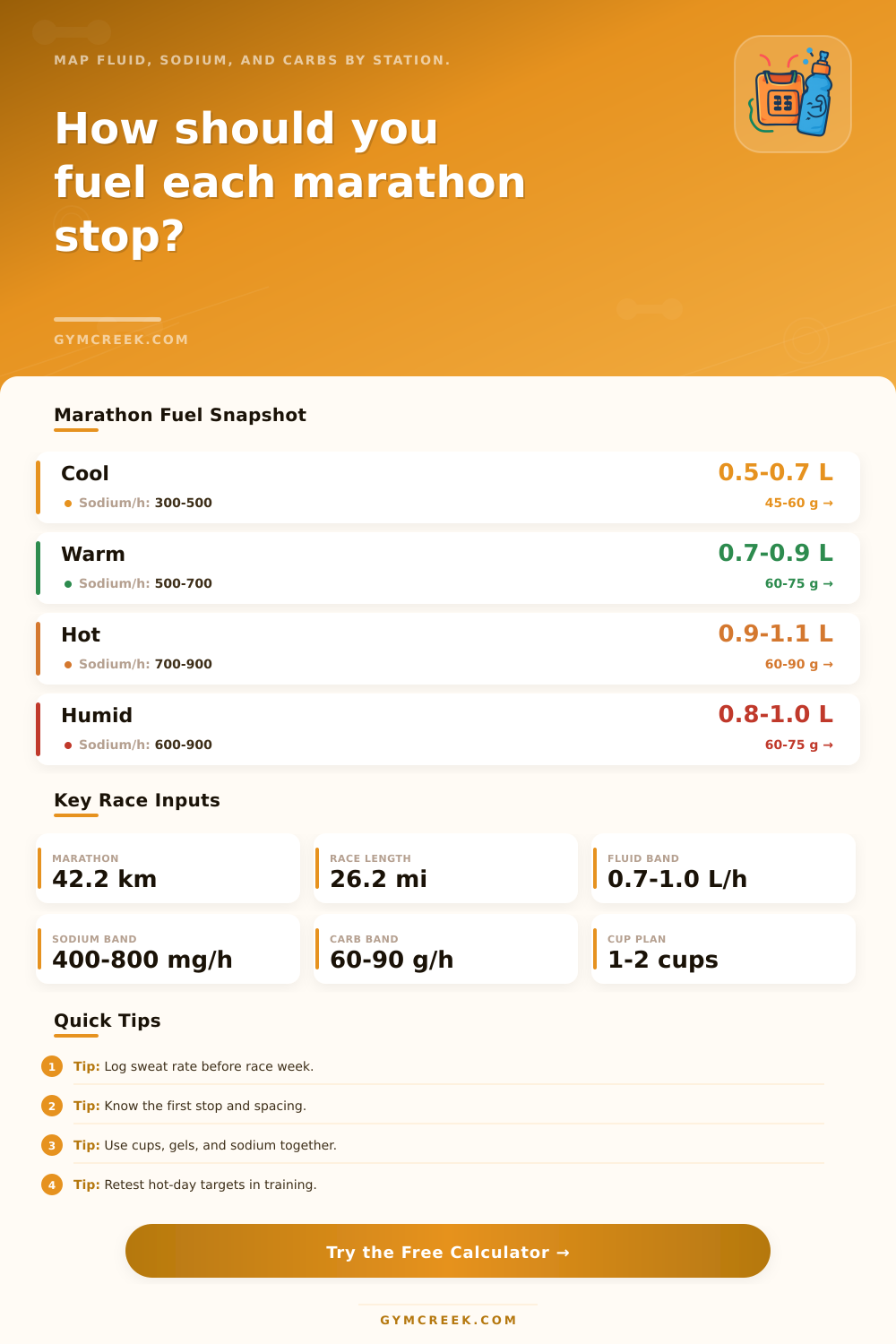
If an individual is running at a faster pace than others, they will generate more heat within their bodies, which can make them sweat more. Additionally, if an individual is running in hotter weather with high level of humidity, they can lose more fluid than when running in cooler, dry weather. For instance, an individual may only need to consume 0.5 liters of fluid each hour when running in dry, cool weather, but may need to consume 1 liter of fluid each hour in hot, humid weather.
If the sweat does not have the chance to evaporate from the body, the internal body temperature can rise. In addition to fluid loss, runners also lose sodium (salt) through their sweat. If a person loses a high amount of sodium through their sweat, they must replace that sodium to avoid developing hyponatremia.
Hyponatremia is the result of a person drinking too much water while running, which dilute the sodium in their blood. To avoid this issue, runners can replace sodium through the use of course drinks, sodium tablets, or energy gels. Additionally, runners should ensure that they consume enough carbohydrate for fuel for their muscles.
A runner should aim to consume 60 to 90 gram of carbohydrates each hour while running. The logistics of the course that runners will run will have an impact upon how a runner consume fluids and carbohydrates. For instance, marathons have aid station that are placed at regular distances along the path that runners will take.
If these aid stations are placed a long distance apart, the runner should carry a bottle of fluid to ensure that they have fluid to drink between aid stations. However, if aid stations are closer together, runners can consume small amount of fluid at each aid station. Runners should create a plan as to how many cups of fluid they will consume at each aid station, and how many energy gel they will consume every 20 minutes along the marathon.
Such a plan should of been practiced during long training runs for the marathon. Long training runs allow individuals to determine their fluid loss, and to test their bodies reactions to the fluids and carbohydrates that they consume during these long run. By adjusting their plan based off these long training runs, runners can find a system that will allow them to maintain a steady pace during their marathons.