Marathon Fueling Calculator
Build a race-day carb, fluid, and sodium plan from your target pace, duration, body weight, gut tolerance, sweat rate, and aid-station rhythm.
📌Presets
Presets load complete race profiles and recalculate the schedule immediately.
⚙Calculator
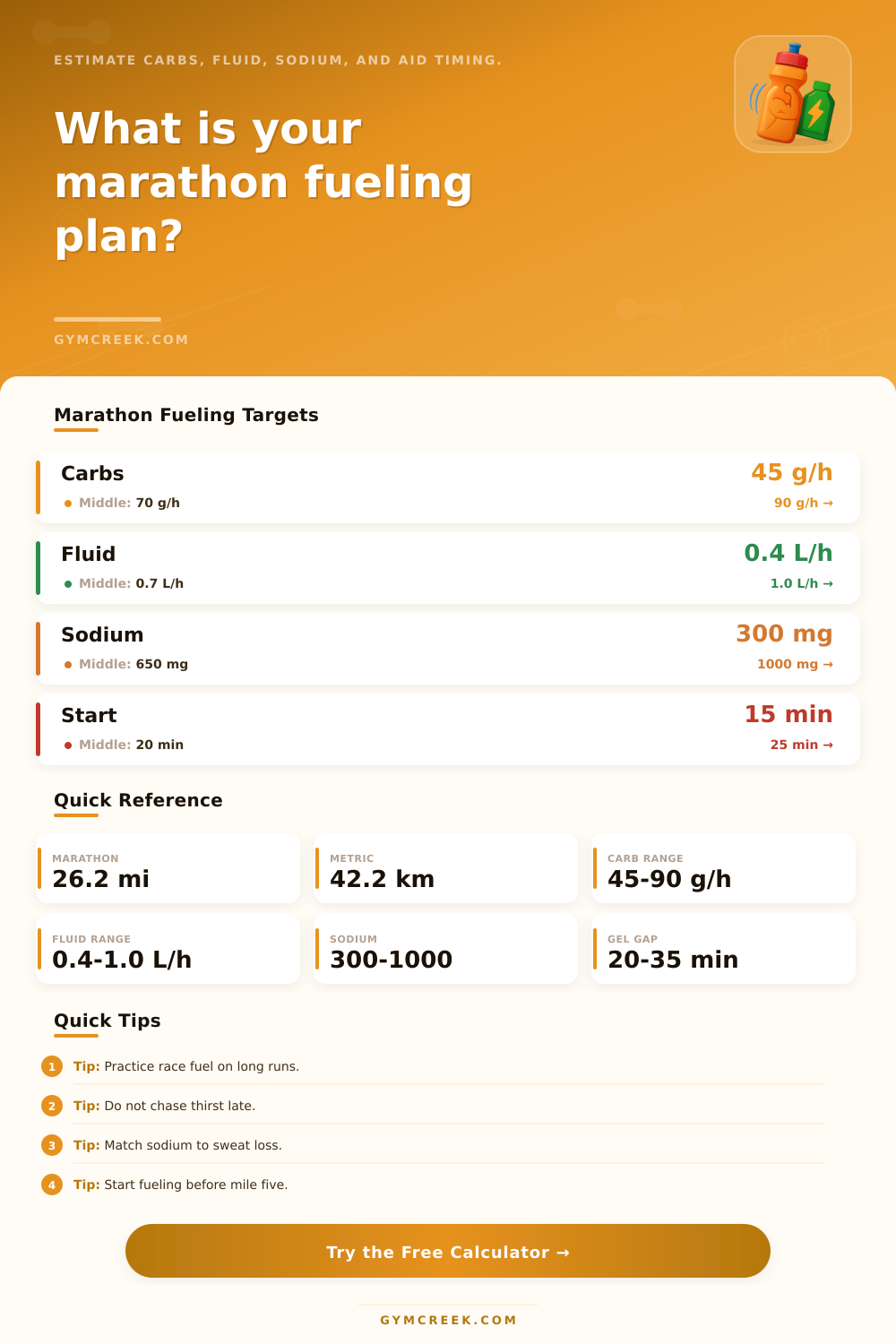
Marathon fueling snapshot
Enter your race profile to calculate a practical intake plan.
📊Fueling Metrics Grid
📑Reference Tables
| Gut tolerance | Carb range | Best use | Watch point |
|---|---|---|---|
| Low | 40-55 g/h | First marathon or sensitive stomach | May fade late if underfueled |
| Moderate | 55-75 g/h | Most trained recreational runners | Needs regular intake from early miles |
| Trained | 75-95 g/h | Runners who practiced mixed carbs | Requires water and gut rehearsal |
| High | 95-110 g/h | Fast or elite fueling practice | High risk if tried first on race day |
| Sweat profile | Sweat rate | Fluid aim | Sodium cue |
|---|---|---|---|
| Cool light sweater | 0.3-0.5 L/h | Small sips at aid stations | 300-500 mg/L sweat |
| Average conditions | 0.5-0.9 L/h | 0.4-0.7 L/h intake | 500-800 mg/L sweat |
| Warm or humid | 0.8-1.2 L/h | 0.6-0.9 L/h intake | 700-1100 mg/L sweat |
| Heavy salty sweater | 1.1-1.8 L/h | Planned cups plus sodium | 900-1500 mg/L sweat |
| Race segment | Fuel focus | Fluid focus | Decision check |
|---|---|---|---|
| Start to 10K | Begin carbs calmly | Do not overdrink | Is stomach settled? |
| 10K to half | Lock into schedule | Use aid rhythm | Are hands sloshy? |
| Half to 20 mi | Protect carb intake | Match heat and thirst | Is pace still smooth? |
| 20 mi to finish | Small frequent doses | Sip, do not chug | Can you tolerate more? |
| Formula | Variables | Output | Use |
|---|---|---|---|
| Duration | Distance x pace | Race hours | Sets total fuel need |
| Carb target | Tolerance and gut practice | g/hour | Builds gel timing |
| Fluid target | Sweat rate x replacement | L/hour | Checks drink feasibility |
| Sodium target | Sweat sodium x sweat x replacement | mg/hour | Guides electrolyte intake |
💡Fueling Tips
Forty-two kilometers lie in front of your fragile gut, and it’s still not race time. Yet here you are pondering hydration levels and options. Runners tend to overlook food until mile twenty or so. This is not the moment to figure this out. Plan on it before you even begin running.
Run your own numbers through calculator. Understand why each input matters so you can finish strong. Carbohydrate tolerance is also single most overlooked variable in endurance sports. Just because you are burning a lot of calories according to your watch doesn’t mean you should consume more. There’s a physical limit as to how much glucose your gut can absorbs per hour. And this is not innate (it can be trained).
How to Plan Your Food and Drink for a Race
Long run training where you only drink water means that race day stomach issues occur when you try to fuel yourself with ninety grams of carbs per hour. The tool recognizes your past, so it sets a reasonable target for you. It tells the difference between the runner who trains with mixed carb sources versus one who doesn’t. Runners should stick to what they’ve practiced rather than what sounds good on paper. That self-control will avoid any issues come race day.
Intuition also doesn’t work well when it comes to fluids. Until it’s hot out, most people don’t sweat as much as they think. The calculator has you estimate how much you sweat in a race. How do you figure that? Weigh yourself before and after long run. If you lost two pounds, it means you are sweating about a liter. But you cannot drink that all back during the run. Your stomach won’t handle it fast enough.
That’s why there’s an input for replacement percentage. Runners typically shoot for replacing roughly seventy percent of what’s lost. Anything higher, aiming for 100%, can result in frequent stops at the porta-potty (or worse: low sodium). Better to feel slightly dehydrated than slow and waterlogged.
The same applies to sodium, which has larger consequences. You might be a salty sweater. This means that you shed large amounts of electrolyte stuff if you’re working out. You’ll notice when it happens; you’ll have white streaks across your clothing from salt. Conditions matter here too, as does sweat rate. Here’s where the sodium reference table in the tool comes into play. It offers a ballpark idea. You need more sodium in hot humid races, fewer in cool early-morning races.
Plug in your anticipated level of sweating and the calculator will generate your hour-by-hour goal. From there, you can determine how many salty gels and sports drinks vs. Plain water is appropriate for you. Mess around with this number and you’ll mess up good plans. The timing makes it real. That’s where it gets interesting.
You’ll hear me say over and over that if you aren’t hungry or thirsty, you’ve missed your chance. Now here’s how I time my intake. According to the system, the first dose should be initiated between 15-20 min from the get-go. This preloads your glycogen reserves while your body finds its groove. After that, your rhythm will follow aid station frequency. Every couple of miles means lots of chances to snatch a cup. Spaced out? Carry extra, or use bigger gulps at each stop.
The output provides a definite schedule for both fluids and gels. No guess work. Focus on your form and pace.
Finally, there’s the section on context: information for different runner profiles. Chasing a Boston qualifying time isn’t the same as running your first marathon. The runner seeking stability will eat differently than the one who can eat more carbs if her stomach can handle it. There’s no magic bullet here; you have to determine what feels right for your unique situation.
Try it out during your longest runs. If you get too full or sluggish, adjust up/down accordingly. These aren’t gospel figures, only what you make of them after trying it out for yourself. Every decision feels huge on race day. That anxiety can be removed by having a pre-calculation strategy.
When mile ten hits, you know exactly what to grab off the table. When mile twenty comes around, you’ll know exactly what to grab. When your legs burn and you don’t know how many hours left until the finish line, you won’t even bother thinking about calories per hour, you’ll just stick to the script you wrote weeks before. That confidence is priceless. It’s worth more then any individual nutrient.
Fuel up before you need it. Drink up before you’re thirsty. Eat before you’re hungry. Small habits like these will help you finish strong. The math backs up the effort, but the discipline carries out the plan. Just stick with it and let your body do what you trained it to do.