Carb Loading for Marathon Calculator
Build a marathon carb-loading plan from bodyweight, race duration, taper length, grams per kilogram, gut tolerance, training load, current glycogen, and meal frequency.
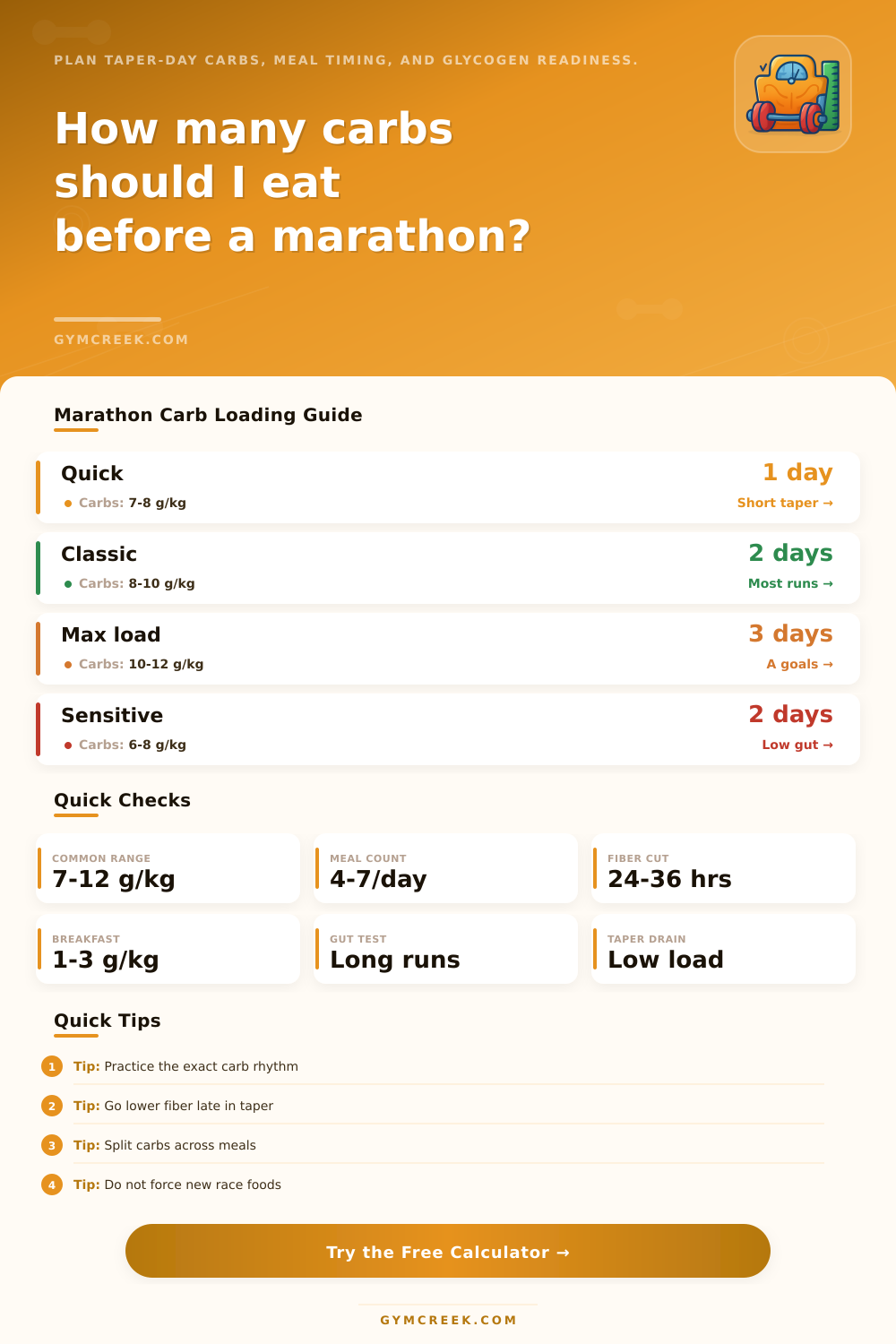
🏁Marathon Loading Presets
Presets give realistic marathon scenarios. After choosing one, edit the grams per kilogram, taper days, meal frequency, and gut tolerance to match training-tested foods.
⚙Calculator Inputs
Marathon carb-load snapshot
Daily carbs, total loading target, per-meal dose, readiness score, gut risk, and race-morning plan update as inputs change.
📊Metrics Grid
📝Planner Notes
📑Carb-Loading Reference Tables
| Target band | Typical g/kg/day | Best use | Watch point |
|---|---|---|---|
| Maintenance taper | 5 to 7 | Easy week, shorter race, or cautious stomach | May under-fill for a full marathon |
| Standard marathon load | 7 to 10 | Most runners with 1 to 3 taper days | Split across meals and snacks |
| Aggressive performance load | 10 to 12 | Experienced runners with trained gut | Higher gut and appetite burden |
| Very high experimental load | 12+ | Special cases only | Usually not worth testing on race week |
| Loading length | Best focus | Training load | Food rhythm |
|---|---|---|---|
| 1 day | Concentrated top-off | Rest or short shakeout | Frequent low-fiber carb meals |
| 2 days | Classic marathon loading | Light taper only | Breakfast through evening snacks |
| 3 days | Gradual high-carb ramp | Reduced volume | Less pressure at each meal |
| 4 days | Gentle sensitive-gut build | Very light or rest | Lower daily peak, more repetition |
| Signal | Comfortable range | Caution range | Adjustment |
|---|---|---|---|
| Low tolerance | 6 to 8 g/kg | Above 8 g/kg | Add snacks, reduce fiber, avoid novelty |
| Moderate tolerance | 7 to 10 g/kg | Above 10 g/kg | Use familiar rice, pasta, bread, potatoes, fruit |
| High tolerance | 8 to 11 g/kg | Above 11 g/kg | Use drinks if chewing feels hard |
| Per sitting | 60 to 110 g | Above 130 g | Increase meal frequency or lower target |
| Check | Green zone | Caution | Race-week note |
|---|---|---|---|
| Fiber | Familiar or reduced | Large salad, bran, legumes | Lower residue helps some runners |
| Fat | Moderate familiar amount | Heavy fried meal | High fat slows digestion |
| Fluids | Steady with thirst | Forced over-drinking | Pair fluids with sodium as needed |
| Breakfast | 1 to 3 g/kg practiced | New foods or too close to start | Keep timing familiar |
| Race fuel | 30 to 90 g/hour practiced | Untested high intake | Coordinate gels and drinks |
💡Carb-Loading Tips
Carbohydrate loading is an process of increasing carbohydrate intake to increase the amount of glycogen stored in the body. Since glycogen provide the energy for a runner during a race, it is important to increase carbohydrate intake in the days before a race. The body needs to increase glycogen store if the athlete is to have enough energy for a long race, but the body must also be managed to make sure that it dont become uncomfortable from the ingestion of so many carbohydrates.
The amount of carbohydrates that may be stored in the body depends on several factor. The size of the body, the amount of glycogen the body uses up, and the amount of training that is performed in the last few days before a race can all play a role in the amount of glycogen that can be stored. For example, individuals who perform intense training sessions will have lower amount of glycogen in their bodies, so they will need to perform carbohydrate loading more aggressive to top up their glycogen stores.
Carbohydrate Loading for Runners
The calculator that is present in this article will help to calculate carbohydrate targets based off the weight of the athlete, the length of the race that the athlete is to perform, and the number of days that the athlete will be consuming carbohydrates. An individual’s gut tolerance must be considered when loading carbohydrates. For most individuals, the suggested amount of carbohydrates per kilogram of body weight is ten or eleven gram.
However, some individuals feel uncomfortably heavy if they consumes these amounts of carbohydrates. Splitting the amount of carbohydrates into many meal instead of one large meal may prevent the body from feeling bloating. Consuming one very large meal can cause an individual to feel bloated, but smaller meals may make an individual feel more comfort during the period in which they are consuming these carbohydrates.
This calculator allow for an individual to adjust the number of meals that they consume to see the effect on the total carbohydrate intake. Individuals should also reduce their intake of dietary fiber in the 24 hour before a race. While reducing fiber does not have an effect upon glycogen levels, it does have an effect upon how comfortable an individual feels during a race.
If an individual consumes too much fiber in the 24 hours before a race, they may experience digestive issue during the race. By using the fiber strategy option in the calculator, individuals can adjust their diet to ensure that they feel physically comfortable during a race. The intake of carbohydrates on the morning of a race is also important.
On the morning of a race, an individual should consume a modest breakfast that contains between one and three gram of carbohydrates per kilogram of body weight. This amount of carbohydrate will help to top off the glycogen stores in the liver. In some cases, an individual may need to consume a larger breakfast if the athlete has already tested that breakfast prior to the race.
The carbohydrate calculator allows for individuals to separate the carbohydrate intake on the morning of the race from the carbohydrate intake during the taper phase of the athletes training. The amount of carbohydrate that the athlete will consume during a race will also have an effect upon the amount of carbohydrate that should be stored prior to the race. For example, if an athlete plans on consuming 60 grams of carbohydrate per hour during a race, their muscles will not need to rely as on the glycogen that is stored in their body.
While it is important to still perform carbohydrate loading prior to a race, it is also important to understand that the amount of glycogen that the body is required to store can be less if an athlete plans to consume carbohydrates during a race. The calculator accounts for the amount of carbohydrate that the athlete will consume during the race to calculate the total amount of carbohydrate energy that will be available to an athlete. Many individuals makes mistakes when loading carbohydrates.
For example, some individuals may choose to eat a very large meal the evening before a race. This type of meal, however, may cause discomfort if the athlete is already consuming carbohydrates each day leading up to the race. Similarly, some individuals may continue to train heavily during the taper period.
In this case, any carbohydrates that are consumed may not be stored in the body. By considering the information provided in this article, however, an individual can avoid these mistake. The goal of carbohydrate loading is not to consume as much carbohydrate as possible.
Instead, an individual should aim to store glycogen levels that are equal than the demands that the body will have during the race. In addition, individuals should only consume the foods and consume carbohydrates at the times that the athlete has tested during his or her training program. They should of listened to their body.