Maintenance Macros Calculator
Estimate maintenance calories and set protein, carbs, and fats from body weight, body fat, training style, meal count, and training/rest day split.
📌Maintenance Presets
Presets are maintenance starting points. Use your tracked intake first when you already know your stable calorie average.
⚙Calculator Inputs
Maintenance macro snapshot
Enter your maintenance profile to calculate macros.
📊Maintenance Metrics Grid
📑Macro Reference Tables
| Method | Formula or input | Best use | Rule |
|---|---|---|---|
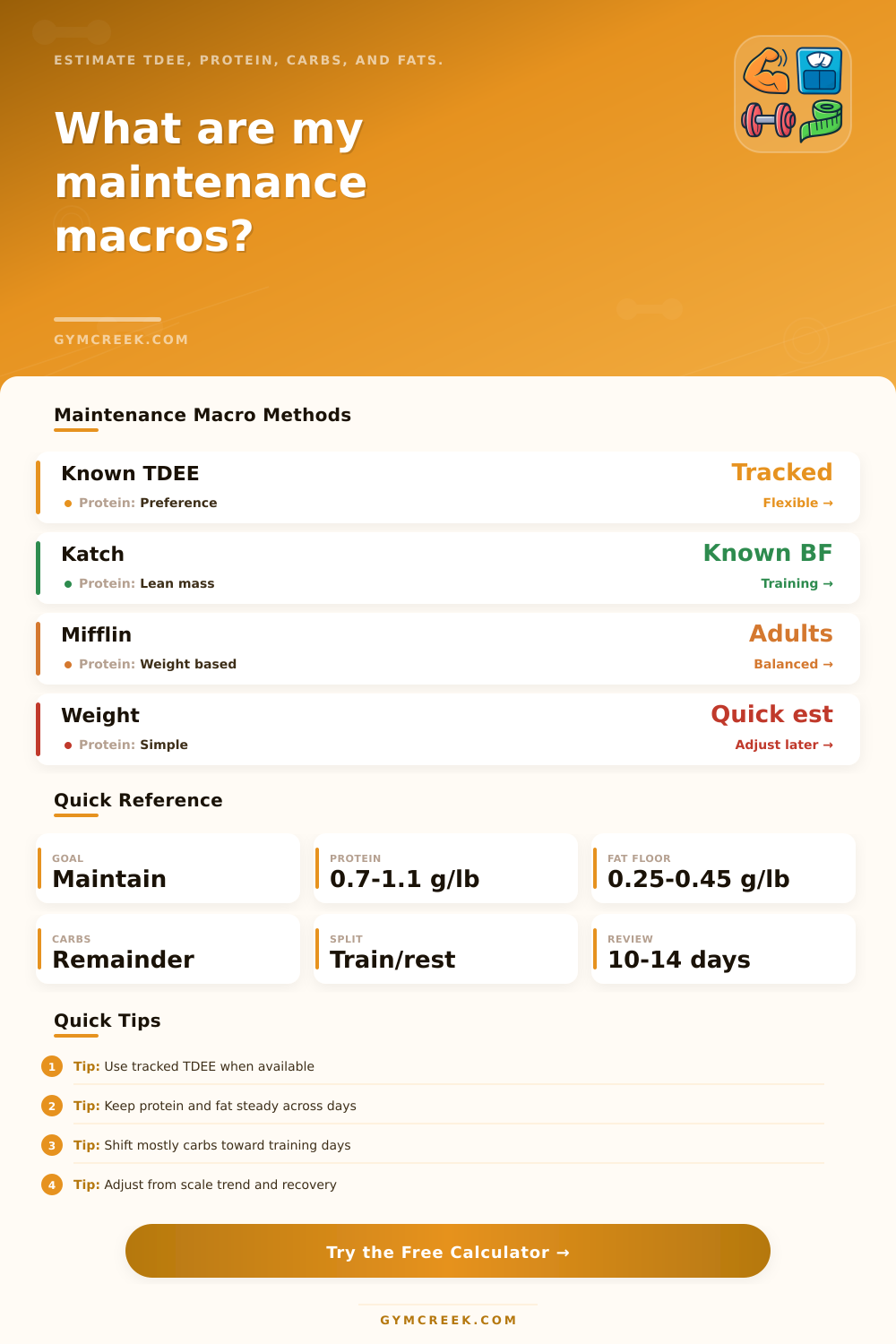
| Known TDEE | Tracked stable intake | Most accurate starting point | Use 10-14 day average. |
| Katch-McArdle | 370 + 21.6 x LBM, then activity | Known body fat | Useful for lean mass context. |
| Mifflin-style | Weight-based RMR estimate, then activity | No height/age available | Good rough planning value. |
| Weight shortcut | Body weight x activity calories | Fast estimate | Adjust from weight trend. |
| Input | Low | Middle | High |
|---|---|---|---|
| Protein g/lb | 0.70 | 0.85-1.00 | 1.05-1.15 |
| Protein g/kg | 1.55 | 1.9-2.2 | 2.3-2.55 |
| Fat g/lb | 0.25 | 0.30-0.40 | 0.45+ |
| Fat g/kg | 0.55 | 0.65-0.90 | 1.00+ |
| Split | Training day | Rest day | Best fit |
|---|---|---|---|
| Flat | Same calories | Same calories | Simple tracking. |
| Small | +3-5% | Slightly lower | Most lifters. |
| Moderate | +7-10% | Lower carbs | Hard sessions. |
| Aggressive | +12-15% | Clear rest drop | High-carb performance days. |
| Factor | Score cue | Why it matters | Improve it |
|---|---|---|---|
| Protein adequacy | 30 points | Supports muscle retention. | Keep meals protein anchored. |
| Fat floor | 20 points | Prevents overly low fat. | Do not chase carbs by cutting fat too far. |
| Carb fit | 20 points | Matches training demand. | Raise carbs around hard training. |
| Distribution | 15 points | Improves meal practicality. | Use 3-5 protein feedings. |
| Method confidence | 15 points | Reduces calorie guesswork. | Validate with body-weight trend. |
💡Maintenance Macro Tips
Maintenance calories are the number of calories that a person consume to maintain a persons body weight over a period of weeks. The number isnt a permanent number for each individuals, and person must make adjustments to the maintenance calories if a person changes their activity or body composition. The calories that are found to maintain the weight of a person can be used as a starting point for the calories that a person consumes each day.
Additionally, the number of calories that a person burn during their training phase can change the distribution of protein, carbohydrates, and fats within the maintenance calorie total. Protein is an essential nutrient that the body require, especially for individuals who dont consume a surplus of calories. The amount of protein that a person should consume is between 0.7 gram of protein per pound of body weight and 1.0 grams of protein per pound of body weight.
How to Find and Use Your Maintenance Calories
Individuals who performs endurance training will require less protein than individuals who perform heavy resistance training. Fat is another essential nutrient that the body requires, as it enables individuals to feel focused on there tasks. Once the individual have set the amount of protein and fat, the remaining calories can be filled with carbohydrates.
The amount of carbohydrates that an individual consume can be adjusted according to the training that an individual performs during a given week. The distribution of calories should change in accordance with the training that the individual perform. The total amount of calories that are consumed each week should remain at the maintenance level, but the timing of those calories can be adjusted.
For instance, individuals who train during the week should consume more carbohydrates than those who do not train. The amount of protein and fat that is consumed should be even during training and non-training days for the body to always recieve these essential nutrient. The shift in the carbohydrate intake should be adjusted according to the amount of energy that an individual requires during training and the individuals performance with carbohydrate intake.
The body composition of an individual can influence the number of maintenance calories that the individual require. For instance, lean mass requires more energy than body fat. Two individuals of the same weight may have different maintenance calories because their body composition are different.
Methods for calculating maintenance calories use body fat and lean mass, but most individuals can use their own weight and performance statistics to find the number of maintenance calories that their bodies require. If an individual eats a certain amount of calories every day and maintains their weight for two weeks, that amount of calories are their maintenance calories. An individuals activity level also impacts the number of calories that an individual burn.
An individual who has a desk job will have a different maintenance calorie level than an individual who has a more active job. The combination of the type of training that an individual performs and their activity level each day can explain why two individuals of the same weight have different maintenance calories. The calculator can process an individual’s body weight, body fat percentage, training, and activity levels to show an individual the number of maintenance calories that are required for that persons body.
The maintenance calories that are calculated for an individual are not a permanent number. The levels of stress that an individual experience, the sleep that they get, and their training phases can all change an individuals maintenance calories. An individual should find a starting point for their maintenance calories and then track their weight and performance levels for a ten to fourteen-day period.
If an individual begins to gain weight despite improvements in performance, that individual should decrease their maintenance calories slightly. In contrast, if an individual begins to lose weight and become tired, that individual should increase their maintenance calories. Such a process will allow an individual to find the average maintenance calories that work best with their training and lifestyle.
The calories that should be distributed to a persons meals should include distributing the protein to three to five meals, as spreading the protein levels is more important than consuming the protein in fewer meals. The carbohydrates should be distributed to the meals nearest to the training that the individual performs. Providing an individual with a loose structure of the calories of protein, carbohydrates, and fat will allow the individual to more easy reach their maintenance calories target.
The tool contains the information that explains how to calculate maintenance calories and how to adjust the protein, carbohydrates, and fat levels to ensure that an individual meet their maintenance calories target. Additionally, the tool includes a quality score for each calculation of maintenance calories. This quality score indicates whether an individuals diet is lacking in certain area.
While maintenance calories isnt the perfect diet for an individual each day, it is a workable target for each week. Furthermore, an individual must use their weight, performance, and energy levels to determine whether their maintenance calories target need to be changed.