Macro Split Converter Calculator
Convert a macro split between percentages, grams, calories, bodyweight rates, per-meal targets, and weekly totals while checking BMR, TDEE, protein, fat floor, and training-day carb context.
◎Macro Presets
Presets load complete body stats, calories, goal context, macro split, fiber, alcohol, meals, and training days. Edit any field after loading.
⚙Converter Inputs
Macro split snapshot
Enter calories and a split to convert macros.
▦Fitness Metrics
▣Reference Tables
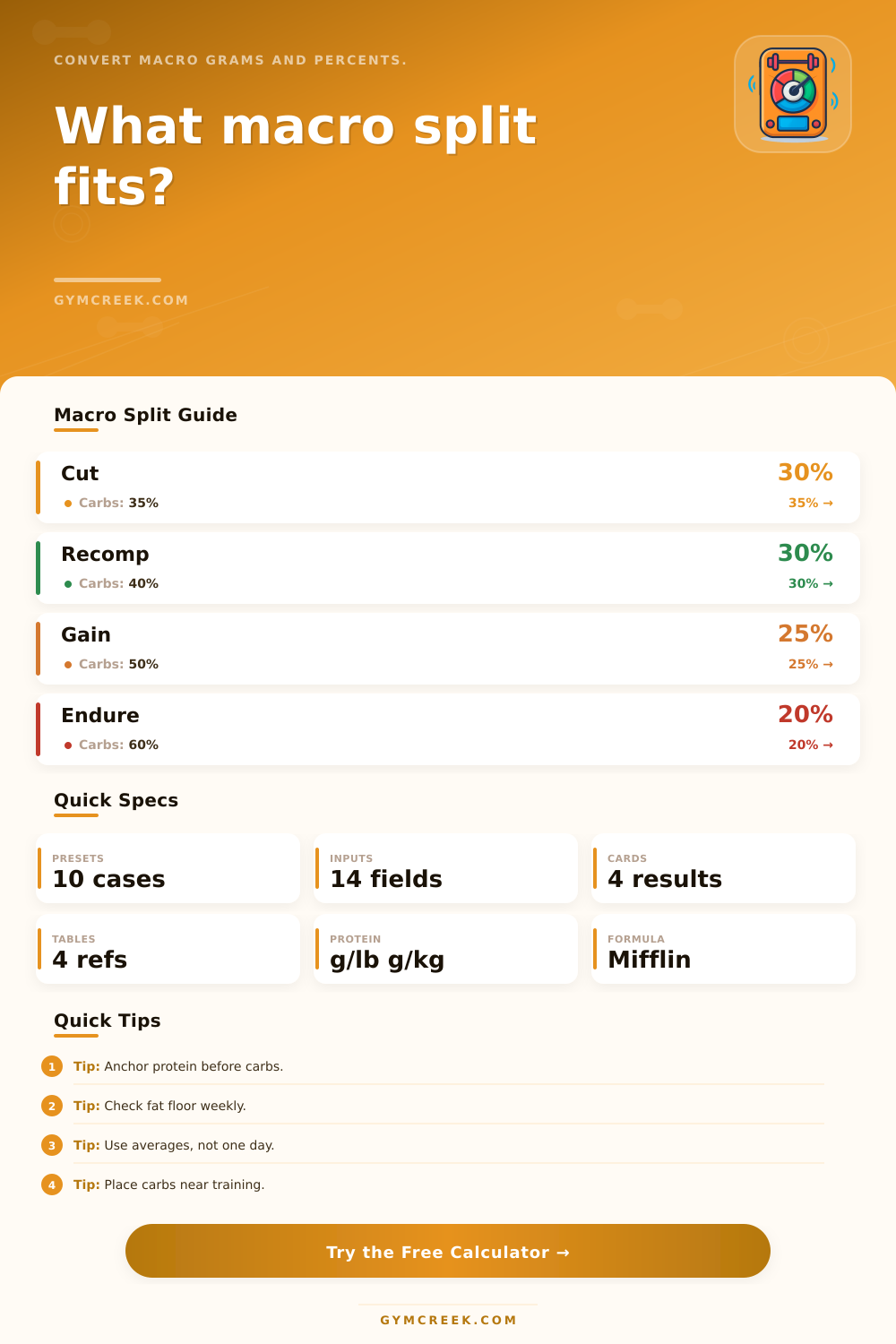
| Goal | Protein | Carbs | Fat |
|---|---|---|---|
| Fat loss | 30% | 35% | 35% |
| Recomp | 30% | 40% | 30% |
| Lean gain | 25% | 50% | 25% |
| Endurance | 20% | 60% | 20% |
| Macro | Cut | Maintain | Build |
|---|---|---|---|
| Protein g/lb | 0.8-1.1 | 0.7-1.0 | 0.7-1.0 |
| Protein g/kg | 1.8-2.4 | 1.6-2.2 | 1.6-2.2 |
| Fat g/lb | 0.25-0.45 | 0.3-0.5 | 0.35-0.6 |
| Carbs | Remainder | Training fit | Higher bias |
| Output | Formula | Inputs | Use |
|---|---|---|---|
| Macro kcal | g x factor | P/C/F | Convert |
| Protein | kcal / 4 | Percent | Grams |
| Carbs | kcal / 4 | Percent | Grams |
| Fat | kcal / 9 | Percent | Grams |
| Measure | Protein | Carbs | Fat |
|---|---|---|---|
| Daily grams | --- | --- | --- |
◇Macro Scenario Benchmarks
| Profile | Calories | Split | Focus |
|---|---|---|---|
| Desk cut | 1800 | 35/30/35 | Satiety |
| Lift recomp | 2400 | 30/40/30 | Balance |
| Lean gain | 3000 | 25/50/25 | Carbs |
| Long run | 3200 | 20/60/20 | Glycogen |
| Item | Calories | Unit | Note |
|---|---|---|---|
| Protein | 4 | per gram | Fixed |
| Carbohydrate | 4 | per gram | Fiber incl. |
| Fat | 9 | per gram | Dense |
| Alcohol | 7 | per gram | Optional |
◈Tips
More importantly, the way many people treat there diet is that it needs to be in perfect balance on day one. Every meal must hit a precise carbohydrate-protein ratio or else. The problem with this is that it’s rigid, which are why most diets fail within the first month.
Instead, try looking at your diet based off how much energy you use each week instead of just day by day. After inputting your stats, the calculator above do all the work for you. Instead of having to convert bodyweight ratios to absolute targets or percentages to grams, it spits out a starting line based on your performance goals and your metabolic needs.
Why Perfection Fails and Consistency Wins
Why? Because most folks neglect how much they train when establishing their carbohydrate targets. As a result, they ends up with unnecessarily slow recoveries, or worse yet, unnecessary fat gains. Think about it like this: active recomposition versus sedentary maintenance. Let’s say that you spend most of your day sitting at a desk but weight-lift four times per week. Your overall daily energy expenditure stays fairly consistant, correct? Your nutrient timing change drastically, however. During the day, low-carbs is fine, but immediately following a hard lifting session, your muscles want refilled glycogen stores. That’s why the tool feature a training-day carb bias. This enable you to front-load carbs on days when you’re physically active. This ensures that you don’t spread your energy out too much on days when you aren’t active.
When we talk about building lean body mass and preserving lean tissue while dieting (i.e., when you’re in a caloric deficit), protein tend to center the discussion due to its high thermic effect. But there’s a point of diminishing return with chasing too many grams “because some influencer said so.” This page puts things into reasonable ranges that will keep most folks within safe limits. To be clear, you need enough protein for repairing muscle. That doesn’t mean cramming in as many gram as possible, which often comes at the expense of your fat or carbs. Both of these macros play important roles in immediate energy and hormonal control.
This means you’ll never go below a nutritional floor when it comes to fat intake… A critical component of any sustainable diet. Fat is the single most calorically dense macronutrient; without enough you’ll feel dissatisfied and food will taste bland. If you intend to follow your plan for more than just weeks or months then staying above a minimum level of fat intake is important for hormonal health.
If you’ve ever attempted to calculate macros, then you know it’s easy to get stuck: Should I do this in grams or percentages? Grams are useless once your overall calorie goal shifts, while percentages are abstract until you convert them into the real-world weight of food. Letting the converter perform those conversions frees up some brain-space to work without constant tinkering. And you can tweak the inputs a bit depending on how well (or not) you sleep and fit into your clothes, safe in the knowledge that those ratios underneath will still be scientifically sound.
Perfection is overrated… Consistency wins. The best macronutrient split are a flexible framework: One that adjusts to suit your changing body. It’s a data-driven baseline; a starting line. And once we give you that, you can relax and trust the bigger picture of how you’re progressing… Rather than get hung up on any small daily fluctuations.
Food isn’t just fuel. It’s culture. Comfort. Trust the numbers for the structure, and leave the rest to your taste buds.