Calories Burned Lunges Calculator
Estimate lunge calories from body weight, total reps, sets, added load, lunge style, tempo, rest, range of motion, and weekly sessions.
📌Lunge Presets
Presets fill a realistic lunge session and calculate automatically. Reps are total reps per set across both legs.
⚙Calculator Inputs
Lunge calorie snapshot
Enter your lunge block and calculate calories, load, density, and weekly burn.
📊Metrics Grid
📑Reference Tables
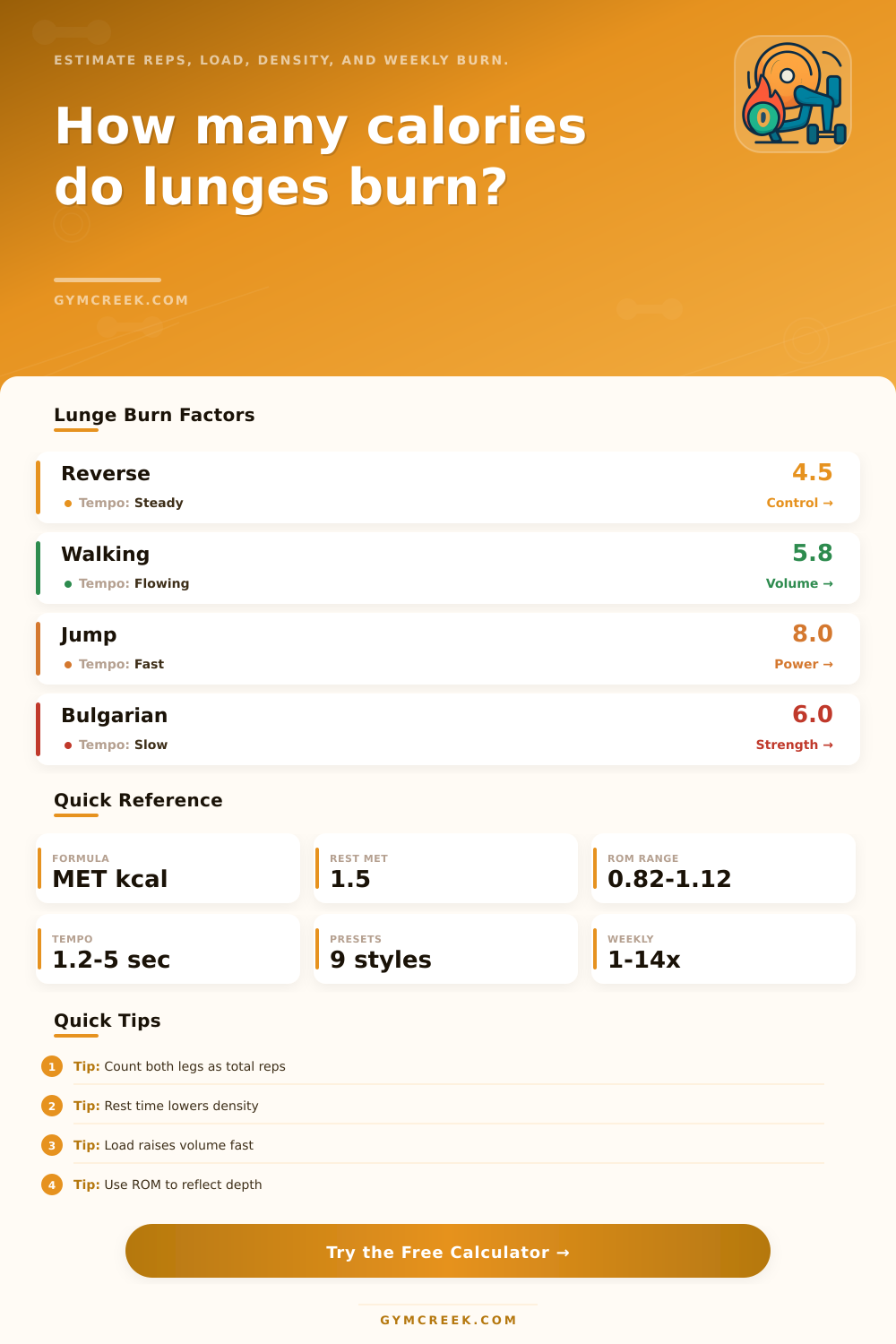
| Lunge style | Base MET | Load bias | Best use |
|---|---|---|---|
| Reverse lunge | 4.5 | 0.64 BW | Control |
| Walking lunge | 5.8 | 0.68 BW | Volume |
| Bulgarian split | 6.0 | 0.72 BW | Strength |
| Jump lunge | 8.0 | 0.62 BW | Power |
| Tempo | Seconds/rep | MET factor | Density cue |
|---|---|---|---|
| Quick | 1.2 | 1.18 | High pace |
| Steady | 2.0 | 1.00 | Balanced |
| Controlled | 3.0 | 1.05 | Strict reps |
| Pause | 5.0 | 1.12 | Hard reps |
| ROM | MET factor | Load factor | Depth cue |
|---|---|---|---|
| Short | 0.82 | 0.88 | Small bend |
| Partial | 0.92 | 0.94 | Mid range |
| Full | 1.00 | 1.00 | Standard |
| Deep | 1.12 | 1.08 | Full depth |
| Session type | Total reps | Rest | Weekly aim |
|---|---|---|---|
| Primer | 40-60 | 30-45s | 1-2x |
| Hypertrophy | 80-160 | 45-90s | 2-4x |
| Conditioning | 120-240 | 0-45s | 1-3x |
| Strength | 40-100 | 90-180s | 1-3x |
💡Tips
Lunges is a lower body exercise that involve stepping forward, dropping into a lunge position, and push back to stand back up. Despite the simplicity of the movement required for performing lunges, there are many different variable that can change the total number of calories that is burned during a session of performing lunges. Variables to consider include body weight, added weight, speed of movement, rest periods between sets of lunges, and the range of motion within each lunge.
While many people turn to the average number of calories that is burned during lunges as displayed on their fitness tracker, such averages does not account for these different variables to lunge calorie burn. The lunge calculator can help individuals estimate the number of calories that can be burned during a session of performing lunges of their choosing. The lunge calculator calculates the calories burned based upon the intensity of the lunges that are performed, the duration of those lunges, the tempo at which the lunges are performed, the range of motion of the legs during the lunges, and the load that are added to the body while performing the lunges.
How Many Calories Do Lunges Burn?
For instance, the number of calories burned performing a set of slow Bulgarian split squats with dumbbells will be different than the number of calories burned during a session of performing quick bodyweight lunges. While the difference in calories burned during a single lunge may be small, the difference in the number of calories burned becomes large if those lunges are compound over time. Thus, small adjustments in the density of the lunges can make one program more physical demanding than another.
Tempo is one of the factor that can alter the bodys calorie burn during a session of performing lunges. For instance, a quick lunge may take one second to perform a single lunge, but a lunge that incorporates a pause at the bottom of the lunge may take five seconds to perform the same number of lunges. The longer that the muscle are under tension during the lunges, the more calories can be burned during the exercise.
However, the number of calories that are burned also decreases if longer periods of rest are take between sets of lunges performed. The lunge calculator accounts for both tempo and rest intervals between sets. The range of motion for the legs may also impact the number of calories burned during lunges.
Range of motion can be increased by deep lunging or decreased by shallow lunging. However, deep lunging may not necessarily result in the burning of more calories than shallow lunging if the range of motion for individual legs is limited. Thus, the range of motion for lunging can be adjusted on the lunge calculator to reflect the actual range of motion that is use during the lunging exercise.
The load that is added to the body during lunging can also impact the number of calories that are burned. By adding additional weight to lunging exercises, the force that is produced by each of the legs during each lunge increase. The increased force used during each lunge increases the number of calories that are burned during lunging.
The lunge calculator accounts for the body weight and any added load during lunging exercises. For instance, performing reverse lunges without any added weight move a portion of the body weight, but performing front rack lunges with heavy barbells move more of the body weight. The lunge calculator also calculates the total volume of load that is moved during the entire lunge session.
The total number of calories that are burned per week can be calculated by multiplying the total number of calories that are burned during a single session of lunging by the total number of lunging session that are performed each week. Thus, three sessions of moderate lunging performed each week may result in a higher total weekly calorie burn than one long session of lunging. These calculations allow individuals to understand how many calories are burned each week by performing lunging exercises.
The reference tables for the calculator help individuals to understand the base intensity levels for each lunge type and tempo. While the reference tables do not need to be memorized, they help to reveal the impact that changing the type of lunges performed may have upon the total number of calories that can be burned. For instance, the reference tables allow an individual to determine whether changing from reverse lunging to jump lunging will increase the number of calories burned.
The reference tables can also reveal whether reducing the tempo of lunging will help to counteract the increased calories burned from adding additional weight to each lunge. Common mistakes when performing lunging exercises include only counting the calories burned by one leg during lunging exercises, and forgetting to include the calories that are burned during rest periods between sets of lunging exercises. Some individuals may not account for the fact that adding a significant amount of load to their body when performing lunging exercises may require longer period of rest between the sets of those lunging exercises.
Thus, while adding weight to lunging exercises increases the calories that are burned during those lunging exercises, the need for longer periods of rest between sets decreases the number of calories that are burned during those lunging exercises. Thus, the lunge calculator accounts for both the increase in load and rest periods between lunging exercises. Beyond the ability to burn calories, lunging exercises also allow individuals to increase their balance, single leg strength, and coordination.
Thus, the lunge calculator allows individuals to have an understanding of the amount of work that is performed by their body during each weeks worth of lunging exercises.