Low Carb Diet Calculator
Estimate a low carb macro target from your body size, activity, body fat, goal, and preferred carb range, with net carbs, total carbs, fiber, protein, fat, and calorie context.
📌Low Carb Presets
Presets load realistic low carb scenarios, from a strict keto cut to a timed-carb training week, then calculate the macro target automatically.
⚙Calculator
Low carb macro snapshot
Enter body stats and carb preference to calculate your target.
📊Diet Metrics
📑Reference Tables
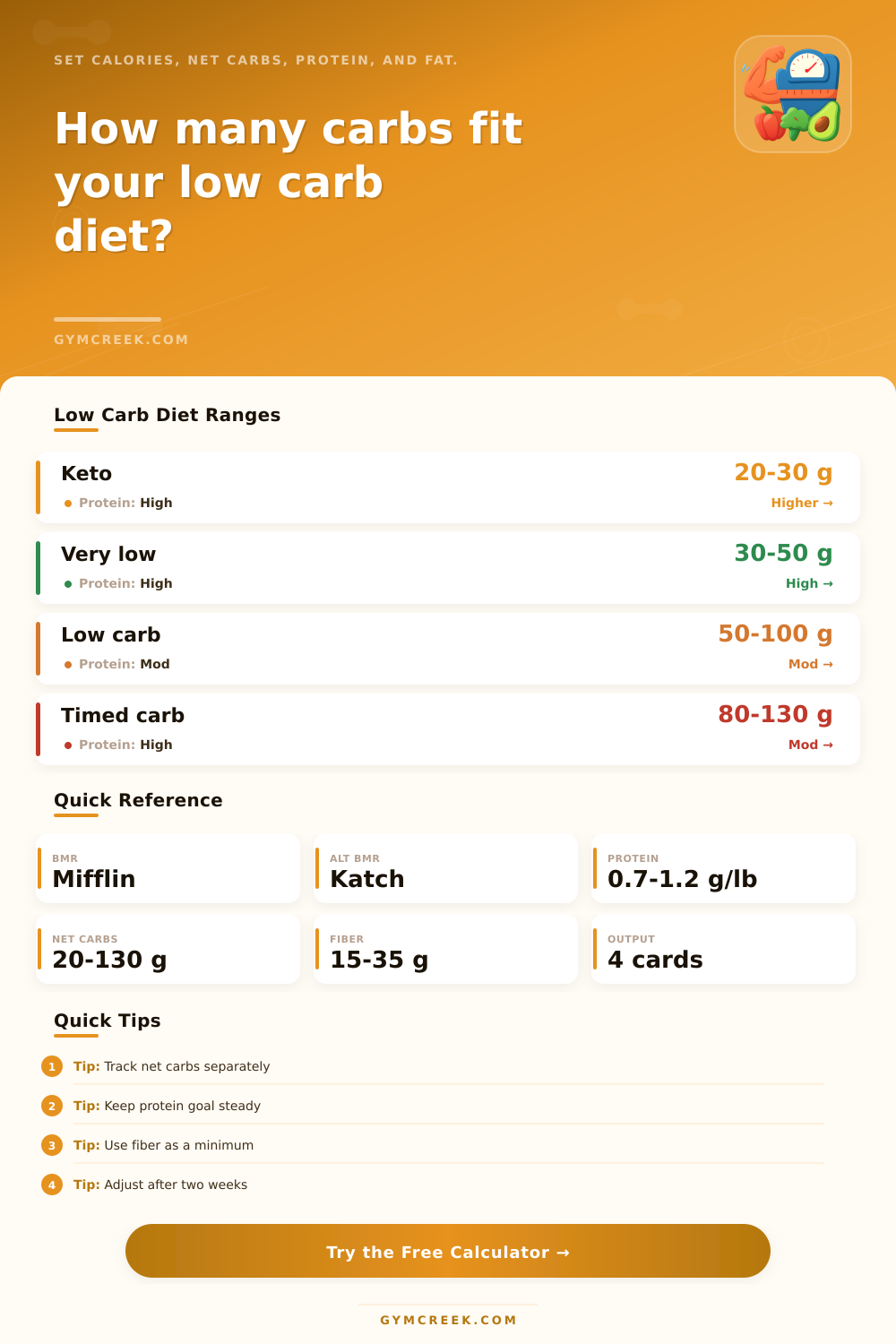
| Style | Net carbs | Best use | Calculator cue |
|---|---|---|---|
| Ketogenic | 20 to 30 g | Strict carb cap | Watch fiber and adherence |
| Very low carb | 30 to 50 g | Fat loss phase | Protein stays steady |
| Standard low carb | 50 to 100 g | General low carb eating | Flexible training weeks |
| Moderate low carb | 100 to 130 g | Active lifters | More training fuel |
| Timed training carbs | 80 to 160 g | Hard sessions | Shift carbs to lift days |
| Metric | Imperial | Metric | Use |
|---|---|---|---|
| Protein base | 0.7 g/lb | 1.5 g/kg | Maintenance context |
| Protein cut | 0.9 g/lb | 2.0 g/kg | Common low carb cut |
| Protein high | 1.1 g/lb | 2.4 g/kg | Lean or hard training |
| Fat floor | 0.25 g/lb | 0.55 g/kg | Minimum check |
| Goal phase | Adjustment | Weekly effect | Use |
|---|---|---|---|
| Fat loss | -20% | Large deficit | Shorter phase |
| Steady loss | -15% | Moderate deficit | Common cut |
| Recomposition | -5% | Small deficit | Strength focus |
| Maintenance | 0% | Stable intake | Habit practice |
| Lean gain | +5% | Small surplus | Slow mass gain |
| Formula | Variables | Output | When used |
|---|---|---|---|
| Mifflin-St Jeor | Weight, height, age, sex | BMR | No body fat needed |
| Katch-McArdle | Lean body mass | BMR | Body fat entered |
| TDEE | BMR x activity | Maintenance | All plans |
| Macro calories | Protein, carb, fat grams | Calorie split | Final target check |
💡Tips
Low carb eating is most effective when the nutritional number match your actual life, and low carb eating is most effective when the numbers align with your specific goals. A plan that works for many people may leave some feeling tired or hungry due to the difference in carb, protein, and calorie need for each individual. You must adjust your carb level based on your training and your goals for your body to experience the benefits of a low carb diet.
A calculator can assist with determining your carb needs based on your body weight, your activity level, and the carb level you want to reach. Once you have these targets for your carb level, you can follow those targets without second-guessing the science behind the calculator. You must choose a style of low carb eating, and many individuals have the option to select from the various styles of low carb eating.
How to Choose the Right Low Carb Plan
Some may opt for a ketogenic eating style that limits their carbs to very low levels, while other individuals may choose a more moderate approach that allows for the inclusion of vegetables, fruit, and the carbs require to fuel their training efforts. Each individual’s choice in carb level will impact the way in which their body utilizes fuel. For those who opt for a more moderate approach to carb intake, more flexibility may be experienced in meal options and training volume, reducing the depletion of energy felt daily by those who attempt to follow a low carb diet.
Your carb range should be chosen based on how your body responds to that level of carbohydrate intake and what goals you wish to accomplish with your body. Your body weight and lean mass estimates play an important role in the determination of your carb needs. Body weight and lean mass plays a larger role than most individuals may think.
While many may believe in the importance of protein in relation to body weight, protein intake is driven by the amount of muscle that an individual has in their body. Individuals with higher body fat percentages require different amounts of protein than those who are lean and strong. An online low carb diet calculator asks for body fat percentage, which allows for adjustments in the calculation to account for lean body mass, important for those who are attempting to lose fat from their bodies.
Activity level plays a role in the calculation of the carb needs of an individual. An individual who has a desk job and three short workouts per week will have a different activity level than an individual that has a job that requires walking most of the work day, with a few short workouts. The activity level adjustment will impact the maintenance calorie level that an individual should aim for.
After two weeks of attempting to eat according to the calculator’s suggestions, if an individual feels that they are not meeting their goals, it is likely that the activity level description did not correspond to their actual activity level; adjusting the description will likely lead to changes that benefit that individual according to their activity. Fiber intake plays a separate role in a low carb diet. The fiber level will impact an individual’s total carb needs, but will not change an individual’s net carb level target.
Some individuals dont consider fiber needs. Individuals who dont consider fiber needs often find themselves struggling with their portion size. Other individuals push their fiber needs to the maximum.
However, increasing fiber increases total carb intake. An individual should aim for the middle range of fiber goals for their body and digestive system. If your schedule includes training days along with rest days, it is important to make adjustments to your training plan.
Shifting the carb intake towards training days will enhance their workouts, while maintaining the weekly carbohydrate total. The online low carb diet calculator can calculate the shift in carbohydrates if you enter the number of training days that you have each during the week. After implementing the suggested changes for training days and rest days, it is useful to assess whether or not these adjustments have enhanced their workouts or if they have made rest days too restrictive.
The various protein factor choices can become confusing for many individuals following a low carb diet. The choices for protein factor include a range between the maintenance levels for protein and higher protein intake levels. It is important to select a factor that provides an individual with the energy to perform their workouts, while not selecting a level that is too high for an individual’s total calorie intake.
For instance, if an individual selects a low protein level, they may experience muscle loss along with fat loss. If they pick a high protein level that includes a deficit in total calories, they may begin to feel too sparse in their diet. The calculator can test these different factors prior to picking a level to follow for several weeks.
The fat that an individual consumes is the most flexible among the low carb diet calculations. An individual can determine the minimum amount of fat that their body requires each day for hormone and satiety health. However, if an individual is attempting to lose fat, their fat target may have to be reduced.
While the reduction of fat intake is normal when losing body fat, it is important to pay attention to whether or not an individual is experiencing any negative impacts to their body due to a reduced fat intake. After two weeks of implementing the suggestions from the calculator, it is important for each individual to reevaluate their suggestions. An individual’s body weight, energy during workouts, and feelings of hunger are all indicators that can help to suggest adjustments in the low carb diet.
If an individual is dropping weight too fast, they may need to increase their carb intake. If they are not feeling hungry despite having enough protein, increasing the fat content of their diet or total calorie intake may help. While the calculator can produce an estimate for each individual, the body’s data is the best way to determine adjustments needed to the diet.
One of the benefits of using the macro tool is that it removes the guesswork that an individual may otherwise have to put into creating their initial low carb diet plan. The remaining elements of the diet can be adjusted as necessary according to each individual’s body. Make adjustments as needed but leave the elements of the diet that are working alone.
The calculator can be used as a reference plan for any number of reasons, including if an individual’s goals or schedule change.