Lombardi 1RM Calculator
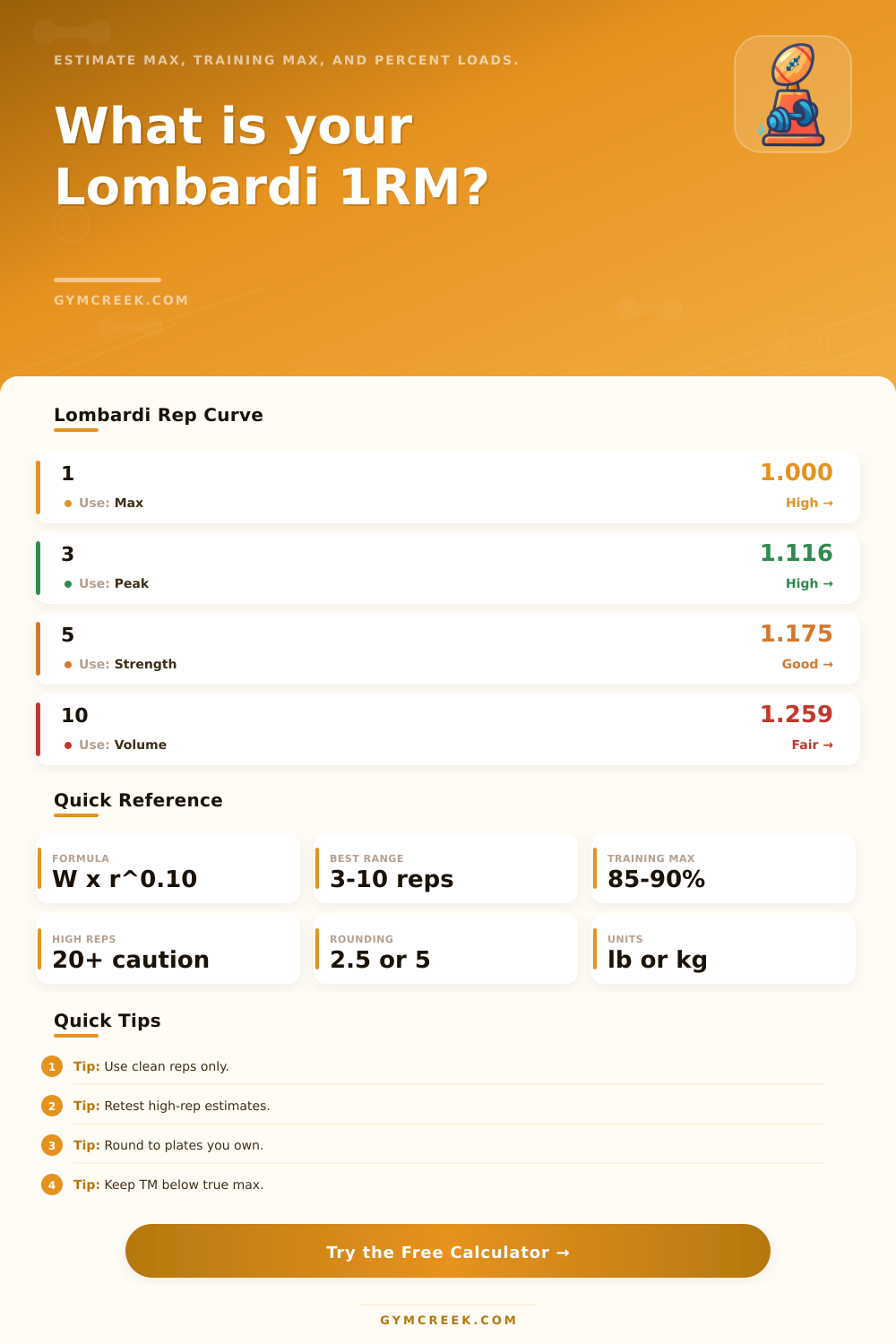
Estimate a one-rep max with the Lombardi power formula, then build a training max, high-rep confidence note, and rounded percent table for the next block.
📌Lombardi Presets
Each preset changes the lift, rep range, rounding, training max, and confidence context while keeping the 1RM estimate Lombardi-only.
⚙Calculator
Lombardi strength estimate
Enter a set weight and reps to estimate 1RM with weight x reps^0.10.
📊Formula Metrics
📑Reference Tables
| Piece | Meaning | Example | Output use |
|---|---|---|---|
| Weight | Load lifted | 225 lb | Base number |
| Reps | Clean reps | 5 reps | Power input |
| 0.10 | Exponent | 5^0.10 | Slow curve |
| 1RM | W x reps^0.10 | 264 lb | Main result |
| Rep band | Multiplier feel | Confidence | Planning move |
|---|---|---|---|
| 1 to 3 | Small boost | High | Good for peaking |
| 4 to 8 | Moderate boost | Good | Best daily use |
| 9 to 15 | Slow climb | Fair | Use lower TM |
| 16 to 30 | Very slow climb | Caution | Retest heavy |
| Percent | Rounded load | Common use | Rep feel |
|---|---|---|---|
| 70% | --- | Speed work | Light |
| 75% | --- | Volume | Moderate |
| 80% | --- | Work sets | Firm |
| 85% | --- | Strength | Heavy |
| 90% | --- | Peak work | Very heavy |
| 95% | --- | Single | Near max |
| TM setting | Best use | Rep estimate | Note |
|---|---|---|---|
| 80% to 84% | Restart | High reps | Most cautious |
| 85% to 87% | Volume | 5 to 10 reps | Repeatable |
| 88% to 90% | Strength | 3 to 6 reps | Balanced |
| 91% to 95% | Peaking | 1 to 3 reps | Use sparingly |
💡Lombardi Tips
A one-rep max estimate represent a person’s maximum strength for a specific lift. This statistic can help a weightlifter understand how a particular set of weightlifting will affect the following training block. The Lombardi formula is an calculation that helps to calculate a one-rep max estimate.
The Lombardi formula calculate the product of the weight lifted and the number of repetitions performed raised to the 0.10 power. This type of formula contain a gentle curve to ensure that the one-rep max estimate dont increase quick with the number of repetitions performed. For instance, lifting a weight for ten repetitions will result in an inflation of the one-rep max estimate for that lift, but the inflation will be minimal due to the 0.10 power of the number of repetitions.
Estimate Your One-Rep Max Using the Lombardi Formula
The five to eight repetition range are the most common for lifters to train within. This range balance the number of repetitions performed with the amount of time the lifter needs to recover between sets. Using the Lombardi formula within this range will allow the estimate of one-rep max strength to remain close to the actual one-rep maximum strength of that individual.
For sets with fewer than three repetitions, the multiplier will remain the same within the Lombardi formula, which allow for the tracking of single and triple repetitions performed with strength. For sets with more than twelve or fifteen repetitions, the curve of the Lombardi formula will flatten. As the one-rep max estimate based on the Lombardi formula become less precise, the lifter should perform another test of their maximum strength before using such an estimate when programming their lift.
Although the calculator allow for the addition of context to a one-rep max estimate, the context will not change the mathematical calculation of the formula. Training age is one form of context that will not change the calculation of the Lombardi formula. For instance, a lifter who has been lifting weights for four years will have a more trustworthy five repetition one-rep max estimate then someone who has been lifting for six months.
Fatigue is another form of context that can be added to a one-rep max estimate. If the final repetition within a set were difficult to perform due to fatigue, the lifter should lower the one-rep max estimate to account for this. Bodyweight and lift choice are two settings on the calculator that can be adjusted but will not change the one-rep max estimate of a lifter.
These setting will calculate the strength ratio of a lifter. The strength ratio isnt a measure of a lifter’s talent, but rather the strength ratio allow a lifter to compare their one-rep max estimates to the amount of work that they have performed in the weightlifting program. If the ratio is low, the lifter should consider whether the sets performed were limited by technique, recovery, or other factor related to the specific conditions of that days training.
Once a lifter has calculated their one-rep max estimate, the lifter must decide on a training-max percentage to use for training with weights. The training-max percentage that most lifters use are between eighty-five and ninety percent of their one-rep max estimate. This percentage create a buffer for the lifter so that their working sets are repeatable.
Using such a percentage allow for a lifter’s training sets to be repeatable because the one-rep max estimate is not used to determine the strength of a lifter every training session. Although the calculator will automatically calculate the training-max percentage, the lifter must choose the percentage themself. A lower training-max percentage can be used for the volume training block for a lifter, and a higher training-max percentage can be used for the peaking phase for an athlete with low repetitions but high recovery of that lifters sets.
The reference tables included in this calculator will reveal the number of percentage of a lifter’s one-rep max that will be used for training loads. These percentages will also show the change in the trustworthiness of the one-rep max estimate as the number of repetitions change. For example, a three repetition one-rep max estimate is more trustworthy than a fifteen repetition estimate.
These reference tables allow a lifter to understand their number of repetitions and the trustworthiness of their one-rep max estimate. The conditions under which the sets were performed may not be the same as the conditions of the calculator. Factors like sleep, stress, and number of previous sets performed that week will change the meaning of a one-rep max estimate.
Although the Lombardi formula will remain the same, the meaning of the one-rep max estimate will change due to these differentiating factor. The fatigue and condition selectors will help to offset these changing meaning of a one-rep max estimate. However, these selectors will not change the math behind the formula.
A one-rep max estimate should be considered one data point of the data that can be collected from training. Using the calculator after each training set will provide a data point of the one-rep max strength of a lifter. These data points can be compared with previous lift to adjust the training max for that day.
By adjusting the training max each training session, the data points of one-rep max estimates will cluster together. Having cluster data points will allow for the one-rep max estimates to inform programming and training decision for that lifter. While the goal of training is to find the perfect one-rep max estimate, the goal is to have a repeatable number that can be used to determine training loads that are close to the one-rep maximum strength of that lifter.
The strength of the Lombardi formula is that it conservatively estimate a lifters one-rep maximum strength whether in high repetitions or low repetitions. It would of been better to use more modern data but this works.