Log Press Weight Calculator
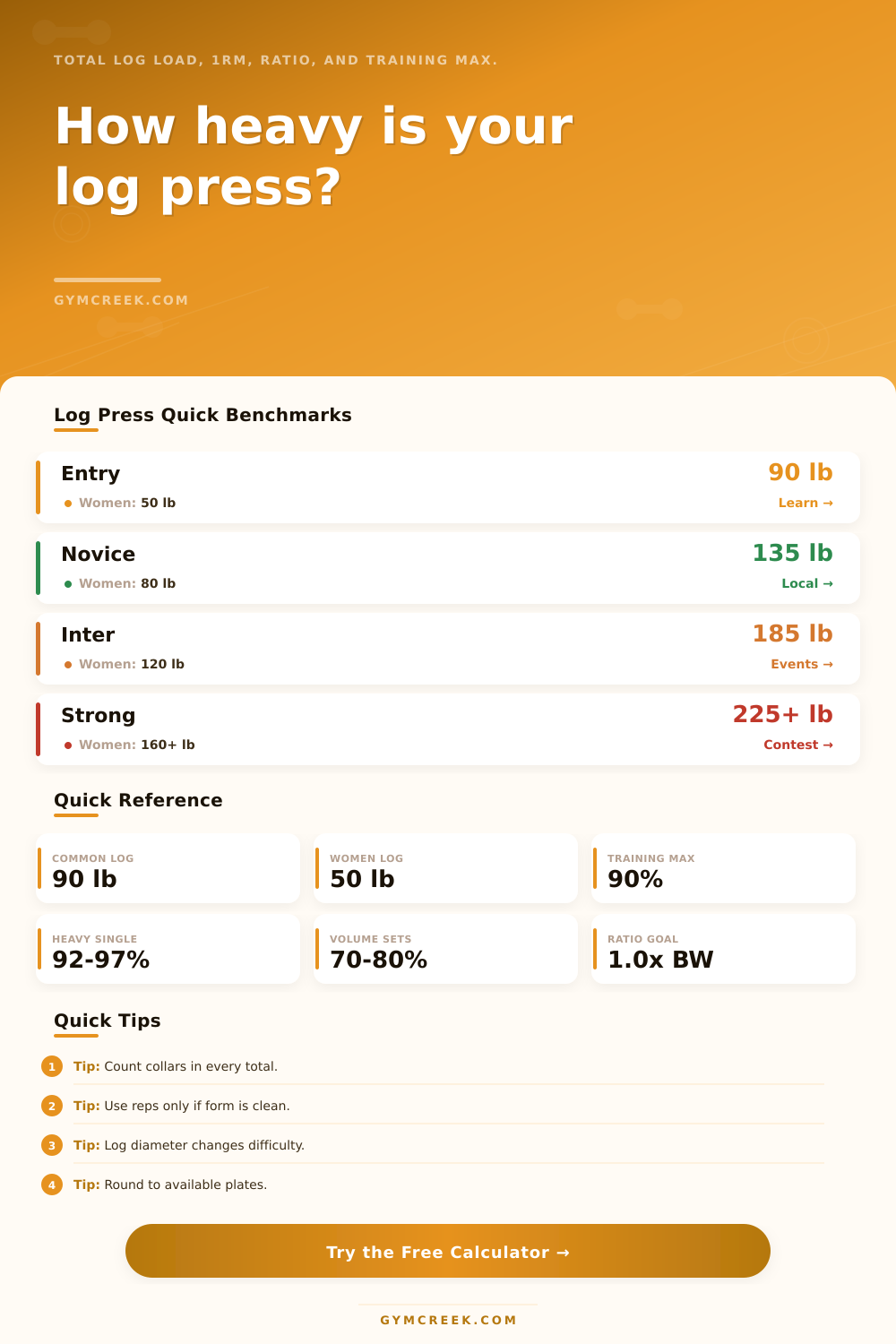
Total the empty log, plates, collars, sleeve loading, estimated log press max, bodyweight ratio, and practical training max for strongman pressing.
📌Presets
Presets fill realistic strongman scenarios and recalculate the log total, plate load, estimated 1RM, and training percentage.
⚙Calculator
Log press loading snapshot
Enter a log press setup to estimate total weight and training numbers.
📊Fitness Metrics Comparison
📑Reference Tables
| Log Type | Common Empty Weight | Diameter | Typical Use |
|---|---|---|---|
| Compact gym log | 45-70 lb | 8-10 in | Skill practice |
| Women contest log | 50-80 lb | 10-12 in | Event training |
| Men training log | 90-100 lb | 10-12 in | Most sessions |
| Heavy wood log | 120-160 lb | 12-14 in | Contest prep |
| Ratio Level | Press Ratio | What It Suggests | Training Note |
|---|---|---|---|
| Entry | Under 0.50x | Technique base | Keep reps crisp |
| Novice | 0.50-0.75x | Local readiness | Build volume |
| Intermediate | 0.75-1.00x | Solid log press | Plan peaks |
| Advanced | Over 1.00x | Strong event lift | Manage fatigue |
| Goal | Percent Range | Rep Target | Use Case |
|---|---|---|---|
| Technique | 60-70% | 3-6 reps | Clean rack timing |
| Volume | 70-80% | 3-8 reps | Strength base |
| Heavy | 82-90% | 1-3 reps | Peaking work |
| Event | 70-85% | Max reps | Time pressure |
| Formula | Variables | Result | When To Use |
|---|---|---|---|
| Total log | Log, plates, collars | Loaded weight | Every set |
| Epley 1RM | Weight and reps | Max estimate | 1-10 reps |
| RPE reserve | RPE to reps | Adjusted reps | Submax sets |
| Ratio | 1RM / bodyweight | BW multiple | Compare lifters |
💡Tips
Sometimes when you first try a strict log press it’ll feel odd but not yet heavy. It’s an odd-shaped bar, thick and unbalanced, which makes it want to roll up into your chest. You have to stabilize the bar; it wants to roll out of place and topple onto itself. Often, this means starting with less weight then you think you can use so that you can get it moving safely. If you go by what you can do overhead, you’re guessing what your max might be and I guarantee it won’t work well. Loading the log different than other lifts will bite you in the ass.
When you input your set-up, the tool does all the math for you. That eliminates having to worry about conversion rates and coefficients. To begin, you’ll input the empty weight of the log. Every brand will differ here. An all-steel training log could be ninety pounds. A wood contest log could be one-hundred-fifty pounds. Guessing on this is a bad idea. Check it on a scale before you go any further. If possible, always weigh the implement yourself. Even small variations in the starting weight can compound rapidy as you attempt to add five pounds at a time.
Why You Should Use a Log Press Calculator
Now that you have weight of the empty bar, you enter in the plates and collars. The calculator will double it on its own for per-side entries. Why? Because most people forget to enter one side. Next they forget about the collar weight. Those metal clasps can weigh as much as ten pounds or more! It might not seem like much, but those pound really matter when you are trying to hit a max lift.
To set this up, the tool requests your bodyweight too, which creates a ratio. Using the ratio lets you compare progress from user to user regardless of body size. After all, the two-hundred fifty pound strongman should be able to press heavier then the one-hundred sixty pounder, but is one doing better for their size?
Estimating your one-rep max requires both reps completed and perceived effort level. It uses traditional formulas but accounts for perceived effort level. Log pressing are not typically done at 100% effort in training. It is also important that the stabilizers gets tired faster when gripping a thick bar. So if you complete a set of five, stopping a rep short, the formula will estimate your max different than if you hit failure on rep five. The difference can easily be fifteen to twenty pounds. That’s the reason static percentage calculations don’t work well with strongman lifts.
The reference tables put you in context with other people. They show what you should of be doing as an absolute beginner all the way up to an advanced competitor. The numbers aren’t things you have to reach overnight, they’re more like mile-markers on the path to see if you’re trending in the right direction after months of practice. The skill curve is steep and most lifters end up staying in the “novice to intermediate” range for quite some time.
Trying to load too much too quickly generaly translates into bad form or broken wrists. Before building up strength, learn to perform the technique correctly. That means lifting light weights for several weeks while concentrating on good form, such as keeping your elbows tight and your torso upright. Recommendations depends somewhat on the style of press. For example, strict presses improve shoulder endurance; push presses incorporates leg drive for greater weight. Understanding how your event dictates your press style will help you prepare. If your event includes a max-rep log press, then low-intensity, high-volume sets is more effective than heavy singles.
A log press is a test of strength but also patience. You can’t brute force your way through poor mechanics on a rolling bar. If you’re not mechanically sound, you’ll never be. Use the calculator as a roadmap to ensure you’re progressing in a steady way. It lets you concentrate on how the lift feels instead of which numbers is on top of what. Go easy at first and get dialed-in with the rack. Allow the numbers to increase naturaly over time. What was once awkward will become confidence.