Loaded Carry Distance Calculator
Estimate carry distance demand, fatigue pressure, grip exposure, and loaded work capacity from the implement, load, route, speed, turns, rest, and terrain.
📌Presets
Presets load practical carry scenarios and recalculate total distance, grip exposure, fatigue pressure, and work capacity.
⚙Calculator
Loaded carry snapshot
Enter the carry details and calculate the loaded distance demand.
📊Carry Metrics Grid
📑Reference Tables
| Load Zone | Load Ratio | Typical Distance | Best Use |
|---|---|---|---|
| Easy | Under 25% BW | 200 m+ | Warm-up or recovery |
| Base | 25-45% BW | 80-200 m | Conditioning |
| Heavy | 45-70% BW | 25-80 m | Strength endurance |
| Limit | 70%+ BW | 10-40 m | Max effort carries |
| Carry Style | Stress Factor | Main Limiter | Distance Bias |
|---|---|---|---|
| Ruck or vest | 0.86 | Breathing | Long |
| Farmer carry | 1.00 | Grip | Medium |
| Suitcase carry | 1.12 | Trunk control | Medium |
| Sandbag carry | 1.20 | Brace fatigue | Short-medium |
| Overhead carry | 1.35 | Shoulders | Short |
| Route Factor | Adjustment | Why It Changes | Planning Note |
|---|---|---|---|
| Flat floor | 1.00 | Least friction | Best baseline |
| Turf lane | 1.06 | Slight drag | Good training lane |
| Shuttle route | 1.14 | Frequent turns | Track spacing |
| Hill or ramp | 1.18+ | Grade cost | Use shorter sets |
| Stairs | 1.28+ | Vertical work | Keep load lower |
| Formula Piece | Variables | Output | Use |
|---|---|---|---|
| Load ratio | Load, body weight | % body weight | Intensity anchor |
| Effective distance | Distance, factors | Stress meters | Route comparison |
| Work capacity | Load, distance | kg-m | Session volume |
| Fatigue index | Load, time, grip | 0-100 score | Set difficulty |
💡Tips
While muscle strength is necessary, you also need structural patience when carrying loads. At that point, you’ll notice your forearms start screaming. If you truly want to condition yourself, most folks approach these exercises as a after thought. Instead of thinking like a load-bearing structure. Enter: the calculator. It does all the math for you. Simply input your weight, distance, and terrain and it will approximate how much stress your joints are under.
One of the things that gets people tripped up is their effective distance: You’ll run four minutes of 10-meter shuttles, which will feel very different than walking 40 meters in a straight line. Stopping and pivoting costs energy; every time you pivot, your core must fight to stay steady as your grip engages again under load. To account for this, the tool adjusts base distance depending on how much friction there is along the route and how often you have to turn. Turf that’s slightly uneven, or just having a bit of grade, multiplies effort quite a lot; after all, the ground pushes back at your feet.
How to Use the Loaded Carry Calculator
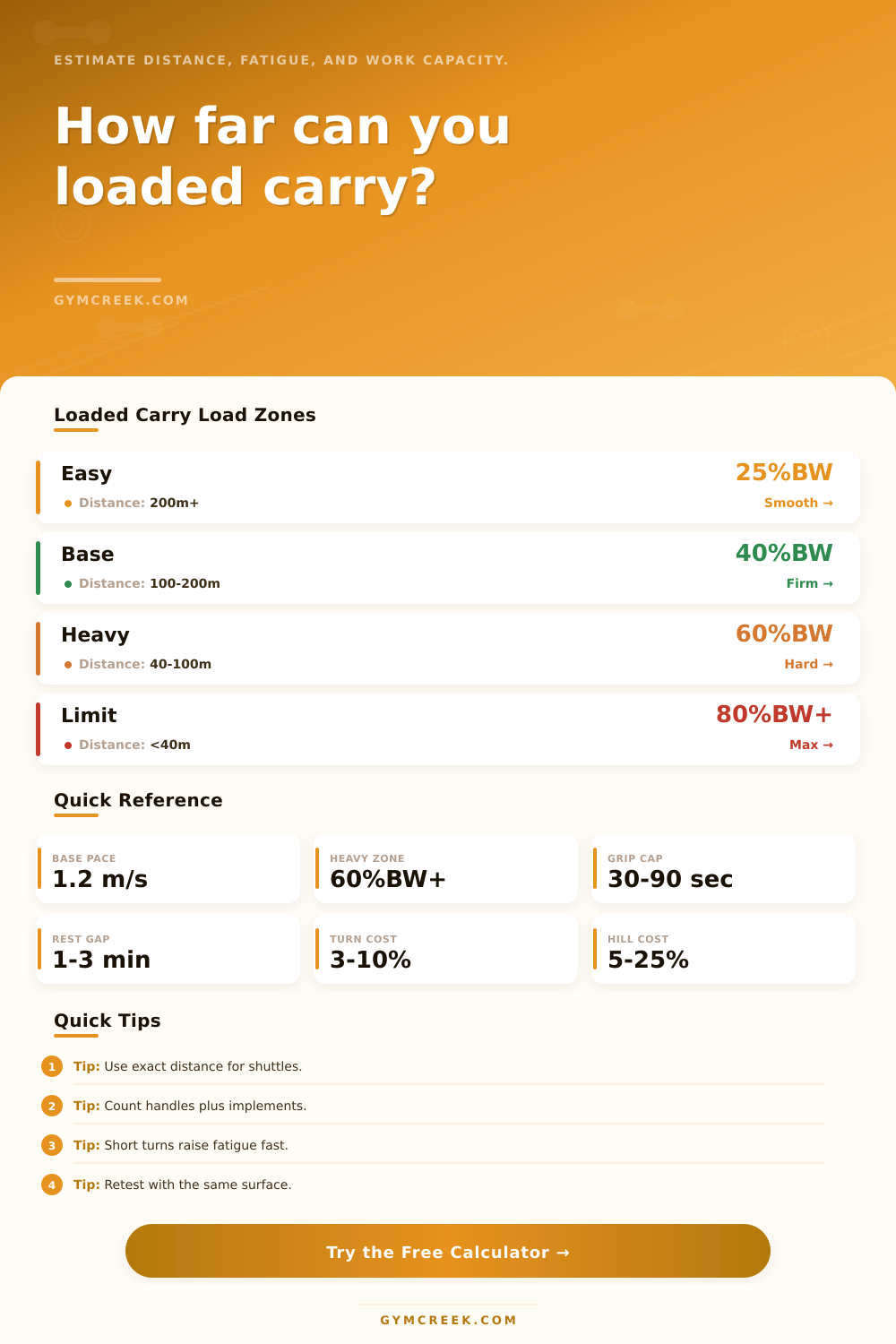
Another key thing to think about is load ratio relative to body weight. Surprisingly this actualy correlates with failure more than absolute weight. Whether it’s 25 or 60 pounds doesn’t matter… Carrying 25% of your bodyweight is a whole different physiological experience from carrying 60%. Your spine must work overtime to maintain posture and your leverage will change significant at higher loads. This table below (from the page) break the zones out well. As you can see, the distance you can sustain becomes increasingly small as the percentage increases. It’s a matter of going light but long vs. It is heavy but short. Doing both at once will lead to injury and breakdown in form.
The majority of folks don’t consider grip strength an input, until it’s too late. Your nervous system dumps adrenaline/fatigue into your hands when they’re under extended tension. When you think you can hold all the weight, you may be right… until your hands give out on you. The calculator assumes this based off your reported grip level. If your grip lasts only 30 seconds, no amount of core strength will help you finish a two-minute carry without stopping. This is where core training comes in, it won’t do jack if you can’t keep the weight hanging off your skeleton long enough to get it moving. Grip is a bottleneck because when your hands let go, everything else falters. Carries is about keeping something heavy on your skeleton long enough to transport it.
Rest interval is another factor many trainers neglect when thinking about calculations. More intense efforts has higher metabolic costs and greater density if rest periods remain short. This essentially converts a strength workout into a conditioning one. If they’re too long, you’ll be recovered for lifting heavy weight, but there’s little conditioning benefit as you won’t maintain intensity during that time. Your goal (aerobic capacity or raw strength) determines where the sweet spot lies. The tool’s presets help demonstrate this by loading typical workouts such as a heavy strongman medley or tactical shuttles. Notice how altering the tempo, say transitioning from a brisk shuffle to a slow powerful pace, alters fatigue index completely.
So finally, loaded carries are deceptively simple: No need for complex spotting, no machines required, and not much space needed. But they do take some honesty regarding your limits; you can’t fake a carry. It’s either on your shoulders or it’s not. And with a little understanding of how terrain, distance, and load interact, you’ll transform what might be a generic movement into a finely tuned tool for developing resilience. Whether you’re training toward an event or simply looking to build more strength in your grip, understanding the numbers will help you understand when to respect the stress. The scary “forearm burn” of the beginner will become real strength among those who carefully plan out their efforts. You should of noticed that progress takes time.