Linear Progression Calculator
Plan session-by-session bar weight increases, target dates, stall rules, and deload adjustments for the lifts that progress best with simple loading.
📌Progression Presets
Each preset loads a recognizable novice or early-intermediate linear progression setup, including session frequency, increment size, stall rule, and deload behavior.
⚙Calculator Inputs
Linear progression plan
Enter your lift setup to estimate jumps, milestone timing, and stall risk.
📊Progression Snapshot
📑Reference Tables
| Lift | Common Jump | Rep Scheme | Progression Note |
|---|---|---|---|
| Back squat | 5-10 lb or 2.5-5 kg | 3x5 or 5x5 | Large muscle mass often tolerates faster early jumps. |
| Bench press | 2.5-5 lb or 1-2.5 kg | 3x5 or 5x5 | Upper-body lifts usually need smaller jumps sooner. |
| Overhead press | 1-2.5 lb or 0.5-1 kg | 3x5 or 5x5 | Microplates help extend the linear phase. |
| Deadlift | 5-10 lb or 2.5-5 kg | 1x5 or 3x3 | Progress can move fast, but fatigue accumulates quickly. |
| Missed-Rep Rule | How It Works | Deload Amount | Best Use |
|---|---|---|---|
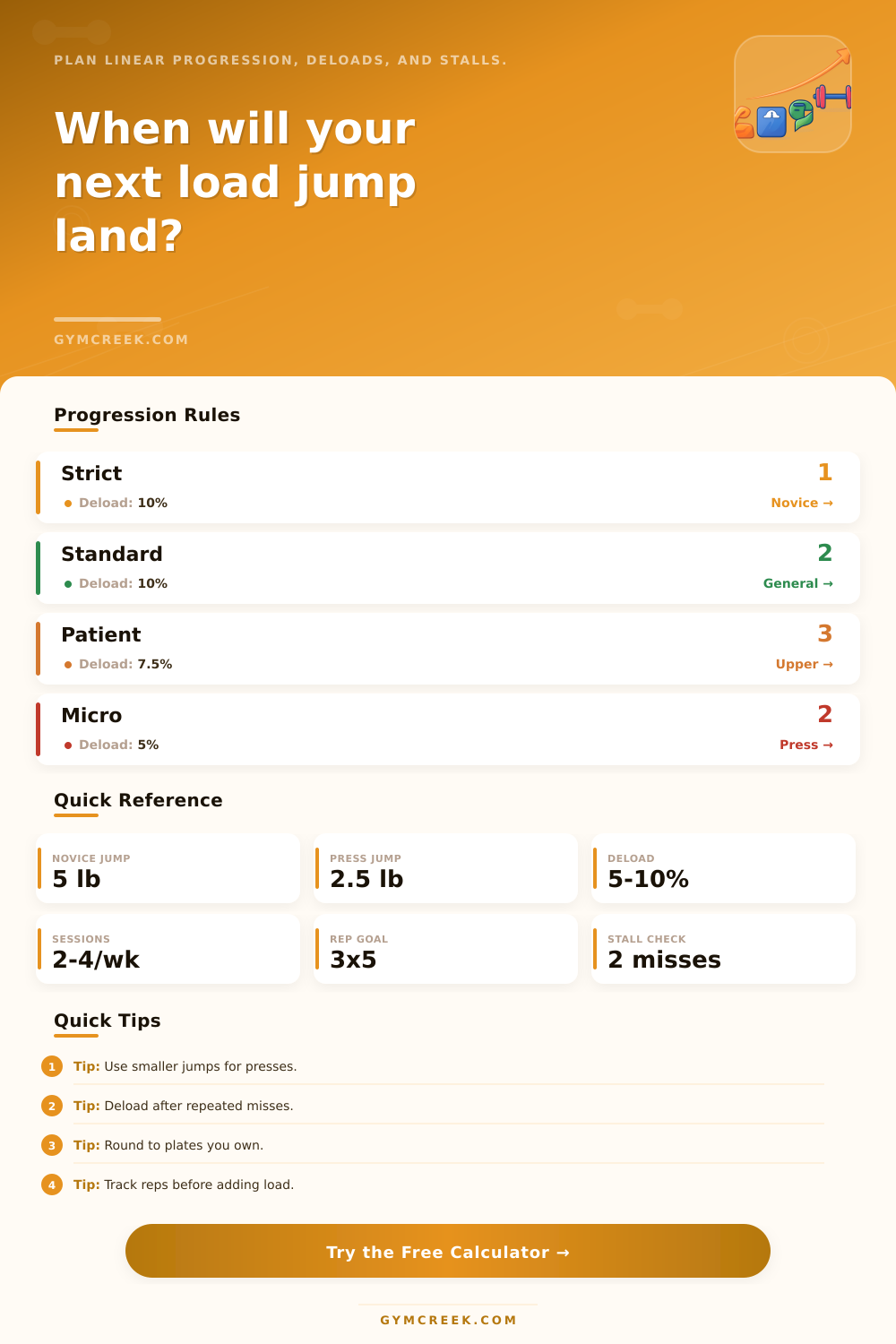
| Strict | Miss once, reduce the load next exposure. | 10% | High fatigue blocks or technique cleanup. |
| Standard | Repeat the same load once before deloading. | 10% | Most novice linear progression setups. |
| Patient | Allow two repeats before reducing the load. | 7.5% | Upper-body lifts and cautious return phases. |
| Microload | Cut the jump size before taking a full reset. | 5% | Press, bench, and home gym microplate setups. |
| Experience | Expected Hit Rate | Useful Increment | Planning Bias |
|---|---|---|---|
| Novice | 88-95% | Standard jumps | Plan by sessions and keep rest consistent. |
| Late novice | 78-88% | Standard to small | Expect occasional repeated loads. |
| Intermediate | 65-78% | Small jumps | Use linear loading only for narrow blocks. |
| Returning | 80-92% | Moderate jumps | Regain quickly, then reduce jump size. |
| Formula | Variables | Output | Why It Matters |
|---|---|---|---|
| Sessions | Target minus start, divided by jump | Load exposures | Shows how many successful increases are required. |
| Calendar | Sessions divided by weekly frequency | Estimated weeks | Turns gym progress into a realistic timeline. |
| Tonnage | Load x sets x reps | Work volume | Tracks how much weekly work rises as load climbs. |
| Deload | Current load x reset percent | Reset load | Gives a clear next step after repeated misses. |
📋Fitness Metrics Comparison
| Metric | Conservative | Standard | Aggressive |
|---|---|---|---|
| Lower-body jump | 2.5-5 lb | 5 lb | 10 lb |
| Upper-body jump | 1-2.5 lb | 2.5 lb | 5 lb |
| Deload trigger | 1 miss | 2 misses | 3 misses |
| Deload depth | 5% | 10% | 15% |
| Weekly exposure | 1-2 sessions | 2-3 sessions | 3-4 sessions |
💡Progression Tips
A linear progression calculator is a tool that help a person make decisions about lifting weights. Specifically, a linear progression calculator help a person to decide how much weight to add during each lifting session. While many people thinks that lifting weights is simply a process of adding weight to the lifts during each session, lifting weights are actualy a difficult process for an individual to master.
An individual must figure out how much weight to add to each lift during each session, as well as when to repeat those session or to reduce the weight that the individual is lifting. The linear progression calculator is a tool that provides an individual with these different decision for weight lifting. The calculator creates a plan for the individual based off specific input from the individual.
How to Use a Weight Lifting Progression Calculator
Each input into the weight lifting calculator represent a specific variable for the individual’s weight lifting efforts. Some of the variables that an individual must account for include the starting load for the weights that will be lifted, the target load that the individual desire to lift, the increment size for how much the individual will increase the weights that is lifted, the number of sessions that the individual will perform each week, the missed-rep rule that dictates when the individual should take a break from lifting weights, and the experience level of the individual with weight lifting. Based upon the individual’s answer to these different variables, the linear progression calculator can provide information regarding the number of sessions that will be required to reach the target load, the number of calendar week that will be required to reach those sessions, the load that the individual will hit if they miss too many repetition, and the tonnage that will be increased each week.
The tonnage that will be increased each week is an important variable for the individual to understand, as lifting too much weight too quickly can lead to injury to the individuals muscles. Two table are provided within the calculator that depict typical jump size for the different lifts within weight lifting, as well as the typical percentage of the load that should be used for deloads for those same lifts. These tables are not rules for weight lifting, but they do provide a starting point for individuals that are lifting weights for the first time or who have not regularly lifted weights in recent years.
For instance, an individual may recognize that certain lift, such as weight pressing, may allow for different jump in load than lifts like squatting or deadlifting. Deadlifting, in particular, may require a deload more often than other type of weight lifting exercises. In addition to the different variables of the lift that must be accounted for within the calculator, there are additional variable that may impact the individual’s ability to lift weights.
For instance, an individual’s sleep cycle, the amount of food that they consume, and the amount of stress that they experience each day can all impact the number of repetition that an individual can lift each day. For instance, if an individual plans to increase the load by 5 pounds for a lift, but didnt sleep enough or eat enough the previous days, it is possible that the individual will have difficulty increasing the load. To account for this variable, the success rate for weight lifting is one of the variables that is included within the linear progression calculator.
While this variable is not a guarantee that the individual will be successful in lifting the weights, it does provide for some buffer within the timeline for the individual to account for potential difficulty in lifting a certain weight. Despite the number and variety of the variables that are included within the linear progression calculator, there are still some mistake that individuals may make within the weight lifting process. For instance, an individual may use the same amount of weight that was used for another lift within the body, such as using the same pound increment for a bench press as for a squat.
Similarly, an individual may choose to continue to lift the same load for a number of week in a row without taking a deload period, which can lead to the individual losing momentum in relation to the load that they can lift. These type of mistakes the linear progression calculator does not prevent, but they are visible within the parameter of the calculator. An individual should treat the linear progression calculator as a document that may change over time.
When an individual starts lifting weights for a certain period of time, they should run the linear progression calculator. However, after the individual hits a period of time when strength increases slow or cease altogether (a stall), they should also run the linear progression calculator again. If the projections for the individual indicate that the time required to reach the target load is unrealistic, the individual must change the variable within the calculator.
For instance, they can modify the jump in load that are attempted, reduce the frequency with which the individual lifts weight, or be more conservative in applying the missed-rep rule within the calculator. These changes will allow the individual to reach their goal for the load that they can lift without taking too much time to recover from lifting weights. The linear progression calculator works in that human bodies adapt to stress that is measured and accounted for in the calculator.
Thus, the linear progression calculator removes the guesswork for an individual about the strength that is required to lift weights for that individual. When the variable within the calculator match the lift that the individual perform, the number of session that are performed each week, and the strength of the individuals recovery from lifting those weight, the calculator will provide the individual with a map of the process of lifting weights for that individual.