Line Dancing Calorie Calculator
Estimate calories burned from song count, average BPM, beginner or advanced step mix, turns, class or social mode, rest ratio, body size, and rest-adjusted MET logic.
📌Presets
Presets load common line dancing sessions and recalculate with playlist pace, step complexity, turn volume, and teaching or social rest.
⚙Calculator
Your calorie snapshot
Adjust the session details to estimate rest-adjusted line dancing calories.
📊Session Metrics
🧮Formula Cards
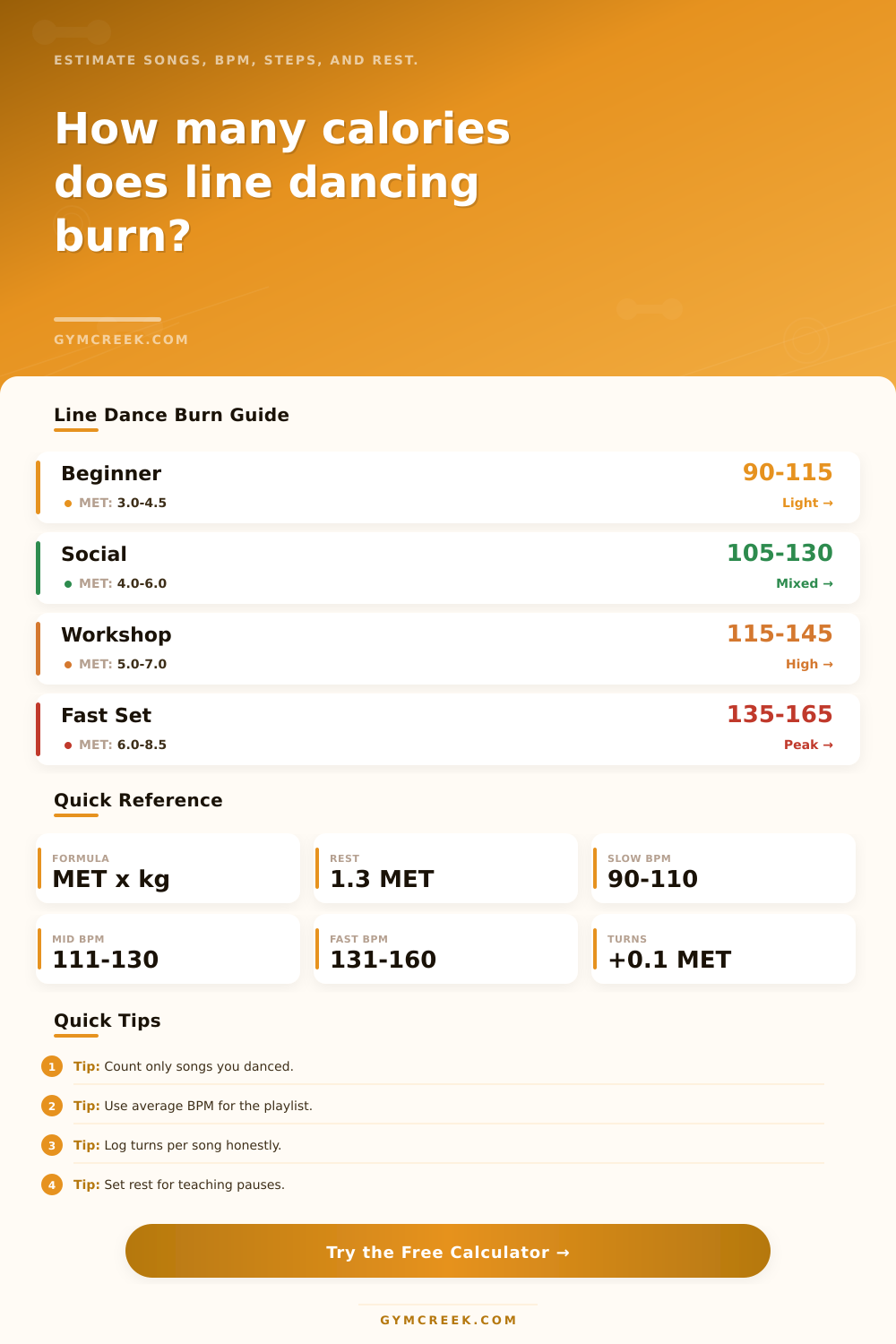
Calories per minute = MET x 3.5 x body weight in kg / 200. Dance minutes and rest minutes are calculated separately, then added for the session total.
Average BPM increases or lowers the dance MET around a mid-tempo baseline. Slow songs reduce demand, while fast two-wall and four-wall dances raise it.
Beginner, improver, intermediate, and advanced settings adjust for complexity. Turns per song add a controlled load for pivots, rolling vines, spins, and direction changes.
Mifflin-St Jeor estimates BMR from age, height, weight, and gender. The activity multiplier estimates TDEE so the dance session can be compared with a full day.
📑Reference Tables
| BPM Range | Pace Feel | MET Add | Typical Songs |
|---|---|---|---|
| 80-100 | Slow | -0.6 | Teaching |
| 101-120 | Easy | -0.2 | Warm-up |
| 121-140 | Brisk | +0.3 | Main floor |
| 141-160 | Fast | +0.8 | Country pop |
| 161+ | Very fast | +1.2 | Peak set |
| Setting | Base MET | Rest Pattern | Best Input |
|---|---|---|---|
| Class | 3.9 | Higher | Rest ratio |
| Social | 4.8 | Mixed | Songs danced |
| Practice | 5.1 | Lower | Turns |
| Workshop | 5.4 | Teaching | Step share |
| Festival | 5.8 | Variable | Song count |
| Competition | 6.2 | Planned | Effort feel |
| Step Level | Modifier | Turn Load | Notes |
|---|---|---|---|
| Beginner | 0.92x | Low | Basic walls |
| Improver | 0.98x | Light | More tags |
| Intermediate | 1.05x | Mixed | Syncopation |
| Advanced | 1.14x | High | Fast changes |
| Advanced plus | 1.22x | Peak | Dense phrasing |
| Formula | Variables | Output | Use |
|---|---|---|---|
| MET kcal | MET, kg, min | Calories | Main burn |
| Dance time | Songs, length | Minutes | Work time |
| Rest split | Ratio, time | Session | Total time |
| Turn index | Turns, songs | Load | Complexity |
| TDEE share | Kcal, TDEE | Percent | Context |
💡Tips
The social aspect of line dancing and its rhythmic patterns makes it seem like a fun activity that disguises its physical demands. You’re not huffing and puffing during class, so it’s difficult to know if your body is getting a good burn. It burns a lot of calories, though it might be easy to mistake for something less strenuous since following each move becomes second nature.
And then there’s your session information. Feed all of that into the calculator and it does the math. No need to guess whether what you did was high- or low-intensity, no matter how long you were out.
How to Calculate Calories in Line Dancing
It begins with your baseline information (age, weight, etc.) but the nitty gritty is in the details of what you do during a workout. How many beats per minute? More then you’d expect. A slow-moving song at 90 beats per minute will keep your heart rate where you want while still allowing conversation between each verse. But a fast-paced country pop tune at 140 beats per minute require fast feet and rapid shifts in direction. The styles is different and involve a major change in energy use. To compensate, the body changes how much energy it uses based off the pace.
You burn more calories with complexity. Even if you’re dancing to the same tempo, the complexity of the steps tell a different story. Simple beginner routines keep you rooted to the wall with easy turns and heel digs. More complex choreography includes quick directional changes, traveling steps, and syncopated timing that requires constant engagement of core to maintain balance. This means that as more turns, steps, and advanced moves is included, more calories are factored into its calculations. Spins and pivots also use rotational torque between your shoulders and hips; something ignored by simple side-to-side stepping. Your burn will be higher doing this routine with paddle turns and rolling vines, even though the song may be slow.
The resting part is where it becomes complicated. If you’re in a class, there’s a lot of stopping (for instruction, to observe the instructor). Or maybe you’re on a social dance floor, where there will be songs for when you sit down to talk with friends and catch your breath. The calculator includes a spot to enter a rest ratio; without it, the tool assumes you are dancing without stopping, which will make the estimate too high. Most dances has lots of downtime if you’re going to a social session. By entering a reasonable rest percentage, the final calorie number takes into account only the time spent actively moving. This is the difference between standing in a square waiting for your turn and sitting on a chair.
Then there’s the mode setting which further adjusts that starting point. And here we have another drill, this time, a workshop. Precision. It involves repetition. This is perhaps even more strenuous both physically and mentally than free flowing on a social evening listening to your favorite tunes. Next comes competition practice; focused effort increase the tension yet again. In this way, it structures the modifiers according to speed and complexity and then sets a base metabolic level prior to doing so. It reflects how a human trainer might evaluate a training session: What’s going on? Then what are the specifics of the movements being done? How hard were they done?
No tool can measure individual variance in efficiency. You might be someone who moves easily and efficient, or someone who tenses up and wastes movement with extra arm flailing. Personal fitness levels also comes into play. If you’re fitter, you’ll likely become more efficient at burning calories as you do the same routine. Your body is able to operate more efficienty. The calorie counts above are estimates that represent averages. They provide a frame of reference to help you understand relative effort. Regardless of how efficient you are, you’ll still burn more during a festival session then a beginning class.
Line dancing falls somewhere in between. You are getting some balance and coordination training as well as cardio. While the calories certainly is a piece of the puzzle, the true benefit lies in moving consistently in an activity you enjoy so much you continue to do it. Take the estimates with a grain of salt, use them to know how hard you danced and tweak your expectations. For example, if you believe you burnt two hundred calories and according to the math, it’s closer to four-hundred, that’s a good indication you worked out harder than you thought. You should of taken note. If the number is lower, it might be time to add more fast songs or complex steps to your playlist. The floor doesn’t lie, but knowing how hard you work can help.